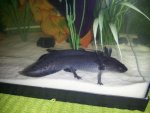
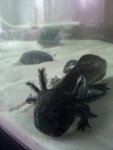
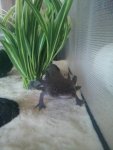
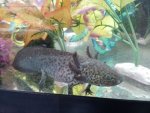
I think he's dying, please help me.

Sylerwin

New member
Joined
Jan 21, 2013
Messages
204
Reaction score
2
Points
0
Location
Chicago
Country
United States
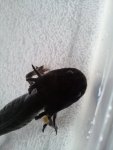
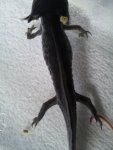
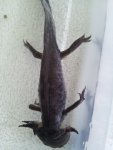
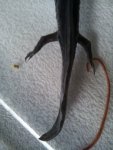
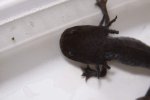
I'm pretty sure my first axie, Smudge, is dying. Over the past few months he has become extremely lethargic, skinny, little to no appetite, discolored, and susceptible to illnesses. I think it started when I added his 2 tank mates. Perhaps the stress of it lowered his immune system. I moved him from his 10gal by himself to a roomy 40gal breeder. After a while by himself, I added a divider and his two new tank mates. That's when he got his first fungal infection, which took most of his one gill. I treated with aquarium salt and it went away after 2 days, taking his gill with it. Once his two tank mates were the same size as Smudge, I removed the divider. That's when things went drastically downhill. Smudge hid a lot from his tank mates, especially once they surpassed him in size. He stopped eating for a few weeks so I would take him out of the tank, put him in a small container and let him stay in there until he ate. I thought it was maybe the sand, he would often get some in his mouth so I used the feeding container from then on. I accidentally forgot to stir the sand in my aquarium for a while so when I did it once I "gassed" my axolotls by accident. They spent about 2 days in a large container as I removed all of the sand from the tank and did a huge 90% water change. Once the ammonia was in check, I moved them back home. Even though there is no sand in the tank, Smudge still will not eat. He has recently developed an injury on his foot and I don't know from what. It was never red, just pale in color so I let it be. He used it no problem for a while but now he isn't. Today is feeding day so I scooped him into his container, and he's in horrible shape. He's not using his foot, he's not making any effort to take the worm or pellet, and he's kind of floating on his side. I don't know what else to do.

Some background info:
Housing
What size is your tank? 40 gal breeder
What temperature is your tank? average 65-68F, it's been hot in the house recently and sometimes it sneaks up to 75F :( He's been sick even in ideal temp/water parameters though.
Does your tank have a filter? Yes
Does your tank have an air stone or other type of aeration? Yes
Is your tank heated? No
What tank mates? 2 other axolotls.

Food
What type of food do you feed your axolotl? 1 Red wiggler every other day, some newt pellets on occasion
How often do you feed your axolotl? Every other day

Maintenance

How often do you perform a water change? I do not remove water--it evaporates because of the fan to keep the tank cool, so I add water about 2-3 times a month, around 10 gallons worth.
What percentage of the water do you change when you perform a water change? 10/40 gallons... 25% average
What type of additives do you add to the water when you perform a water change? I add dechlorinator to the water in buckets and let it sit overnight

Water Parameters:
Have you tested your water? If so, what are the following parameters?

Ammonia: Somewhere between 0ppm and .25ppm
Nitrite: 0ppm
Nitrate: 0ppm
pH: 7.6 (holy cow I had no idea it was this high)
Hardness: N/A
Alkalinity: N/A

Symptoms and Treatment
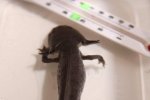
How has your axoltols appearance changed? He's dull in color, he was black, and now he has grey colors. He's skinny, gill fronds are horrible. he lost most of one gill to a fungal infection and it's mostly grown back main structure, but not the fronds. It looks like he hurt his front left foot somehow. There's a bump, surrounded by pale skin, and he doesn't really use it.
How has your axoltols behavior changed? He doesn't want to eat. I thought it was because he was eating sand so I removed the sand from the tank. I scoop him into a container so he's away from his tank mates and he sits in the container with one worm and a few pellets and I leave him in there until he eats. Today he kind of floats on his side, not laying at the bottom of the container
When did you start noticing the symptoms? Months ago his appetite diminished. He's in horrid condition and I can't seem to make him better. He's slowly deteriorating.
Have you started treating your axolotl? If so, how? I tried removing the sand hoping that was the issue but he just doesn't want to eat. I add aquarium salt to the water (as directed) to prevent fungal infection again which he's had twice. I separate him from his tank mates during feeding time so he doesn't get it stolen and he can take his time
Does your axolotl have any history of being ill? Just those fungal infections, which I does with aquarium salt and it went away within 2 days, and a recently hurt foot.
How old is your axolotl (approximately)? I got him a year ago from a reptile show.


His tank mates are showing no signs of illness. They are willing to eat and their gill fronds are nice and fluffy. (not as fluffy as before, but they have a lot of aeration in the tank) They are plenty plump. I think they are sad that I removed the sand though, makes them anxious so I plan on adding sand again and revamping their tank seeing as sand wasn't the cause of not eating. They seem a little lethargic, but not nearly the amount that my little guy Smudge, is.

Here are all the possible treatments I have available:
Aquarium salt
Tetra Parasite Guard
pH Down
Melafix
Pimafix
Stability
Prime
Bacteria Supplement

I could also add the divider back in the tank so he's away from his tank mates, but honestly I'm afraid that's a lost cause, he's practically dead. I'll attach photos.
Pictures: 1.Before he was sick 2.Fungal infection 3.After fungal infection 4.One of his tank mates 5-8. Today in a container

Should I try fridging? Salt? pH down? I'm out of ideas... please help.

EDIT: I've put him in the fridge, he's barely moving. I honestly thought he was dead a few minutes ago so I slid him in the fridge.
 

Attachments

  • smudge before.jpg
    smudge before.jpg
    73.6 KB · Views: 1,567
  • fungal infection.jpg
    fungal infection.jpg
    49.7 KB · Views: 811
  • fungal infection after.jpg
    fungal infection after.jpg
    70.2 KB · Views: 674
  • tank mate today.jpg
    tank mate today.jpg
    58.8 KB · Views: 954
  • Smudge head.jpg
    Smudge head.jpg
    39.9 KB · Views: 778
  • Smudge body.jpg
    Smudge body.jpg
    38.6 KB · Views: 761
  • Smudge hurt foot.jpg
    Smudge hurt foot.jpg
    35.4 KB · Views: 722
  • Smudge tail.jpg
    Smudge tail.jpg
    40.9 KB · Views: 765
Last edited:
I would suggest more food. 1 red wiggler isnt enough. If you absolutely have to, follow a tutorial on how to force feed. But before that, try a lot of different feeding options. Bloodworms, earthworms, black worms, shrimps from your pet store might be good.
Other than that I'm not sure, I hope someone more experienced can help.

Sent from my DROID RAZR using Tapatalk 4
 
I would suggest more food. 1 red wiggler isnt enough. If you absolutely have to, follow a tutorial on how to force feed. But before that, try a lot of different feeding options. Bloodworms, earthworms, black worms, shrimps from your pet store might be good.
Other than that I'm not sure, I hope someone more experienced can help.

Sent from my DROID RAZR using Tapatalk 4

Sorry forgot to add: I have tried other foods, he won't eat them. My other guys were eating 2 worms but they got waaayyyy fat so I cut it down. I can barely get him to eat one worm, let alone 2 :(
 
I have had a very similar situation to this, where one axolotl stopped eating, and had unexplained skin problems and general malaise.

To get him to eat, I started putting him into a tupperware tub, defrosting cubes of bloodworm, and using tweezers to drop clumps of them directly over his head. He couldn't resist the bloodworm, and by dropping them over his head, he snapped at them, and they were easy to swallow.

I had to do this every night for a while, it was VERY time consuming and hard work, but had to be done. After a while I started him on pellets and he loves them now, but he refuses to eat earthworms any more.

I eventually swapped him into a tank with a different axolotl, and put his snappy tank mate on his own - it made a huge difference. He is now getting nice and chubby, he appears a lot happier, and his skin is fully cleared up.

I really cannot be sure what the causes of his problems were, all I know is this process worked for me.

As an aside, are you familiar with cycling tanks? Your parameters look like your tank is not cycled.

How often are you changing the water for Smudge while he is in the tub? Are you keeping him refrigerated, or is he at room temp?

Edit - are those last photos from today? His gills look dreadful - unless I am mistaken in what I am seeing there. Have you followed the salt bath tutorial? Smudge needs attention quickly - if he isn't already, make sure he is in clean dechlorinated water in a tub with a lid, rest the lid loosely on the top of the tub and cover with a towel and put him in the fridge. This should slow down any fungal growth while you get help.

Be prepared to work hard to keep Smudge with us, salt bathing takes precision and care, but the tutorial I linked to is excellent.
 
Aww poor thing, he's not looking good.

If he still has fungus he needs salt baths, but he also really needs to eat too. Have you tried cutting the worms up? I've heard red wrigglers can taste foul, so maybe try other live worms. I'd get live food and leave him in the dark and wait to see if he eats them.

If he doesn't like other lotls I'd get him his very own tank. That should reduce the stress. I hope he recovers. :sick:
 
So i think the best thing you can do for him right now is leave him in a tub, doing 100% water changes daily, with dechlorinated water.
Try feeding him at least twice daily. If wont eat, remove food and/or do a full water change and try again later.
Do not refridgerate him because he needs to eat and he is to frail to fridge. However keeping him in the coolest room in your house will help. Keeping him in the low 60s F would be suffice.

Try using tweezers to feed him, and be persistant! I know it sounds like a lot of work and it is time consuming, i had a baby with short toe disease or whatever it is called i forget already and he had fluid retention and itgot so bad that i had to sit there and feed him by hand for 15minutes per day because his belly was so full he could not eat on his own. But i did it till the day he passed(this guy i knew would probably not make it but your lotl still has a chance since it isnt genetic)
With hard work on your side, and axolotls miracle powers, i think he has a chance, but you need to be willing to do all the work necessary. If somebody could post the link of the thread from last week of the seriously injured axolotl, this owner is doing an awesome job with rehabilitating an axolotl that was going to die if nothing was done! It is absolutly heartwarming to see the wonderful progress, ill admit i did shed a tear when i saw the updated pictures and seeing how well he took out advice.

It just proves that anything is possible and if its ment to be it is ment to be. And it is possible to save even the worst off lotl.
I dont want to give you to much hope, since this problem has been going on for a while now its going to be touch and go but i have seen worst rehabilitate perfectly.

After you can get him to start eating again and make sure there isnt anymore problems. And make sure your tank is cycled and the water parameters are okay, it may benefit him to go back in the tank, but i would not do so until you know the water parameters are perfect! Because the last thing we want to do is add him into a tank that will make himworst again.

Keep us updated on his progress but i think water quality may have a say in this and if it is the case keepi g him in the tank for any amount of time is going to make it worst.
 
I have had a very similar situation to this, where one axolotl stopped eating, and had unexplained skin problems and general malaise.

To get him to eat, I started putting him into a tupperware tub, defrosting cubes of bloodworm, and using tweezers to drop clumps of them directly over his head. He couldn't resist the bloodworm, and by dropping them over his head, he snapped at them, and they were easy to swallow.

I had to do this every night for a while, it was VERY time consuming and hard work, but had to be done. After a while I started him on pellets and he loves them now, but he refuses to eat earthworms any more.

I eventually swapped him into a tank with a different axolotl, and put his snappy tank mate on his own - it made a huge difference. He is now getting nice and chubby, he appears a lot happier, and his skin is fully cleared up.

I really cannot be sure what the causes of his problems were, all I know is this process worked for me.

As an aside, are you familiar with cycling tanks? Your parameters look like your tank is not cycled.

How often are you changing the water for Smudge while he is in the tub? Are you keeping him refrigerated, or is he at room temp?

Edit - are those last photos from today? His gills look dreadful - unless I am mistaken in what I am seeing there. Have you followed the salt bath tutorial? Smudge needs attention quickly - if he isn't already, make sure he is in clean dechlorinated water in a tub with a lid, rest the lid loosely on the top of the tub and cover with a towel and put him in the fridge. This should slow down any fungal growth while you get help.

Be prepared to work hard to keep Smudge with us, salt bathing takes precision and care, but the tutorial I linked to is excellent.

The tank was cycled, but I think after I had the incident with the sand removal and the 90% water change it's not unlikely that my cycle could have indeed crashed. I've tried different food for him with no luck, but I'll keep offering it just in case. Yes, those photos are from today, aren't his gills horrendous? I have no idea what caused that as his tank mates gills are nice and fluffy. I know it's not ammonia... I think I will try clean salt bath by following the tutorial, and try and get he pH level in check in the main tank. Then I'll add the tank divider and have him by himself on one side, hopefully that helps him.
 
So i think the best thing you can do for him right now is leave him in a tub, doing 100% water changes daily, with dechlorinated water.
Try feeding him at least twice daily. If wont eat, remove food and/or do a full water change and try again later.
Do not refridgerate him because he needs to eat and he is to frail to fridge. However keeping him in the coolest room in your house will help. Keeping him in the low 60s F would be suffice.

Try using tweezers to feed him, and be persistant! I know it sounds like a lot of work and it is time consuming, i had a baby with short toe disease or whatever it is called i forget already and he had fluid retention and itgot so bad that i had to sit there and feed him by hand for 15minutes per day because his belly was so full he could not eat on his own. But i did it till the day he passed(this guy i knew would probably not make it but your lotl still has a chance since it isnt genetic)
With hard work on your side, and axolotls miracle powers, i think he has a chance, but you need to be willing to do all the work necessary. If somebody could post the link of the thread from last week of the seriously injured axolotl, this owner is doing an awesome job with rehabilitating an axolotl that was going to die if nothing was done! It is absolutly heartwarming to see the wonderful progress, ill admit i did shed a tear when i saw the updated pictures and seeing how well he took out advice.

It just proves that anything is possible and if its ment to be it is ment to be. And it is possible to save even the worst off lotl.
I dont want to give you to much hope, since this problem has been going on for a while now its going to be touch and go but i have seen worst rehabilitate perfectly.

After you can get him to start eating again and make sure there isnt anymore problems. And make sure your tank is cycled and the water parameters are okay, it may benefit him to go back in the tank, but i would not do so until you know the water parameters are perfect! Because the last thing we want to do is add him into a tank that will make himworst again.

Keep us updated on his progress but i think water quality may have a say in this and if it is the case keepi g him in the tank for any amount of time is going to make it worst.

The air is not on in my house today and we're all dripping with sweat. It's just too hot in my house I don't think I have an option other than to fridge him :/ I added a little bit of salt to his tub in the fridge and he seems to be moving more in the cooler environment so hopefully it's helping. Should I add a pH down solution to my tank to get my pH in check?
 
I couldnt open the additional information things on your first thread so i dont know. I really would advise against putting him in the fridge like i said you need to get him to eat and the fridge is stressful on them all on its own. Doing anything to keep the temperature down like a fan blowing on his tub, ice bottles(be sure to keep an eye on the temp) anything that could keep the tub cooler. What about your other lotls? What is the temp of the water outside of the fridge. As long as it isnt over 74F i would really recommend keeping him out of the fridge so that you can work on getting him eating again. It really is the most important part of their healing(other then good water quality)

I would not suggest just adding salt randomly to their water! Salt is highly corrosive to an axolotl and will eat at their slime coat, that is why salt baths are used by mixing a very specific weak salt bath solution and only used for 15minutes at a time! And that they are only used when fungus is apparent. Salt baths are one of those things where the good outweighs the bad, not getting rid of the fungus is more harmful then the salt baths themselves so it is beneficial to do them. Same with fridging. Fridging is stressful to an axolotl and should only be done if not doing so is going to be more harmful.

As far as your ph, i dont know what it is but as long as its under 8.5 and above 7 i would t worry about it. Plus those chemicals are only a temp fix and need to be used after every water change. With axolotls i try to avoid all chemicals if necessary. All i use in my tank is dechlorinator, my tap water has a low ph so i have crushed coral in my filter that helps keep the ph in a safe level for my axies. Im not sure what could be used to naturally bring ph down because ive never seen the problem of a freshwater tank having a ph above 8.5 :p thats like saltwater ph...

What kind of salt are you using? Because aquarium salt does not do the same thing as sea salt and table salt. It just adds hardness to the water which you dont want to be doing.

And non iodonized salt, because iodine has been linked to the metamorphosis of axolotls.
 
Id also like to make sure that you are aware that you should have a constant eye on the temperature of the water in the fridge if you really insist on putting him in there.
First the act of removing and puttinghim back in is ery stressful due to the temp changes. So if you are going to put him in dont decide to take him out then decide to put him back in etc.
Second you must do at least one 100% water change daily, using declorinated water that is also in the fridge to prevent temp shock. This and the act of trying to feed him(which probably should be done together) are the only times to take him out of the fridge.

When fridging my lotls, i left a glass of water with a thermometer in my fridge so i could get the rough temp of the water without disturbing my axie. You want the temp above 5C but lower then 8 so your food doesnt spoil, though 10C is ideal so people have often recommended wrapping the tub in a towel to try to keep it a bit warmerthen fridge temp.

Make sure the water you keep him in has no salt please! Just dechlorinated wAter. If you really feel the need to fridge him please at least listen to this. It is important and we are just trying to help. I really dont think fridging is a good idea. I normally only recommend fridging if you tried everything and cant keep the water colder then 74F or if the axolotl is of good weight and otherwise healthy but is suffering from some kind of viral or bacterial disease, or if it is known or suspected that they have ingested gravel, or any illness in which you are waiting to bring your lotl to the vet, where if you dont put them in the fridge they may not live to see the vet. Which normally involves one of the above statements unless you are able to successfully get your lotl to regurgitate the gravel.
 
Id also like to make sure that you are aware that you should have a constant eye on the temperature of the water in the fridge if you really insist on putting him in there.
First the act of removing and puttinghim back in is ery stressful due to the temp changes. So if you are going to put him in dont decide to take him out then decide to put him back in etc.
Second you must do at least one 100% water change daily, using declorinated water that is also in the fridge to prevent temp shock. This and the act of trying to feed him(which probably should be done together) are the only times to take him out of the fridge.

When fridging my lotls, i left a glass of water with a thermometer in my fridge so i could get the rough temp of the water without disturbing my axie. You want the temp above 5C but lower then 8 so your food doesnt spoil, though 10C is ideal so people have often recommended wrapping the tub in a towel to try to keep it a bit warmerthen fridge temp.

Make sure the water you keep him in has no salt please! Just dechlorinated wAter. If you really feel the need to fridge him please at least listen to this. It is important and we are just trying to help. I really dont think fridging is a good idea. I normally only recommend fridging if you tried everything and cant keep the water colder then 74F or if the axolotl is of good weight and otherwise healthy but is suffering from some kind of viral or bacterial disease, or if it is known or suspected that they have ingested gravel, or any illness in which you are waiting to bring your lotl to the vet, where if you dont put them in the fridge they may not live to see the vet. Which normally involves one of the above statements unless you are able to successfully get your lotl to regurgitate the gravel.

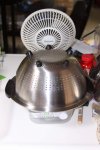
I was getting an Error 404 ALL DAY for this site so I couldn't get back to this thread! :( I did remove him from the fridge and put him on the counter with a fan blowing on his tub instead, with a strainer covering him so he's safe from my kitty. I'm afraid now because I added some aquarium salt to his little tub (only a few little granules) and he's been sitting in that for hours. I add dechlorinator to water in buckets and let it sit overnight, there is a LOT of chlorine in the water here. It's been about 8 hours, I hope that's enough. I'm going to put him in clean water now
 
Okay I went to add him to clean water and at first I thought he was dead. He was floating kind of side ways and wasn't moving.. not even a gill twitch. I even poked him twice because I thought he was dead, still no movement. Hoping I was wrong, I went to get the clean water anyway and when I came back in I saw a gill twitch. I set the new water tub on ice packs because I dipped my hand in and there was a significant temp difference. I added a few ice cubes and waited for them to melt before adding my axie. It was still warmer than I wanted it to be, but I figured the salt water he was in was worse for him. I gently held a cup in the water and scooped him up, and then moved him into the clean tub of water. He started moving then. I covered him back up with the strainer and put the fan back on him before shutting off the light. He's in such horrible condition I'm terrified. What did I do wrong that made him get into this state? His tank mates are okay. A little lethargic, but I'm assuming that's because the water is warm. I have a fan on their tank as well trying to bring down the temp. I'm going to have the air on in the house tomorrow if I can. The two other axie's gill fronds have slowly become less fluffy over the past few months but I assumed that was because I have a bubbler bar in there that they like to swim through on occasion. Could that be why, or should I be worried of some other issue? I don't want them to end up in the same condition. Though they both gobbled up their worms today as usual...
 
I have had a very similar situation to this, where one axolotl stopped eating, and had unexplained skin problems and general malaise.

To get him to eat, I started putting him into a tupperware tub, defrosting cubes of bloodworm, and using tweezers to drop clumps of them directly over his head. He couldn't resist the bloodworm, and by dropping them over his head, he snapped at them, and they were easy to swallow.

I had to do this every night for a while, it was VERY time consuming and hard work, but had to be done. After a while I started him on pellets and he loves them now, but he refuses to eat earthworms any more.

I eventually swapped him into a tank with a different axolotl, and put his snappy tank mate on his own - it made a huge difference. He is now getting nice and chubby, he appears a lot happier, and his skin is fully cleared up.

I really cannot be sure what the causes of his problems were, all I know is this process worked for me.

As an aside, are you familiar with cycling tanks? Your parameters look like your tank is not cycled.

How often are you changing the water for Smudge while he is in the tub? Are you keeping him refrigerated, or is he at room temp?

Edit - are those last photos from today? His gills look dreadful - unless I am mistaken in what I am seeing there. Have you followed the salt bath tutorial? Smudge needs attention quickly - if he isn't already, make sure he is in clean dechlorinated water in a tub with a lid, rest the lid loosely on the top of the tub and cover with a towel and put him in the fridge. This should slow down any fungal growth while you get help.

Be prepared to work hard to keep Smudge with us, salt bathing takes precision and care, but the tutorial I linked to is excellent.

I got scared when I saw my pH at 7.6, but apparently that's ideal for axies. Now I'm even more upset with myself because I added some pH down to the tank. :( What about my water parameters makes my tank not look cycled? What needs to happen?
Thanks so much, I feel like a failure to my little guys.
 
PH down and other chemicals are a bad idea in general, for example if your pH is high, crushed coral is good + water changes.. but no worries about that now. You aren't a failure! Keep your head up :)

Sent from my DROID RAZR using Tapatalk 4
 
Hey - I too had the 404 of doom yesterday so I missed all these messages. Hopefully I'll catch all your questions...

The fact that you have a little ammonia, and no nitrite or nitrate shows that your tank is uncycled, I don't know if you've seen this article on cycling but it's worth reading for an explanation. Understanding this process will really help you manage your tanks.

Yep, the 90% water change probably did it. Stop beating yourself up about stuff, no time for that, my friend! We all make mistakes, what is important now is, you're asking questions and hopefully taking all this in!

I disagree that fridging stresses axolotls. In my experience the colder temp, dark space, clean fresh water, and still conditions literally chills them out. Smudge is not eating - and no wonder, and fridging will slow down his metabolism. He may continue to not eat, but he'll also burn a lot less energy and will be less likely to lose weight too. It will also slow down that horrible fungus while you try and treat it.

Covering the tub in a towel prevents the sudden light when you open the door from startling your axolotl. I suggest putting tape over the little switch in the door that causes the light to go on.

I agree that water temp changes are not good - but swapping Smudge across tubs is quick, just be prepared for wriggling. Go slow. Your hands are going to be freezing. Go slow. Don't scare him.

You WILL need to change his water for fresh dechlorinated stuff (yes, make sure it is in the fridge to bring it down to the fridge temp. You're going to need a lot.) but the salt baths mean you have to do this twice a day anyway.

You can try and feed him with the tweezer/bloodworm method I suggested without removing him from the fridge, if needs be - he might chomp down on the odd one or two. Make sure any feedings attempts are done in water you're about to swap out, and if any straggling bloodworm cross into the fresh water, tweezer them out to stop them rotting in there.

Please read this page on fridging so that you understand the process.

Read the fridging and salt bath article and ask as many questions as you need to to feel comfortable before you start this process, but you do need to start this process quickly. It's alarming at first, but it gets easier, i promise.

Then you need to work on keeping the others happy and giving Smudge somewhere to move in to after his ordeal.
 
Hey - I too had the 404 of doom yesterday so I missed all these messages. Hopefully I'll catch all your questions...

The fact that you have a little ammonia, and no nitrite or nitrate shows that your tank is uncycled, I don't know if you've seen this article on cycling but it's worth reading for an explanation. Understanding this process will really help you manage your tanks.

Yep, the 90% water change probably did it. Stop beating yourself up about stuff, no time for that, my friend! We all make mistakes, what is important now is, you're asking questions and hopefully taking all this in!

I disagree that fridging stresses axolotls. In my experience the colder temp, dark space, clean fresh water, and still conditions literally chills them out. Smudge is not eating - and no wonder, and fridging will slow down his metabolism. He may continue to not eat, but he'll also burn a lot less energy and will be less likely to lose weight too. It will also slow down that horrible fungus while you try and treat it.

Covering the tub in a towel prevents the sudden light when you open the door from startling your axolotl. I suggest putting tape over the little switch in the door that causes the light to go on.

I agree that water temp changes are not good - but swapping Smudge across tubs is quick, just be prepared for wriggling. Go slow. Your hands are going to be freezing. Go slow. Don't scare him.

You WILL need to change his water for fresh dechlorinated stuff (yes, make sure it is in the fridge to bring it down to the fridge temp. You're going to need a lot.) but the salt baths mean you have to do this twice a day anyway.

You can try and feed him with the tweezer/bloodworm method I suggested without removing him from the fridge, if needs be - he might chomp down on the odd one or two. Make sure any feedings attempts are done in water you're about to swap out, and if any straggling bloodworm cross into the fresh water, tweezer them out to stop them rotting in there.

Please read this page on fridging so that you understand the process.

Read the fridging and salt bath article and ask as many questions as you need to to feel comfortable before you start this process, but you do need to start this process quickly. It's alarming at first, but it gets easier, i promise.

Then you need to work on keeping the others happy and giving Smudge somewhere to move in to after his ordeal.

Sorry if I miscommunicated, he doesn't have a fungus right now, I just wanted to provide a history that he did. Do you think he still needs salt baths, or just clean, cold water and try and get him to eat?
 
Sorry if I miscommunicated, he doesn't have a fungus right now, I just wanted to provide a history that he did. Do you think he still needs salt baths, or just clean, cold water and try and get him to eat?

Hey Sylerwin,

Can you try and get some new photos of his gills? They looked pretty fungussy - but I'm not sure which are from when and with the pics being a bit fuzzy it could look like fungus. That'd really help! From the front and back if possible :)

If he doesn't have fungus, he won't need salt baths, but those pics really made it look like he does...
 
Hey Sylerwin,

Can you try and get some new photos of his gills? They looked pretty fungussy - but I'm not sure which are from when and with the pics being a bit fuzzy it could look like fungus. That'd really help! From the front and back if possible :)

If he doesn't have fungus, he won't need salt baths, but those pics really made it look like he does...

Yeah I'll get a photo in a few minutes. His gill fronds are really short, almost gone, behind his gills his skin is very light colored, maybe that's what you saw. I'm pretty sure it's always been that way though, just light pigmentation behind his head. I don't see any signs of fungus like he had before though, that stuff almost looked like a cloudy white stuff, he doesn't seem to have any now.
I just went to feed him before putting him in a clean tub. I tried thawed bloodworms, newt pellets, and cut up red wiggler so it's bite size. He wouldn't take anything. It seemed like he made a weak attempt once, but he didn't get any in his mouth. I kept putting food in front of his face touching his mouth with the tweezers but nothing :( When I was about to give up he started this weird twitching. It almost looked like he was swallowing or choking, and his eyes would do this weird twitch and recess into his head for a moment, I've never seen that before. Then he started twitching as if something was bothering him--something he used to do when I was uneducated and didn't let the chlorine evaporate overnight, as if the water was irritating him. I took a turkey baster and got the food out before dipping the cup in to scoop him up and into clean water. Because I have one person telling me to fridge and another not to, I'm keeping him on the counter with a fan blowing on his tub so it's nice and cool... a medium I guess. :/ It's cool in the house today, not like yesterday so I think the temp is good. I'm going to get my regular camera this time, not just my phone and take pictures. I'll get a temp of the water while I'm at it.
 
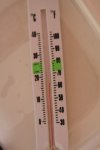
Here's some photos. It was really hard to focus through water, especially because my camera won't take a photo if it doesn't think it's in focus, even if it is. Even with manual focus. his innermost left side gill looks light in color, but that's just the light in the room. I looked REALLY close. I'm pretty positive he doesn't have fungus but here's some photos of his current setup, temp, and of his gills.
 

Attachments

  • Current Setup.jpg
    Current Setup.jpg
    135.4 KB · Views: 481
  • Temp.jpg
    Temp.jpg
    80.9 KB · Views: 558
  • gills.jpg
    gills.jpg
    37.6 KB · Views: 701
  • gills2.jpg
    gills2.jpg
    36.6 KB · Views: 516
it is true that axolotls like colder temperatures but fridge temperatures are used to help heal their body in times of great distress. Its been proven that lowering a axolotls body temperature promotes healing. But this is to the temperature if almost death pretty much. Yes an axolotl can live in cold temps but not below freezing. For long anyways(they can live up to 48hours in the freezer though) but its not good for them. Thats why they recommend when fridging tokeep the water above 5 preferably around 10 though most peoples food would rot at 10C

10C is the temp in which they have found being the best temperature to let an axolotls body heal.

However you suffer a great loss when fridging an axolotl, it causes them to become more lethargic, their metabolism slows down so they are not hungry, they wont eat, then dont "need" to eat most times but if you are adding an axolotl that is thin and you are trying to rehabilitate back to health it really isnt the place to put your lotl. We are trying to get him back up and healthy as soon as possible, not prolong his suffering. Ive read that a lotl can live comfortably up to 10C any lower and you are slowing down their system to much and unless its a life and death situation then it really isnt the place for them to be. I very rarely recommend it. Maybe twice ive told somebody to put their lotl in thefridge. Ive had to do it once when my water temp went over 74 and i couldnt cool it down, this was at night, the next day it went over 80, i was working that day, had i have not done what i did they potentially could of died. Does this explain it a bit better? If not i can figure out a different way.


Your lotl probably still wont eat because it can take upwards of a week after renoving them from the fridge before they will eat again, expecially since he didnt have much of an appetite before. all i can say is keep trying to feed him. It is what he needs.
As far as the twitching goes i really dont know what could be causing that, has he stoped?
He does look better in the newer pictures then he did before.

The best thing you can do for him is to just keep him in cool clean water(mid to low 60s which i think is what your thermometer said anyways) and 100% water changes daily with dechlorinated water

May i ask what kind of dechlorinator you are using?
Also, before you added your new axies to the tank, were they quarantined? Also have you added anything new to the tank since he has started to go downhill? It probably is nothing but id like to rule out any kind of infection that could of been introduced to the tank. I still firmly believe this i ALL caused by water quality and just keeping up with his tub and trying to feed him, id say you should start seeing imrovements within a week.

Good luck and keep us posted.
The only thing i could think of that could be making the twitching happen is your dechlorinator. Hense why i asked, if you could tell me what kind it is it will help me out.
 
General chit-chat
Help Users
  • No one is chatting at the moment.
  • Chat Bot:
    SSV has left the room.
    +1
    Unlike
  • Arlet:
    Hello, may I ask a question here? Or do I need to ask a question somewhere else?
    +1
    Unlike
  • Rorey132:
    Is this guy still available?
    +1
    Unlike
    Rorey132: Is this guy still available? +1
    Back
    Top