Illness/Sickness: White spots

kevintaco

New member
Joined
Apr 9, 2014
Messages
22
Reaction score
0
Points
0
Location
WA
Country
United States
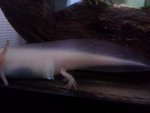
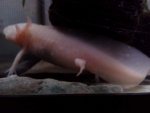
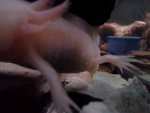
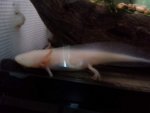
I just noticed that my axolotl has these terrible looking white spots all over him and I'm worried it is some sort of infection. I've read other posts about people seeing similar spots but I do not think these are iridiophores. The picture is a little blurry, best I could get. Any help would be great, thanks!
 

Attachments

  • sick Kevin.jpg
    sick Kevin.jpg
    48.1 KB · Views: 355
  • sick kev2.jpg
    sick kev2.jpg
    55.6 KB · Views: 337
It's very hard to tell from the picture which is a bit blurry, but they kinda look like markings like iridophores.
What are your current water parameters? (Sometimes they can show skin blotches when water quality is poor)
 
I just checked my water parameters and I am so shocked:

Nitrites=0ppm
Nitrates=30ppm
Ammonia=4.0ppm!!!

I recently had a cyanobacteria invasion which I treated by removing the driftwood it was growing on and increasing water flow. To displace the water flow I use a turtle lily pad thing so it just flows on the very surface of the water. It seemed to really work, no more cyanobacteria as far as I can tell.

I just did a 20% water change and added two Ammonia Safe tablets I had. The tank is well cycled and I do regular water changes, I can't believe the ammonia was so high, I feel terrible. What could have caused this and is this why my Kevin has these terrible bumps?

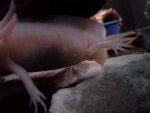
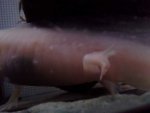
I was able to take some better pictures. The spots are more visible in the picture and look raised. Does that mean they are not iridophores? Ignore the lines in one of the photos, the glass on the tank is scratched.

Please help. :( Thanks.
 

Attachments

  • kev4.jpg
    kev4.jpg
    48.5 KB · Views: 293
  • kev3.jpg
    kev3.jpg
    55.8 KB · Views: 260
  • kev2.jpg
    kev2.jpg
    49 KB · Views: 303
  • kev1.jpg
    kev1.jpg
    58.3 KB · Views: 251
Now I'm thinking for sure it's a fungal infection due to the toxicity of the high ammonia weakening his immune system. I feel awful! How should I proceed?
 
It looks like ammonia burns and blistering. Sometimes axolotls never recover from ammonia poisoning, and sometimes they do. Either do huge water changes daily to keep ammonia to zero, or put your axolotl in a separate container while getting the ammonia levels under control.
If you put it in a separate container, do 100% daily water changes.
To be honest, IF YOU CAN do the massive daily water changes on the tank, to insure that the ammonia dissapears, I think this would be the least stressful thing for your axie.
But start asap, like 5 minutes ago! I don't mean to be rude, but I want to stress that this is critical to his health.
Is he eating?
Cool, clean water. Nothing else. Just add dechlorinator(like Seachem Prime) if you need to.
Please keep us updated!
 
Massive water changes=60% -70% +
Also test water daily.
What size is the tank?
 
I agree with Bette, you need to be doing some BIG water changes - a 20% will only bring your ammonia down by 20%, so to get down from 4ppm to 0.5ppm you need to do at least 90%.

It looks like your cycle has crashed - you're going to have to treat it as a new cycle. And don't bother with the 'ammonia safe' stuff - axies are sensitive to chemicals and unless you know exactly what they consist of I wouldn't use them.
 
I will do large daily water changes and hope that helps. I don't think my system crashed because I still have nitrates in the tank.

Could this be due to the cyanobacteria that was in the tank?
 
Also, it's a 20 gallon tank, about 8 months old.
 
Update: Last night I did a 20% water change after discovering the high ammonia and this morning I did about a 60% water change. I tested immediately after and the ammonia was down to 0.25ppm. I will check again later today.

Behavior: He hasn't been as active lately but I figured it was just due to him getting older. And he gets a "red wiggler" worm every other day, and he's been mostly eating fine, just a couple of times where he wouldn't eat his dinner. He ate Saturday.

Is there anything else I can do besides water changes? It's just hard to have a plan of action when I don't know what caused this.

Thanks for everyone's help.
 
Update: Last night I did a 20% water change after discovering the high ammonia and this morning I did about a 60% water change. I tested immediately after and the ammonia was down to 0.25ppm. I will check again later today.

Behavior: He hasn't been as active lately but I figured it was just due to him getting older. And he gets a "red wiggler" worm every other day, and he's been mostly eating fine, just a couple of times where he wouldn't eat his dinner. He ate Saturday.

Is there anything else I can do besides water changes? It's just hard to have a plan of action when I don't know what caused this.

Thanks for everyone's help.

The cause of his health problems is directly from high ammonia levels. If you waited too long between water changes, the levels can easily get that high. Especially if the tank wasn't completely cycled....or if the cycle crashed.
Thoroughly clean the tank and make sure that there are no rotten food scraps hiding. Keep doing daily water changes to insure good water quality. This is the best treatment.
You are lucky that he is still eating.
The tank size is good. In future(when the tank cycling is complete)stick to weekly water changes. Best of luck :happy:
 
I had been doing regular water changes and the tank was well cycled. I don't think the cycle crashed completely because there is still a good nitrate level. I think this was due to the cyanobacteria in the tank. I feel terrible that I didn't think to check the water parameters after getting rid of the cyanobacteria. I'll be closely monitoring the levels and my axolotl, I really hope he recovers.
 
I had been doing regular water changes and the tank was well cycled. I don't think the cycle crashed completely because there is still a good nitrate level. I think this was due to the cyanobacteria in the tank. I feel terrible that I didn't think to check the water parameters after getting rid of the cyanobacteria. I'll be closely monitoring the levels and my axolotl, I really hope he recovers.

I don't know enough about the cynobacteria to know if this is related. Perhaps someone else on the forum has knowledge about this?
I really hope that your axie recovers, too! Let's think positive :happy:
 
A common cause for skin bumps like those shown, is the presence of an irritant, with a bacteria infection or parasite also being possible causes. I'm not entirely convinced your axolotl is showing any signs of ammonia toxicity, specifically.

Once you correct the water chemistry, the skin condition may improve on its own. If it doesn't improve or gets worse, you can look into a quarantine environment or fridging with daily water changes to help isolate the axolotl from the irritant and aid in healing.

I've also seen posts where aloe vera in select water conditioners have caused skin irritation in axolotls. If you are using a water conditioner which contains aloe vera, it may be worth trying a different product.
 
Please keep us updated, and take more, clearer pics if possible. Let us know if it gets worse or changes.
 
A common cause for skin bumps like those shown, is the presence of an irritant, with a bacteria infection or parasite also being possible causes. I'm not entirely convinced your axolotl is showing any signs of ammonia toxicity, specifically.

Once you correct the water chemistry, the skin condition may improve on its own. If it doesn't improve or gets worse, you can look into a quarantine environment or fridging with daily water changes to help isolate the axolotl from the irritant and aid in healing.

I've also seen posts where aloe vera in select water conditioners have caused some skin irritation in axolotls. If you are using a water conditioner which contains aloe vera, it may be worth trying a different product.

Good points, Elise. I was also wondering if it could be something like ick, but its so hard to tell from the pics.
 
I can't take any better pictures right now, but I think it's due to the ammonia.

Since realizing the ammonia was high, I've been doing large water changes and monitoring daily, and I can get it down to 0ppm, but it just keeps rising. I've vacuumed up all of the debris but it doesn't seem to help.

I moved him to the 5 gallon tank he used to be in because it was still cycled (I had a couple of minnows in it). I check all the water parameters before moving him and they were perfect. The day after moving him (I took the minnows out of course), I checked the water and the ammonia was at 0.5ppm! This tank has never had a problem before and is well cycled.

I have no idea what's going on or what to do. I think this is problem with the tanks, but why? I just want to be able to put him in a tank without ammonia so he can heal.

Thanks.
 
You need to treat the bigger tank as if you're just now cycling it. For some reason the cycle has crashed. Once you do a water chance the ammonia goes down, but will start going up again because the axie produces wastes all the time in the tank. The smaller tank only had enough bacteria to take care of the wastes of the few minnows. An axie produces a lot more so the ammonia will go up because there isn't enough bacteria to take care of all of it.
 
Update: I have been adding Special Blend bacteria to the tank, which is what I used to cycle it in the first place, and it doesn't seem to be working at all. The ammonia is at 0.25ppm every day and I'm still having to do water changes every day. Now there is also a ton of planaria in the tank that I'm trying to control. I don't know what else I can do, he's still eating and his spots look a little better but they are still there. Thanks for any advice anyone can provide.
 
I have been adding Special Blend bacteria to the tank, which is what I used to cycle it in the first place, and it doesn't seem to be working at all.

Don't use that. Most of the time they're just a waste of money and I've heard of many cycles that crashed after some time that were started with bottled bacteria. They also contain chemicals to keep the bacteria alive that can be bad for your axies.
Try to get some seeding material from a healthy aquarium. It won't instantly cycle the whole tank, but will speed up the process.
 
General chit-chat
Help Users
  • No one is chatting at the moment.
    There are no messages in the chat. Be the first one to say Hi!
    Back
    Top