Axolotl foot problem, please help

Slime

New member
Joined
May 13, 2023
Messages
9
Reaction score
1
Points
3
Location
Pennsylvania
Country
United States
Hello,
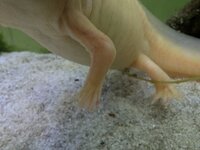
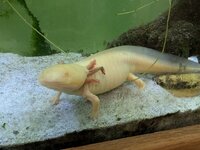
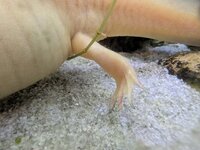
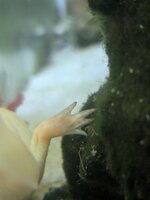
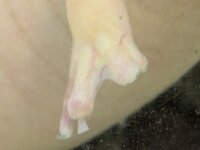
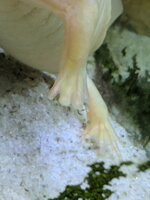
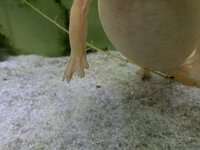
This morning I noticed my axolotl Zero's front feet were looking strange, it looks like they became stubbier and there even appears to be exposed bone on a few of the toes. I checked the back feet and they look better, but one looks like it's starting to have this problem. I don't know when this first started but looking through my photos this is very recent and has only started within the past month.
My water test strips show the parameters at:
Nitrate: Possibly above 0 ppm, but below 20
Nitrite: 0
pH: Between 7.5 and 8.0
KH: 180
GH: 180
I have not been able to check ammonia yet. I haven't noticed any signs of stress and she is still eating. My tank has live plants and a sand bottom. I did recently switch out the canister filter for a new one, because my old one started acting up, it was making a noise and had a weak flow. I also removed a hang on back filter I used to have on the tank so I could add a metal screen lid to keep my cat from getting in. The current Canister filter I'm using is the Marineland Magniflow 180. I don't have experience with tubbing or treating an axolotl illness and I don't know of an exotic vet in my area. Please help, I can tell something's going on and I don't want it to get worse.
 

Attachments

  • PXL_20260818_185950156.jpg
    PXL_20260818_185950156.jpg
    1.9 MB · Views: 83
  • PXL_20260818_185959363.jpg
    PXL_20260818_185959363.jpg
    1.9 MB · Views: 28
A couple other photos (the last one of these is the healthy foot), I couldn't upload these at first due to the file size
 

Attachments

  • PXL_20260818_185939366.jpg
    PXL_20260818_185939366.jpg
    1.7 MB · Views: 25
  • PXL_20260818_185924035.jpg
    PXL_20260818_185924035.jpg
    1.7 MB · Views: 22
  • PXL_20260818_190447089.jpg
    PXL_20260818_190447089.jpg
    1.9 MB · Views: 22
your sand looks to be a bit coarse which can cause damage to his/her digits when he/she digs around hunting for food.
be aware that any changes to substrate or filtration can cause fluctuating levels and should be monitored until everything has settled.
try to get a liquid test kit for accurate readings and ensure that ammonia is tested.
 
I picked up a liquid test kit today, I was able to test the ammonia and the levels are at 0. I also added two Indian almond leaves as I was reading they can help with certain things like bacteria that can cause this. I forgot to mention that my tank is 29 gallons.
your sand looks to be a bit coarse which can cause damage to his/her digits when he/she digs around hunting for food.
be aware that any changes to substrate or filtration can cause fluctuating levels and should be monitored until everything has settled.
try to get a liquid test kit for accurate readings and ensure that ammonia is tested.
I believe the sand is pool filter sand, but I've never changed it. I've had her in this tank for a few years now, I'm unsure why it would only start damaging her toes now. I'm a bit worried that changing out the filter could be what caused this since that would line up with when this happened. I don't know if it could be that though since the tank parameters are normal as far as I can tell.
 
might be worth while monitoring her at night when she is more active, she might be digging for food or searching for a change in hides (not unusual to try digging into small spaces).
 
might be worth while monitoring her at night when she is more active, she might be digging for food or searching for a change in hides (not unusual to try digging into small spaces).
I tried watching her somewhat at night, I haven't seen her clearly digging at anything or doing anything unusual. I will keep an eye out to see if that changes.
I also tested the other water parameters again with the liquid test kit and I got:
Nitrite - 0 ppm
Nitrate - 10 ppm
pH - 7.8-8.0 (I added the Indian almond leaves, so this may change)
I cleaned the sand somewhat today with a gravel siphon and did a water change, I don't remember the last time I cleaned the sand.
The big thing I'm worried about is photos of a bacteria infection eating away at the feet seem similar to this. I haven't seen other warning signs yet though (no fuzz, no curling gills, no fuzzy/red/curled tail tip, no frantic swimming). The toes don't look that red to me either, I do see some visible blood vessels around them inside the feet though I'm also wondering if that could just be how the toes heal. Is there anything else I should be keeping an eye out for?
 
due to how an axolotls repair system works (regeneration rather than repair) the healing processes can seem as if the injury is getting worse before getting better.
the bacteria which causes rot with the inability to heal has been noted as being seen mostly by animals which are kept in plastic containers (always ensure thorough cleaning of containers whilst tubbing) although being a bacteria it is possible to be found elsewhere, if the rot bacteria is found amputation is preferable to allow for proper healing.
almond leaves slowly release beneficial tannins which can be soothing but are slow acting due to the release being tied to the leaves breakdown, a quicker way is to crush leaves into a cup/mug/jug then add boiling water, stir on occasion, once cooled the tea/extract produced can be used.
adding a small amount of salt (ie.. 2 grams per litre) can help with healing and towards prevention of bacterial infection, feeding food containing vitamin A helps with the healing process (ie. eyed prey such as fish, shrimp, prawns etc).
 
General chit-chat
Help Users
  • No one is chatting at the moment.
  • Chat Bot:
    SSV has left the room.
    +1
    Unlike
  • Arlet:
    Hello, may I ask a question here? Or do I need to ask a question somewhere else?
    +1
    Unlike
  • Rorey132:
    Is this guy still available?
    +1
    Unlike
    Rorey132: Is this guy still available? +1
    Back
    Top