Gills Turning White and Slightly Red

CrazyForLotls

Active member
Joined
Mar 14, 2021
Messages
106
Reaction score
32
Points
28
Location
Ohio
Country
United States
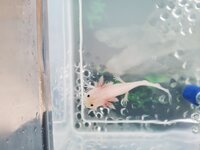
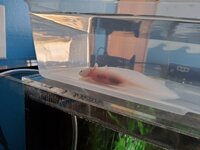
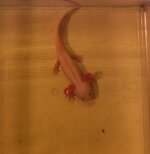
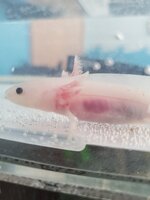
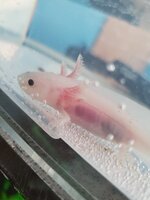
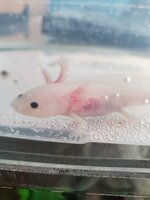
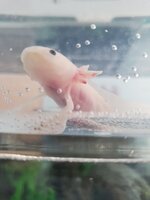
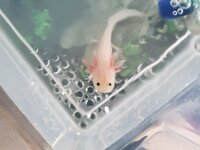
I have a juvenile axolotl that I received about a month ago. Yesterday I noticed that it's gills seem to be turning white and one of his lower ones looked red with the fronds slightly droopy. The tips of it's gills looked a bit white for several weeks now and it wasn't spreading at all. Yesterday I noticed that the lack of coloration seemed to extend further down the gill stalks. I also noticed a bit of red at the end of one stalk, on his fronds. It looks slightly worse today, like the fronds and stalk are receding. I have had the axolotl in a bare-bottom container since I received it. I do daily water changes from an established aquarium. First I fill up a clean container, then I use a brine shrimp net to move the axolotl. (It has gotten rather used to being transferred daily and does not appear stressed out. It's tail is not curled nor do it's gills point forwards.) After I do that, I remove the ceramic weights from the airstone I have in the container. I scrub them with a toothbrush under the tap water and set them aside. Then I rub the airstone while it is still in the dirty container to get any slime off of it. I then move it to the clean container with the axolotl in it, and re-attach the weights. The airstone and weights are the only thing in the container besides water and the axolotl. The water parameters are as follows:

General Hardness 150 ppm
Nitrite 0 ppm
Nitrate 0 ppm (It has been like this for awhile but I know there must be some in the water. I use test strips since I do not have a liquid test kit, which I am aware is recommended)
Chlorine 0 ppm
Carbonate Hardness 40 ppm
pH is 6.8-7.2 (The bottle of the strips doesn't have any reading in between those two numbers)

The axolotl seems happy. It's active and responsive. It always turns to look at me when I come in the room, even though I've only had it for about a month. It still has a good appetite as well. I feed it one red wiggler cut into four pieces on one day, and four crushed salmon pellets the next day. The aquarium I take the water from for the daily water changes has a subadult male in it who appears healthy and happy as can be. I had several rosy red minnows in the aquarium as feeders for him but they have been gone (as in eaten, not removed or dead from illness) for nearly two weeks. Attached are pictures of the potentially ill juvenile. It will not be put in the larger aquarium until it is over four inches, as that was what was recommended. It will be seperated from the subadult to prevent injury. I have looked for similar issues on here and couldn't find anything. It doesn't look like new growth or fungus. Apologies if my post seemed to ramble, I wanted to give as much information as possible. Any ideas on what could have happened to my little guy? All help will be much appreciated!
 

Attachments

  • 20210315_101739.jpg
    20210315_101739.jpg
    1.1 MB · Views: 351
  • 20210315_101824(0).jpg
    20210315_101824(0).jpg
    3.6 MB · Views: 221
  • 20210315_101858.jpg
    20210315_101858.jpg
    1.7 MB · Views: 229
  • 20210315_101936.jpg
    20210315_101936.jpg
    2.7 MB · Views: 248
I have a juvenile axolotl that I received about a month ago. Yesterday I noticed that it's gills seem to be turning white and one of his lower ones looked red with the fronds slightly droopy. The tips of it's gills looked a bit white for several weeks now and it wasn't spreading at all. Yesterday I noticed that the lack of coloration seemed to extend further down the gill stalks. I also noticed a bit of red at the end of one stalk, on his fronds. It looks slightly worse today, like the fronds and stalk are receding. I have had the axolotl in a bare-bottom container since I received it. I do daily water changes from an established aquarium. First I fill up a clean container, then I use a brine shrimp net to move the axolotl. (It has gotten rather used to being transferred daily and does not appear stressed out. It's tail is not curled nor do it's gills point forwards.) After I do that, I remove the ceramic weights from the airstone I have in the container. I scrub them with a toothbrush under the tap water and set them aside. Then I rub the airstone while it is still in the dirty container to get any slime off of it. I then move it to the clean container with the axolotl in it, and re-attach the weights. The airstone and weights are the only thing in the container besides water and the axolotl. The water parameters are as follows:

General Hardness 150 ppm
Nitrite 0 ppm
Nitrate 0 ppm (It has been like this for awhile but I know there must be some in the water. I use test strips since I do not have a liquid test kit, which I am aware is recommended)
Chlorine 0 ppm
Carbonate Hardness 40 ppm
pH is 6.8-7.2 (The bottle of the strips doesn't have any reading in between those two numbers)

The axolotl seems happy. It's active and responsive. It always turns to look at me when I come in the room, even though I've only had it for about a month. It still has a good appetite as well. I feed it one red wiggler cut into four pieces on one day, and four crushed salmon pellets the next day. The aquarium I take the water from for the daily water changes has a subadult male in it who appears healthy and happy as can be. I had several rosy red minnows in the aquarium as feeders for him but they have been gone (as in eaten, not removed or dead from illness) for nearly two weeks. Attached are pictures of the potentially ill juvenile. It will not be put in the larger aquarium until it is over four inches, as that was what was recommended. It will be seperated from the subadult to prevent injury. I have looked for similar issues on here and couldn't find anything. It doesn't look like new growth or fungus. Apologies if my post seemed to ramble, I wanted to give as much information as possible. Any ideas on what could have happened to my little guy? All help will be much appreciated!
He does look healthy. How much does he swim/move around?
 
He does look healthy. How much does he swim/move around?
A fair amount. It doesn't appear distressed but likes to swim back and forth or hang out near the airstone. It is notably more active than my subadult. (He's pretty lazy)
 
A fair amount. It doesn't appear distressed but likes to swim back and forth or hang out near the airstone. It is notably more active than my subadult. (He's pretty lazy)
Is there any blood? He may had cut his gill stalk on something.
 
Is there any blood? He may had cut his gill stalk on something.
I don't think so. The fronds look red and kinda droopy to me. The reddened gill looks to be receding slightly
 
I havent seen anything else like it. I’ll go look into it more
Okay, thank you. I contacted the breeder I got it from and they think the white is new growth. I was concerned that it was not new growth because it looks to be spreading further down the gills. They said that the red is concerning and that it looks like it may have bumped or scratched itself at some point. They recommended that I lower the water level, the temperature, and put it an indian almond leaf. Opinions and other advice welcome!
 
Has anybody found anything? I looked through some old forums for similar issues but didn't find anything. I lowered the water level slightly, along with the temperature, and put in an Indian almond leaf on Wednesday morning as the breeder recommended. I gently rub it to make sure it isn't slimy and gross before I put it in the fresh container of water during the daily 100% water changes. Today I removed the airstone from the container, as some red specks showed up on two other gill tips. (I think it may be harboring bacteria and/or creating a stressful water current, even though it has been in the container awhile without any negative effects) The most affected gill, as seen in the photos, doesn't seem to be getting any better. It may be slightly worse, but it's hard to tell by comparing it to the photos. The reddened tip looks like it curls backwards a bit and the gill filaments are shorter and red than the others. The color is more prominent in person. The "patient" seems pretty happy though, which really confuses me. It has a great appetite still, is pretty active, and very aware of his/her surroundings. It always looks at me and comes over to say hello when I'm in the room. I tested the water today with a test strip and the parameters all are the same as before. The nitrates may be changing from 0 to 10 on the scale, but it's hard to tell. The color is somewhere in between the 0 block and the 10 block. I've read that nitrates are beneficial and axolotls can tolerate much more than a reading of 10. I think I'm going to do a 30-40% water change in my established aquarium today, as it is where I get the water for the "patient's" 100% daily water changes. The axolotl in said establish aquarium doesn't seem to be having any problems. He looks like his usual happy self, but I have read that leucistics can be a bit more sensitive than darker colored axolotls.
 
Last edited:
Has anybody found anything? I looked through some old forums for similar issues but didn't find anything. I lowered the water level slightly, along with the temperature, and put in an Indian almond leaf on Wednesday morning as the breeder recommended. I gently rub it to make sure it isn't slimy and gross before I put it in the fresh container of water during the daily 100% water changes. Today I removed the airstone from the container, as some red specks showed up on two other gill tips. (I think it may be harboring bacteria and/or creating a stressful water current, even though it has been in the container awhile without any negative effects) The most affected gill, as seen in the photos, doesn't seem to be getting any better. It may be slightly worse, but it's hard to tell by comparing it to the photos. The reddened tip looks like it curls backwards a bit and the gill filaments are shorter and red than the others. The color is more prominent in person. The "patient" seems pretty happy though, which really confuses me. It has a great appetite still, is pretty active, and very aware of his/her surroundings. It always looks at me and comes over to say hello when I'm in the room. I tested the water today with a test strip and the parameters all are the same as before. The nitrates may be changing from 0 to 10 on the scale, but it's hard to tell. The color is somewhere in between the 0 block and the 10 block. I've read that nitrates are beneficial and axolotls can tolerate much more than a reading of 10. I think I'm going to do a 30-40% water change in my established aquarium today, as it is where I get the water for the "patient's" 100% daily water changes. The axolotl in said establish aquarium doesn't seem to be having any problems. He looks like his usual happy self, but I have read that leucistics can be a bit more sensitive than darker colored axolotls.
Ok so a couple correction here:

100% water changes on the tub should not be coming from your auarium that also has waste in it, it should be fresh cold water from the tap (treated with decholinator if youre on city water).

Test strips is highly inaccurate and should not be used. Liquid test kits like the API freshwater master kit are the best and most reliable. You shouldnt really have the need to test the tub water as you should be changing it at least once a day with fresh water from the tap.

Nitrates are not beneficial. They are still toxic, just not as much so as nitrites and ammonia. All nitrates indicate is that you have established bacteria colonies to break down your axololt's waste. That bacteria takes weeks to establish so you would not naturally have any appear in a quarantine tub.

Airstones aren't necessary in tubs and often actually create too much water movement. Removing the airstone is fine.

The use of indian almond leaf is misunderstood. Simply putting a leaf in the tub wont really do anything in the short term, especially since you are changing the water daily and removing any beneficial tannins these leafs produce. In nature, indian almond leaves would fall into the water where they would start to decompose. This breakdown is what releases the natural tannins into the water and will give the water a yellow-ish brown hue. This doesnt happen over night. They can be useful when used as a long term treatment in an aquarium as long as you dont mind the brown colored water. In this case though, its really not doing much for you. You would be better off using black tea baths. Black tea offers the same tannins with the same antibacterial and antifungal properties. Brew one bag of plain black tea in 8oz boiling water. Steep for 5-10 mins. Dilute the tea with cold water until it is a light amber color. This will also need to be changed daily, but will be more beneficial.

Leucisitics are no more sensitive than any other axolotl, it's just easier to see on their skin when their is irritation since they are light colored.
 
Ok so a couple correction here:

100% water changes on the tub should not be coming from your auarium that also has waste in it, it should be fresh cold water from the tap (treated with decholinator if youre on city water).

Test strips is highly inaccurate and should not be used. Liquid test kits like the API freshwater master kit are the best and most reliable. You shouldnt really have the need to test the tub water as you should be changing it at least once a day with fresh water from the tap.

Nitrates are not beneficial. They are still toxic, just not as much so as nitrites and ammonia. All nitrates indicate is that you have established bacteria colonies to break down your axololt's waste. That bacteria takes weeks to establish so you would not naturally have any appear in a quarantine tub.

Airstones aren't necessary in tubs and often actually create too much water movement. Removing the airstone is fine.

The use of indian almond leaf is misunderstood. Simply putting a leaf in the tub wont really do anything in the short term, especially since you are changing the water daily and removing any beneficial tannins these leafs produce. In nature, indian almond leaves would fall into the water where they would start to decompose. This breakdown is what releases the natural tannins into the water and will give the water a yellow-ish brown hue. This doesnt happen over night. They can be useful when used as a long term treatment in an aquarium as long as you dont mind the brown colored water. In this case though, its really not doing much for you. You would be better off using black tea baths. Black tea offers the same tannins with the same antibacterial and antifungal properties. Brew one bag of plain black tea in 8oz boiling water. Steep for 5-10 mins. Dilute the tea with cold water until it is a light amber color. This will also need to be changed daily, but will be more beneficial.

Leucisitics are no more sensitive than any other axolotl, it's just easier to see on their skin when their is irritation since they are light colored.
Thanks for your help! I thought that using water from the aquarium would be better, because I knew the parameters were in decent condition. I was testing the water from the aquarium, not the tub, but I will be using dechlorinated tap water starting in the morning.

I put the airstone in the tub since the axolotl was looking pretty pale towards the end of the day. It would turn a more white with orangeish pink colored gills instead of light pink with darker pink gills like it is with the airstone. It has been in there for awhile now and my little guy seemed to like it. He sat next to it a lot, but it may be doing more harm than good so it has been removed.

The first day I put the leaf in, the water changed color quite a bit. Yesterday it didn't do much of anything. Today I doubt the water will change color much at all. I figured that would happen but took the breeder's advice anyways. Should I move the leaf to my established aquarium as a preventative and so that it isn't wasted? The aquarium is 45 gallons though, so I don't know how much it will do.

I will brew a tea bath later today. How long should I leave my axolotl in it? I have heard that several hours are okay, but what would you recommend? Apologies if this next question sounds ridiculous. Would it be all right to leave the axolotl in it for a full 24 hours? I don't want to stress it out by moving it around multiple times a day if I don't need to. Also, do you have any photos of the correct dilution color? No need to make a bath just for a picture if you don't already have one. Thanks for the instruction!

Thank you for clearing up the sensitivity suspicion. That seems to make much more sense than what I heard.
 
Thanks for your help! I thought that using water from the aquarium would be better, because I knew the parameters were in decent condition. I was testing the water from the aquarium, not the tub, but I will be using dechlorinated tap water starting in the morning.

I put the airstone in the tub since the axolotl was looking pretty pale towards the end of the day. It would turn a more white with orangeish pink colored gills instead of light pink with darker pink gills like it is with the airstone. It has been in there for awhile now and my little guy seemed to like it. He sat next to it a lot, but it may be doing more harm than good so it has been removed.

The first day I put the leaf in, the water changed color quite a bit. Yesterday it didn't do much of anything. Today I doubt the water will change color much at all. I figured that would happen but took the breeder's advice anyways. Should I move the leaf to my established aquarium as a preventative and so that it isn't wasted? The aquarium is 45 gallons though, so I don't know how much it will do.

I will brew a tea bath later today. How long should I leave my axolotl in it? I have heard that several hours are okay, but what would you recommend? Apologies if this next question sounds ridiculous. Would it be all right to leave the axolotl in it for a full 24 hours? I don't want to stress it out by moving it around multiple times a day if I don't need to. Also, do you have any photos of the correct dilution color? No need to make a bath just for a picture if you don't already have one. Thanks for the instruction!

Thank you for clearing up the sensitivity suspicion. That seems to make much more sense than what I heard.
I've attached a photo as a example for the tea bath for you (that particular baby was a very grumpy rescue with some curled gills, fungus, and a couple small lesions on his tail). Anything around that color (or a little lighter) is fine. I generally make up the tea solution and let them hang out in it over night. Then I change it for fresh water in the morning. I repeat that process for a couple days until the fungus falls off. Make sure whatever tea you use is straight black tea with no spices in it.
Side Note: tea does tend to get darker the longer it sits, that photo was taken about 4 hours after brewing so it did darker up a bit from it's original color.

Sometimes you'll notice their slime coat gets a little brownish spotting; that's normal and will go away.

You can definitely move the leaf to your other aquarium. Indian almond leaf, just like tea, is not a cure all, but it is a gentle, safe preventative measure. Both have good antimicrobial properties, but tea tends to be the more readily available and faster working active treatment for minor infections and lesions.

When they are resting, they will tend to be paler. It's not necessarily a bad thing, it just means they don't have the extra blood flow that they normally have after eating or swimming around.
 

Attachments

  • thumbnail_20200822_215055.jpg
    thumbnail_20200822_215055.jpg
    280.3 KB · Views: 214
I've attached a photo as a example for the tea bath for you (that particular baby was a very grumpy rescue with some curled gills, fungus, and a couple small lesions on his tail). Anything around that color (or a little lighter) is fine. I generally make up the tea solution and let them hang out in it over night. Then I change it for fresh water in the morning. I repeat that process for a couple days until the fungus falls off. Make sure whatever tea you use is straight black tea with no spices in it.
Side Note: tea does tend to get darker the longer it sits, that photo was taken about 4 hours after brewing so it did darker up a bit from it's original color.

Sometimes you'll notice their slime coat gets a little brownish spotting; that's normal and will go away.

You can definitely move the leaf to your other aquarium. Indian almond leaf, just like tea, is not a cure all, but it is a gentle, safe preventative measure. Both have good antimicrobial properties, but tea tends to be the more readily available and faster working active treatment for minor infections and lesions.

When they are resting, they will tend to be paler. It's not necessarily a bad thing, it just means they don't have the extra blood flow that they normally have after eating or swimming around.
Okay, thank you! He doesn't have any fungus thank goodness, just some red on his gills. I'm not sure what it is but it's a tad concerning.

I am aware that they tend to look pale when resting, but thanks for the reminder. I was concerned it needed more air because it looked very pale without the airstone. Since I removed the airstone this morning, it is back to looking very pale. Perhaps I worry too much about it though. I'm going to try a new, clean airstone. The current did not seem it was bothering the axolotl for the weeks the airstone in there. (Gills were positioned normally, straight tail, no abnormal posture etc.) I suspect the old airstone may be harboring bacteria, so we'll see how it goes with a new one and the tea baths. Thanks for the picture and the heads up about the possible spotting!
 
I did a tea bath Friday night to Saturday morning. The patient was not a happy camper. It had loads of brown gunk stuck all over his gill filaments and his body had numerous light brown splotches. He's back to normal now, but was refusing to eat after the bath. I have removed the airstone completely and he seems ok without it. The red on the lower gill looks better, but there is some more on his middle gill tip now. I think I'm going to dilute the tea more, and do the bath for a much shorter duration today. It had all of Saturday, Sunday, and yesterday to return to his usual happy and responsive self and seems okay now. I feel bad stressing/upsetting it with another tea bath but the redness on the two gill tips is concerning. The lower gill that was first affected has much shorter, recessed filaments near the redness. I don't want that to happen to the middle stalk and possibly the top one next.
 
I did a tea bath Friday night to Saturday morning. The patient was not a happy camper. It had loads of brown gunk stuck all over his gill filaments and his body had numerous light brown splotches. He's back to normal now, but was refusing to eat after the bath. I have removed the airstone completely and he seems ok without it. The red on the lower gill looks better, but there is some more on his middle gill tip now. I think I'm going to dilute the tea more, and do the bath for a much shorter duration today. It had all of Saturday, Sunday, and yesterday to return to his usual happy and responsive self and seems okay now. I feel bad stressing/upsetting it with another tea bath but the redness on the two gill tips is concerning. The lower gill that was first affected has much shorter, recessed filaments near the redness. I don't want that to happen to the middle stalk and possibly the top one next.
can you get a better close up photo of his gills?

the brown gunk /spots are completely normal after a tea bath. nothing to be concerned about there
 
can you get a better close up photo of his gills?

the brown gunk /spots are completely normal after a tea bath. nothing to be concerned about there
I'll try. It's hard to get the camera to focus through the plastic container and the water.

Good to know. Poor thing definitely didn't seem too happy with a bunch of stuff on his gill filaments though.
 
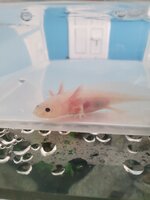
This was the best I could do. Sorry for weird angles or any blur. The last picture shows it the best
 

Attachments

  • 20210323_145911.jpg
    20210323_145911.jpg
    1.5 MB · Views: 244
  • 20210323_145928.jpg
    20210323_145928.jpg
    1.5 MB · Views: 217
  • 20210323_150105.jpg
    20210323_150105.jpg
    1.3 MB · Views: 243
  • 20210323_150147.jpg
    20210323_150147.jpg
    1.1 MB · Views: 227
Does anybody know what the red could be? It looks like the filaments on his lowest gill stalk are almost gone. They're very short. I also noticed that the gill stalks on the unaffected side are considerably longer than the affected side. I'm not sure if the affected side is receding or the unaffected side is just growing faster. It's hard to tell. I did a tea bath for about an hour yesterday and that didn't seem to bother him. His appetite is still great, so I think I'm going to do another tea bath today for slightly longer.
 
Does anybody know what the red could be? It looks like the filaments on his lowest gill stalk are almost gone. They're very short. I also noticed that the gill stalks on the unaffected side are considerably longer than the affected side. I'm not sure if the affected side is receding or the unaffected side is just growing faster. It's hard to tell. I did a tea bath for about an hour yesterday and that didn't seem to bother him. His appetite is still great, so I think I'm going to do another tea bath today for slightly longer.
at this point, since you have had her tubbed and have been doing water changes daily, Im suspect of a potential bacterial infection. Certain types of systemic infections can cause red spots to appear. She doesnt appear to have spots anywhere else on her body though which is interesting. Furan 2 is a relatively safe treatment you can get at more pet stores. You can also order it online. It's a otc antibiotic that is pretty effective in treating most minor bacterial infections. Since she is still eating and acting normal, that's good.
 
at this point, since you have had her tubbed and have been doing water changes daily, Im suspect of a potential bacterial infection. Certain types of systemic infections can cause red spots to appear. She doesnt appear to have spots anywhere else on her body though which is interesting. Furan 2 is a relatively safe treatment you can get at more pet stores. You can also order it online. It's a otc antibiotic that is pretty effective in treating most minor bacterial infections. Since she is still eating and acting normal, that's good.
Okay, thank you. I will look into getting some right away and continue with the tea baths until I get some, as they seemed to help a little bit. What dosage would you recommend? I've heard of people using it before in small doses but I don't want to do more harm than good by putting in too much. When I do put use it, how long should I leave my axolotl in the water? All day/24 hours, a few hours, or just a couple minutes?

(Edit: I looked it up online. My local petstore says they have some. It comes in a box with 10 packets of powder and the brand is API. Does that sound right?)
 
Okay, thank you. I will look into getting some right away and continue with the tea baths until I get some, as they seemed to help a little bit. What dosage would you recommend? I've heard of people using it before in small doses but I don't want to do more harm than good by putting in too much. When I do put use it, how long should I leave my axolotl in the water? All day/24 hours, a few hours, or just a couple minutes?

(Edit: I looked it up online. My local petstore says they have some. It comes in a box with 10 packets of powder and the brand is API. Does that sound right?)
Yep, thats it.

it's a yellow powder. One packet treats 10 gallons. What I have done in the past is just get a rough estimate of how much water I am using in my quarantine tub and then just sprinkle a little of the powder in. It doesnt have to be exact, but you wont need much. Let her sit in the treatment for 24 hours, then do a water change and add the treatment again. Basically just let them stay in it for about 4 days (changing the water every day like usual). If that makes sense.
 
General chit-chat
Help Users
  • No one is chatting at the moment.
    Sclater94: Could anyone tell me what likely morph my baby axolotl is? +1
    Back
    Top