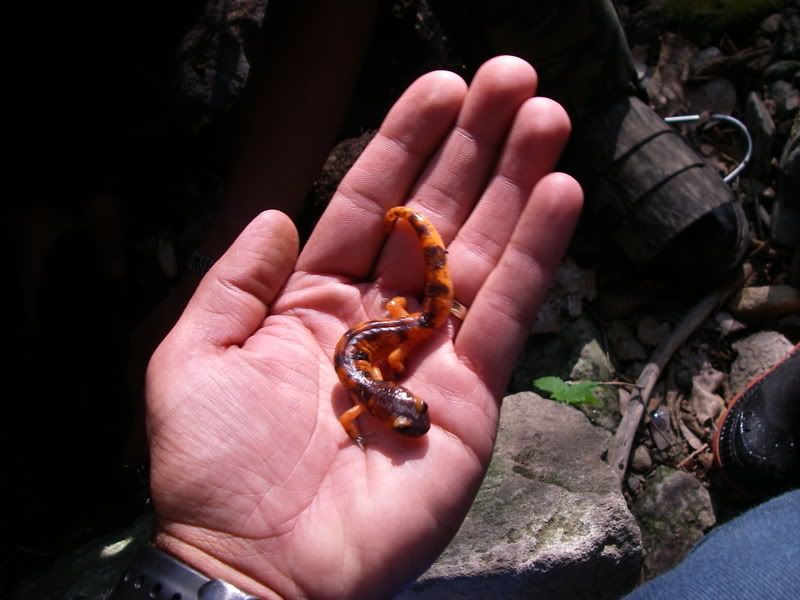
More Pics of Yellow Eyed Ensatinas

D

david

Guest
Couple more pics of my Yellow-Eyed Ensatinas. The longer, thinner one is, I presume, a male; the two shorter, stouter ones (big and little) are females?
I found the two females under a rotting log after the rains in Sonoma County, California.
I found the male under a rotting log, after more rains, a solid month of constant rain later, in adjacent Napa County, California.
What is interesting is that the male is decidedly more pale, while the females are a more striking orange.
I gotta tell you, they are beautiful, but again, these are bo-o-oring pets. I keep putting in crickets, and the crickets keep getting abducted by UFOs. Unless I have hi-tech nightvision goggles, I am never going to see these critters eat!
65443.jpg
65444.jpg
 
males have longer skinnier tails and sexually mature ones will have a squarish snout-sort of dog like. females are 'thicker' and their tails are shorter and wider if they are in good health.

the one in the first photo on the side of the tray escaping is a female. the one on the right in the 's' shape is a male. the smaller one under the male looks like it may be a female.

nice omelette tray, btw, i have one myself
wink.gif
 
That's strange, they dont eat in front of you? As soon as I put crickets in my ensatinas cage they start eating them right away! They dont really walk around looking for theor meals. Based on my observations of my own, they seam to just wait until something gets too close and then they quickly snatch it off of the ground. Once the ensatina has its food in its mouth it is quickly swallowed so if you want see it you have to be pacient (sometimes those crickets can be very sneaky).
 
housing

i was wondering what type of housing you use for these little guys and have you ever breed them?
 
i keep mine on a peat/sand mix with a thick layer of humus and oak leaves with some rotting wood for them to hide under. they do great.

as for breeding them, i have gotten them to breed several times in the past. that is not so difficult. the difficult part seems to be preventing the female from eating the clutch of eggs before you find them. i have so far gotten one clutch to hatch from a female croceator. i knew she was gravid. she disappeared for months and i just let her be. she eventually resurfaced and was very hungry. a few weeks later, i sprayed down the tank and 2 TINY babies came out and were walking around the tank. i was very excited. i know a couple other people on the board have had some luck as well. there are plenty of articles on here about breeding them. you should find enough info.

dosjax, im going to guess you have klauberi. do you keep any other species??
 
i keep mine on a peat/sand mix with a thick layer of humus and oak leaves with some rotting wood for them to hide under. they do great.

as for breeding them, i have gotten them to breed several times in the past. that is not so difficult. the difficult part seems to be preventing the female from eating the clutch of eggs before you find them. i have so far gotten one clutch to hatch from a female croceator. i knew she was gravid. she disappeared for months and i just let her be. she eventually resurfaced and was very hungry. a few weeks later, i sprayed down the tank and 2 TINY babies came out and were walking around the tank. i was very excited. i know a couple other people on the board have had some luck as well. there are plenty of articles on here about breeding them. you should find enough info.

dosjax, im going to guess you have klauberi. do you keep any other species??

Yes. Croceator and monterey :D.
 
i had all 7 subspecies at one point. now i have klauberi, croceator and platensis

-josh
 
General chit-chat
Help Users
  • No one is chatting at the moment.
    Sclater94: Could anyone tell me what likely morph my baby axolotl is? +1
    Back
    Top