Pinky Extermities / Nerves?

the1banana

Member
Joined
Jun 11, 2019
Messages
39
Reaction score
5
Points
8
Country
Canada
This might just be my OCD and anxiety kicking up, but I just want to make triple sure nothing here is going wrong.

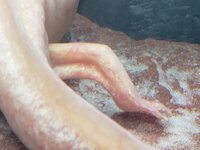
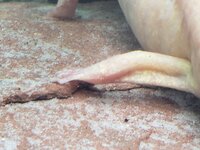
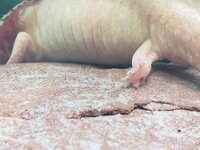
Basically, I've noticed that my gold axolotl's legs are a bit pinky near the end, and on closer inspection, you can see visible nerves. His left foot also has a distinct black dot (I know black toes are normal).
Is this a sign of anything, or am I just paranoid and this is a natural coloration / natural result of how transluscent their skin can be?
 

Attachments

  • 20220820_180003.jpg
    20220820_180003.jpg
    1.7 MB · Views: 544
  • 20220820_180011.jpg
    20220820_180011.jpg
    2.1 MB · Views: 171
  • 20220820_181136.jpg
    20220820_181136.jpg
    2.3 MB · Views: 171
Ammonia at 0, Nitrites at 0, Nitrates at ~10 PPM
pH is about 7.6, KH is fine, and GH is a smidge lower than it should be.
 
You have more than one axolotl in the tank? I saw your other thread and there was a leucistic in the tank.
 
No, just one axolotl. I don't believe I mentioned a leucistic ever, it's always just been one gold axolotl. I know they aren't particularly sociable and can be territorial, so I've avoided getting two.
 
Your picture here shows an axolotl with black eyes.

That's a leucistic, not a gold. Unless that's someone else's tank, I'm tempted to say it's not normal. If it is a golden albino, then it seems to look like normal coloration based on photos though veininess can indicate bacterial infection or chemical burn. If your axolotl is the leucistic in the photo in your other thread, then the veininess does not seem normal.

Other factors could be impaction or injury.

Has he been eating?
 
Oh, lmao! That's a weird visual glitch or a tiny fragment of driftwood that just positioned itself very conveniently. Zoom in and you'll see.
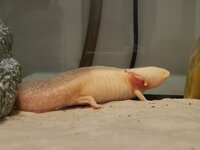
Puck has never had black eyes. They've always been vaguely pink, and you can hardly discern them at a distance. My mother has joked that I should get a sharpie and give him proper eyes. I've attached a photo from about half a year ago to reference.

He's always been a gold axolotl. Speckles and everything.

then it seems to look like normal coloration based on photos though veininess can indicate bacterial infection or chemical burn
Is it severe enough to merit fridging, or should I wait it out a bit? A chemical burn would be odd, I retested the water chemistry this morning and found nothing off.

Other factors could be impaction or injury.
Has he been eating?
This seems possible, though I've had some strange experiences with Puck feeding schedule-wise. From what I gleaned, healthy axolotl body weight/size should be slightly thinner than the head, to slightly thicker than the head. Puck's never gone underweight (though he has gotten a little fat at one point), and he's gone between every other day to once a week when it comes to earthworms, with the longest stretch being a worrying ten days, after which he continued to eat every 3-4 days with no issue. Tried to feed him again this morning, and that would make it about the fourth day.

The last possible thing I can consider based on what you linked is that perhaps there's some minor stress from the introduction of new elements to his tank. I've added a portion of plants and stones and lighting. But the weird part about that is that he really seems to like hanging out near them, and blithely ignores the lighting and opts not to use either hide provided when the "daytime" cycle is on. So if he's stressed, he's not showing it (no frantic swimming, gills not curved forward).

Maybe this is normal and I'm worrying over nothing?
 

Attachments

  • 20220218_215452.jpg
    20220218_215452.jpg
    2.6 MB · Views: 177
It's probably just normal coloration then. Many golden albinos I've seen seem to be more veiny.
 
Got it. Thanks for the resources, they'll equip me well in the future!
 
your axolotl is what is called a golden albino, this is noticeable by the lack of colour in the eyes.
albinos and leucistic have semi translucent skin so blood vessels are very easy to notice, which is what you are seeing on your axolotls legs.
do you have an air stone in the tank? his gills seem to be a bit reduced so additional oxygen would help.
because axolotls love to dig around it is very important that the sand is regularly turned over to prevent any muck/bacteria build up that an axolotl will get a face full when digging.
the dark patch is only on the surface of the skin and is unlikely to be harmful.
make sure that he has the option of plenty of dark places to go into if he chooses to.
how was the water parameters measured ie.. test sticks or liquid ?
 
do you have an air stone in the tank? his gills seem to be a bit reduced so additional oxygen would help.
I don't, but I could get one and see if that helps with that. His gills have always been a bit small, and the middle one on the right side has always been kind of dinky (almost loose, kinda drifts).
because axolotls love to dig around it is very important that the sand is regularly turned over to prevent any muck/bacteria build up that an axolotl will get a face full when digging.
I'll make a note of that, thanks! How often would "regularly" be?
make sure that he has the option of plenty of dark places to go into if he chooses to.
I've provided hides, yeah.
how was the water parameters measured ie.. test sticks or liquid ?
Liquid testing kit. If you'd like to know specifics, the Freshwater API Master Testing Kit, and the KH/GH API set as well.
 
the sand should be turned over every week before removing water during a water change.
it's good that hides are provided.
I ask about test kits because a lot of people use test strips then find that their parameters are way off, so now it tends to be a routine question.
the only thing I could add apart from air stones would be to consider using holtfreters solution but without the calcium chloride and bicarbonate of soda and adding magnesium sulphate, link here.. Axolotls - Requirements & Water Conditions in Captivity doing the same as the author at 50% with 0.1g magnesium sulphate but without calcium or bicarb, this will add the required salts and minerals for good health.
 
The sand should be turned over every week before removing water during a water change.
Noted, thank you.
Got it. Would you consider holtfreter's a better solution than using KH/GH buffers? From what I was told in a previous thread, it's an either/or situation.
Also, why omit the calcium chloride and bicarbonate soda, and add magnesium sulfate?
 
if your water is hard ie.. high kh then you already have calcium carbonate in the water (calcium chloride + bicarbonate of soda = calcium carbonate), if your water is soft then it would benefit from have calcium chloride and bicarbonate of soda, if your water is in between then adding the two chemicals would be up to the owner although hard water won't harm an axolotl but soft will.
as to adding magnesium sulphate, just like salt, calcium and potassium it is a mineral that is found in a natural habitat and it will also improve the gh level (gh, ie general hardness is the combined calcium magnesium level)
kh buffers add carbonates ie.. bicarbonate of soda and gh improvers add calcium and magnesium all of which are in holtfreters solution.
 
Just to be ultra clear on proportions, I should be creating 100% Holtfreter's Solution which is composed of:
3.46g/L NaCl
0.05g/L KCl
0.1g/L CaCl2
0.2g/L NaHCO3

As you mentioned, it would be good to omit the Calcium Chloride and Bicarbonate soda if my water is already hard, in proportion based on the hardness KH/GH tests I run on the tap water I supply to the tank. On top of completing Holtfreter's, I should also add 0.2g/L MgSO4.

Is that accurate?
 
Just to be ultra clear on proportions, I should be creating 100% Holtfreter's Solution which is composed of:
3.46g/L NaCl
0.05g/L KCl
0.1g/L CaCl2
0.2g/L NaHCO3

As you mentioned, it would be good to omit the Calcium Chloride and Bicarbonate soda if my water is already hard, in proportion based on the hardness KH/GH tests I run on the tap water I supply to the tank. On top of completing Holtfreter's, I should also add 0.2g/L MgSO4.

Is that accurate?
for 100% yes but unless your axolotl is ill 50% should suffice. for more info also read https://ambystoma.uky.edu/genetic-s...Issues-1-12/archive/Issue 3/09-16brothers.pdf
 
Got it. As a parting question, what is a good source for the chemicals described?
NaCl seems like it would be easy to get but I'm aware that actual table salt is not NaCl but also contains a variety of anti-caking agents and stabilizers. Similarly, I have no idea where to get the other stuff for an aquarium context.
 
I tend to get my chemicals of ebay, I also use unrefined fine himalayan salt although because it can cause cloudiness plain marine salt should be just fine.
 
General chit-chat
Help Users
  • No one is chatting at the moment.
    RyanLHawk: Spotted +1
    Back
    Top