Questions about water parameters

victoriakallgren

New member
Joined
Jan 7, 2022
Messages
3
Reaction score
0
Points
1
Location
Oregon
Country
United States
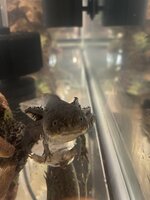
I have a lovely axolotl named Dragonfruit that has been in her tank since May 2021. I had to do about a 90% water change on her tank to move it from the stand that broke to a new stand. Since I was in a major hurry to move the tank before it fell from the table, I didn’t save any of the water I pulled off and then did another stupid move of not testing the city water prior to filling the tank. When it rains heavily here our city water switches from mountain runoff to well. With the well water comes much higher ammonia and chlorine levels. I use Prime to treat the water. Testing the water after treatment with a API freshwater master test kit, I’m getting 1.0 ppm total ammonia, 0 ppm nitrite levels, 40 ppm nitrate, and pH of 7. Her tank temperature is 66.4 degrees F during the day and about 61 to 62 degrees F at night.
Is it safe to put her back in the tank with ammonia levels that high? How badly is this going to throw off the nitrogen cycle? I don’t have any live plants in the tank at the moment because my green thumb is black. If plants would help, what do you recommend?
 

Attachments

  • 839E4E6D-1F87-4FE2-BE31-0339C0051F0C.jpeg
    839E4E6D-1F87-4FE2-BE31-0339C0051F0C.jpeg
    1.2 MB · Views: 602
Hi,
You seem to have already good knowledge about aquariums and axolotls.
I'll try to propose you some answers :
I use Prime to treat the water.
Prime is usually efficient to treat against chloramine. Chloramine is separated in chlorid, which is neutralized, and ammonia. Ammonia probably reflects high chloramine in tap water.
Testing the water after treatment with a API freshwater master test kit, I’m getting 1.0 ppm total ammonia, 0 ppm nitrite levels, 40 ppm nitrate, and pH of 7. Her tank temperature is 66.4 degrees F during the day and about 61 to 62 degrees F at night.
Most of total ammonia is under the form ammonium (NH4+) which is not very toxic. The real toxic form is free ammonia (NH3), which is in minority.
Very goof idea to test the pH. At pH 7, free ammonia (NH3) is less than 1/100th of total ammonia (<0,01 ppm).
So no concern.
Is it safe to put her back in the tank with ammonia levels that high? How badly is this going to throw off the nitrogen cycle? I don’t have any live plants in the tank at the moment because my green thumb is black. If plants would help, what do you recommend?
On the photo you joined, ther seem to be a sponge filter. Moreover, you have some nitrates and zero nitrites. So we can suppose your filter is already cycled. This filter should "digest" the ammonia/ammonium.
(I must admit I have not much knowledge on filters, so I hope other people will also give some answers on it)
Nevertheless, if you consider having live aquatic plants, I can cite some easy and fast growing plants usually easy to find :
- Egeria densa (south american elodea),
- Ceratophyllum demersum (hornwort)
- Pistia stratiotes (water lettuce)
Lemna minor (duckweed) also do a good job eliminating ammonia and nitrates but it's very difficult to eradicate when you're fed up with it.
Microsorium pteropus (Java fern) and Vesicularia dubyana (Java moss) are also hardy plants but they are not growing very fast.

Fast-growing aquatic plants uptake ammonia directly.
Of course, aquatic plants need light to work well.
 
Hi,
You seem to have already good knowledge about aquariums and axolotls.
I'll try to propose you some answers :

Prime is usually efficient to treat against chloramine. Chloramine is separated in chlorid, which is neutralized, and ammonia. Ammonia probably reflects high chloramine in tap water.

Most of total ammonia is under the form ammonium (NH4+) which is not very toxic. The real toxic form is free ammonia (NH3), which is in minority.
Very goof idea to test the pH. At pH 7, free ammonia (NH3) is less than 1/100th of total ammonia (<0,01 ppm).
So no concern.

On the photo you joined, ther seem to be a sponge filter. Moreover, you have some nitrates and zero nitrites. So we can suppose your filter is already cycled. This filter should "digest" the ammonia/ammonium.
(I must admit I have not much knowledge on filters, so I hope other people will also give some answers on it)
Nevertheless, if you consider having live aquatic plants, I can cite some easy and fast growing plants usually easy to find :
- Egeria densa (south american elodea),
- Ceratophyllum demersum (hornwort)
- Pistia stratiotes (water lettuce)
Lemna minor (duckweed) also do a good job eliminating ammonia and nitrates but it's very difficult to eradicate when you're fed up with it.
Microsorium pteropus (Java fern) and Vesicularia dubyana (Java moss) are also hardy plants but they are not growing very fast.

Fast-growing aquatic plants uptake ammonia directly.
Of course, aquatic plants need light to work well.
Thank you so much for the information. I will go get some water lettuce today. Can it be put directly into the tank or does it need some prep?
 
Thank you so much for the information. I will go get some water lettuce today. Can it be put directly into the tank or does it need some prep?
Almost no preparation needed. Just cut off dead parts, and check for hitch-hikers in the roots : snails (some can be useful in an aquarium), leeches,...
 
General chit-chat
Help Users
  • No one is chatting at the moment.
    There are no messages in the chat. Be the first one to say Hi!
    Back
    Top