Tropical salamanders

caudataman

Member
Joined
Feb 6, 2001
Messages
198
Reaction score
14
Points
18
Location
New York
Country
United States
Display Name
Brian
Just a quick question for those in the know...With the ever expanding supply of dart frog varieties, why have we not seen a similar increase in availablity of tropical salamanders? With the wonderful variety of coloration and interesting adaptations and behaviors I would think there would be an incentive for field collectors to bring these to market along with the frogs, but outside of Bolitoglossa dofleini , there are rarely any available. Any ideas as to why? I have heard B. dofleini horror stories in terms of import mortality, but I have also heard that other species have had better success with the few who have seen/kept them. Just wondering...
 
It would be nice. I personally enjoy creating hot(er) humid vivaria for tropical plants but I prefer newts to PDF's. This would be a bteer mix for me but I will not hold my breath.
 
Bolitoglossids just die in captivity. Ed is the only person I've heard to keep them alive for any length of time, and (I think) it was only for 2 years.

Also, from what I gather, they're pretty hard to find.
 
It was longer than 2 years closer to 5 years but there were some other people that kept them alive for a period of time.

They do not really like hotter terraria.. you would still be keeping them no warmer than the mid 70s F for the most part.
In general they are only found in limited numbers and most have really restricted ranges making any collection of them potentially really destructive to the populations.

Typically the ones that have been coming in are either B. mexicana or B. dolflini and both typically have a short life span usually dropping thier tails and dying in a matter of weeks to at most a couple of months.
They have now both been reported coming in infected with chytrid and on necropsy few have any fat bodies indicating that they have been starved for significant periods of time. Establishing them requires a lot of effort and usually veterinary support.
Due to the conditions of all of the ones I have seen for sale, I do not recommend anyone buying any of these imports at this time..

Ed
 
The last time that I remember seeing any was at a show about 3 to 4 years ago. After the show had closed on Sunday I was waiting around on a friend and was talking to a dealer who had quite a few B. dolflini left over, probably around 20 or 30 if memory serves. Anyway he offered the lot to me at cost but I declined. I was a little tempted but I remembered the warnings posted on this site about chytrid being strongly associated with Bolitoglossa and I did not want to risk bringing it home to the Tylototritons. I still think that it would be an interesting project at some point in the future however.
Chip
 
Dear all
Actually, these animals don't seem to be so difficult to maintain. We have some Bolitoglossa platydactyla for years and have succeeded in reproducing Pseudoeurycea cephalica and Chiropterotriton terrestris. Many of these animals live exactly like Plethodon and are quite easy to keep. Some species are so rare now that they can be kept only for a reproduction (reintroduction) program.
 
Hi Jean,

They aren't hard if a person can get healthy animals, the problem is that the ones in the US pet trade have been badly mistreated and have a horrible death rate. Even experienced institutions (like the National Aquarium in Baltimore (NAIB) had a issue with imported B. mexicana (they came in with chytrid) and lost all but one despite prior experience with this species and significant medical support.

Ed
 
Hi Ed
Yes, I know. This is terrible.
 
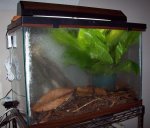
Here's how I'm keeping 2.2 dolfini. The substrate is relatively dry but the humidity is at ~95%. I acheive this by placing a thermostatically controlled heat source under the enclusure directly under a flat clay pot bottom full of water. As the clay absorbs the water the heat increases the evaporation rate, thus the humidity. The temp only fluxuates between 72-76F. I'm feeding them crickets which are dusted with a calcium supplement twice a month. The bark slab on the left is actually two slabs laying on each other with the inner surfaces facing each other to create cover. They seem more content in the magnolia leaves though. So far so good.
 

Attachments

  • dolfonisetup.jpg
    dolfonisetup.jpg
    340 KB · Views: 1,419
General chit-chat
Help Users
  • No one is chatting at the moment.
    There are no messages in the chat. Be the first one to say Hi!
    Back
    Top