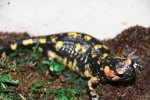
Identification of fire salamander

boylobster

New member
Joined
May 1, 2010
Messages
9
Reaction score
0
Points
0
Country
United States
Can anyone tell what type of fire salamander this is....Portugese? Had him for about 3 months and feeding crickets and nightcrawlers
 

Attachments

  • IMG_0170.jpg
    IMG_0170.jpg
    87 KB · Views: 3,283
  • IMG_0189.jpg
    IMG_0189.jpg
    126.8 KB · Views: 2,605
Salamandra salamandra gallaica.
Is not necessarily portuguese, it could be from Galicia, and although i´m not too familiar with these, i´d think this is a northern form, therefore from Galicia.
 
Last edited:
Looks like a galliaca from Grandola to me.
 
So southern?
Well as i said, i´m no expert xDD
S.s.gallaica for sure, though.

May i ask, was this one sold as an adult? I wonder if the smuggling of illegally caught S.salamandra is continuing in the US.... Seems to me it had subsided for a while.
 
Im no expert either, more a knowledgeable enthusiast!! with a somewhat large salamandra collection
 
Purchased as a juvenile. It was captive bred.
 
Last edited by a moderator:
But you said you had had it for 3 months...i´m confused xDD

Ben: a somewhat large Salamandra collection that makes me green with envy :p
 
Last edited:
Its a salamandra gallaica for sure. But I can´t agree with people giving them any of those locations. In fact populations of any salamandra speciality the gallaica are highly variable within its distribution. I´ve been watching and documenting Coimbra gallaica population for a short period and I´ve found out that animals could be astonishingly different within a very small range. I´ve found adult that could be called with no problem of salamandra s. salamandra or even salamandra s. terrestris with no other markings than yellow dots or patches over the black. In another hands I´ve found individuals that had many % of brown on their sides and dorsal parts. And some had huge % of red on their bodies and even others had a mix of all, with brown and red over the traditional salamandra yellow and black colouration. So, even within ~500m2 in Coimbra montains diversity in colourations was so high that in my sincere opinion, without locality data, nobody, at any circumstance can give an idea. In same way that in Oporto and Matosinhos, far northern same thing happens with almost s.s.salamandra individuals and same time, high red ones. Without locality, well, its a gallaica... BTW you shall write it Portuguese not Portugese.

Cheers,
 
General chit-chat
Help Users
  • No one is chatting at the moment.
    There are no messages in the chat. Be the first one to say Hi!
    Back
    Top