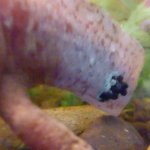
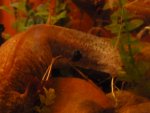
Illness/Sickness: 2 x Floating Axi's 1 with BIG black fungus spot on tail

Bubbakin

New member
Joined
Jun 14, 2009
Messages
10
Reaction score
0
Points
0
Country
Australia
Hi all - needing some advice. Both my normally happy boys are not well - floating around and miserable but still eating. One has a large black fungus growing on his tail. PH level just on the acidic side of neutral with water temp of 18degrees C.

Filtering system is a 'Tetra' canister type with a gentle trickle system for water re-entering the tank.

Problem seemed to really set in when I topped their tank up with water. I have now removed them into separate tub (which is now floating in their tank). I have also covered tank with a towel as they have no cover to hide. I hope to be on the right track for helping their floating but have no idea what to do with the fungus issue.

I have enclosed some photos in the hope that someone can help!!

Cheers :)
 

Attachments

  • Floating Axi's.zip
    1.2 MB · Views: 362
I am not really sure what that growth is. It might be worth seeing a vet.

What are the other parameters? ammonia, nitrite and nitrate?
 
I will speak with my vet tomorrow but don't hold out much hope for his being able to help. He deals mainly with large livestock - living in a rural area has its disadvantages.....

I only have a store bought ph test kit - excuse my ignorance but how do I check nitrates, ammonia etc? :(
 
Regular testing of ammonia, nitrite and nitrate are very important in keeping any aquatic species. I would recommend purchasing a kit ASAP. Don't get test strip ones as they can be inaccurate. Get a liquid test kit such as the API freshwater master kit. They can be pricey but it is necessary and the kit lasts for quite some time. The kit should be pretty easy to use and will come with instructions. It will be good to rule out any water quality issues.
 
Thanks - I will search one out tomorrow.... hopefully the aquarium supply store might be able to help... Its 45 minutes away but worth the drive!!!

Appreciate your advice!!! Hopefully they will get less stressed now that they can touch the bottom of the container!!!! Once I get the additional readings I will post again!!!
 
The containers should hopefully help in the meantime. You will need to conduct daily 100% water changes though to prevent any build up of ammonia. You may find it easier to have a second tub to transfer the axolotls into with fresh dechlorinated water and then discard the water from the first tub and do the water changes that way. Have the second tub filled with fresh water well ahead of time so it is the same temperature as the first tub before you transfer the axolotls.
 
OK - the aquarium supply place tested the water in the tank for me an I can now tell you that the nitrate is 200ppm (which I now know is not good!!!) and the Nitrite is ok at between 0 & 0.5. The ammonia level is ok (?) - does this make sense to you if the nitrate is that high?

The boys seem quite happy at the moment having their feet back on the ground in the tub and I can tell quite easily now that once they eat they definitely poop!! So as far as that goes they seem quite healthy lol. The fungus is another matter - the 'fish' lady at the aquarium shop didn't know what it was from the pictures I showed her and the vet wasn't really interested....

I have gotten some ChemiZee Zeolite which was recommended to add to my canister filter to help remove the nasties from the water but she had no other solution for me...
 
I don't think the growth is fungus but is there another vet you could see?

The nitrate level is alarmingly high. I would be doing water changes to bring the level down (below 40ppm). Live plants also absorb some nitrate but ultimately you need to do water changes. Ammonia and nitrite should be zero in a well maintained cycled tank. How often do you normally conduct water changes and how much water do you change?
 
In the process of doing water changes now with my boys safely in tub of 'good' water.... I had a small epiphany when emptying my dehumidifier water.... I tested the quality of THAT water and found that it is neutral ph... has zero nitrate & nitrites sooo was wondering if anyone else out there has ever used this kind of water with their critters??? The only drawback I can see is that the general hardness of the water is base level 0-30 and I believe that axis like their water on the 'hard' side....

Any thoughts would be greatly appreciated!
 
I would avoid using water from a dehumidifier. I would be concerned that it would lack minerals necessary for axolotls and the issue of hardness. I would stick to dechlorinated tap water and keep going with the water changes and keep the nitrates below 40ppm. In a cycled, well maintained tank ammonia and nitrite should be zero.
 
The boys are both back in their tank and the water quality seem all ok. One has now gone back to the bottom but the other is still floating atm but hoping that it is still in the adjustment phase.

Thanks for all your advise Skudo09!!!! Much appreciate!!! :happy:
 
No worries :) glad I can help.

Which one is still floating? The one with the growth? Has there been any change in the growth at all? It sounds good that one has stopped floating. Hopefully the other one will too soon.
 
Sorry Skudo - Uni became all consuming for a while there....

'Black spot' as I now refer to her is still occasionally floating - mostly tail up. But quite happy, hungry and alert. Her friend can go to the bottom but mysteriously seems to prefer being at the top of the tank and has now taken to sticking his head as far out of the water as he can to stare at me when I approach....? Really not sure what that is all about. He too is otherwise happy, hungry and 'normal'.

I have a closer pic of the black spot - it now appears as a black mass of small spherical balls.....

Have sent pictures off to the Uni of QLD Vet school and the local vet has placed a question to the international vet community to see what we can find.

Water issues now seem to be ok with GH @180. KH @180. PH @7.0. NO2 @0. NO3 is still higher than I like @ between 40 and 80 but no matter what I do I cant get it any lower. Done water changes, added medium to canister filter to take out bad stuff... siphoning off uneaten food... Ammonia levels are fine.

Any other suggestions gratefully received!!! :)
 

Attachments

  • P1000378.jpg
    P1000378.jpg
    109.6 KB · Views: 993
  • P1000412 - Copy.JPG
    P1000412 - Copy.JPG
    148 KB · Views: 767
No worries, I know what it is like sometimes - I am studying vet nursing at the moment.

That growth is certainly interesting but I don't know what it is. It would be interesting to know a vet's opinion.

The nitrate although still a little high is still much improved to what it was before. Have to cleaned your filter out? I found if my filter is not cleaned out often enough the nitrate in my tanks will climb. Of course always use dechlorinated tap water and only just remove debris and a gentle rinse and don't let the filter media dry out so you don't kill off the good bacteria. Don't use straight tap water to clean the filter or this will crash the cycle. Keep doing water changes if you can and spot clean axie poop between water changes. Hopefully your nitrate levels will continue to drop to a safer level.

Some axies do like to float. If it is just their rear end floating she might just need to poo. Is it persistent?
 
The one with the black spot is often tail up but can be grounded... I don't know whether to try the fridge method to see if maybe they are both a bit constipated or have swallowed a bit of gravel.... I have quite large river rock in their tank so they shouldn't be able to swallow that... They are both so FAT!!! I think you may have solved one of my water issues tho - I clean the filter bits out with the garden hose so DOH - of course am disrupting the cycle each time..... now feeling quite stupid lol. (I'm studying social work and have a big exam next Tuesday so back to my books!!!) :)
 
Chlorine will kill your good bacteria, so only rinse the filter in dechlorinated water. A sponge or ceramic filter medium is best - not charcoal.
My question is about water temperature - what is the temperature of your tank? If it is too high, your lotls may have a high metabolism, eating more, and will be more susceptible to fungal infections. They also poop more in colder water, so can get constipated in a tank that's too warm. Temperature should be under 20 degrees celcius (16 to 18 is good).
Bad water conditions (including too high a temperature) can even cause your lotls to morph (signs include floating, breathing lots of oxygen from the air, thickening of limbs, shrinking of gills etc). This is extremely stressful to the lotls and often/usually kills them. I'm not saying this might be happening with yours, just emphasising that it is vital to get your water quality issues solved asap.
 
Temp is normally around 18 degrees C.. and I have just moved them away from the fireplace so that they are not affected by the heat during winter.... I might try putting the frozen water bottles back in like I do over summer and chill the tank down slowly - have never had trouble with them before. I have a canister barrel type external filter with charcoal and about 6 different levels of other filtration media to which I have just added another medium (cant remember its name) to the charcoal to take out nitrates etc. Next time I clean filter I will use de-chlorinated water to see if that improves things so as not to disturb the good bacteria. Thanks Sweetie!!!
 
Would you say your axolotls are more than a few years old?
Abnormal markings and growths are not uncommon among older axolotl. I think this particular growth is uncommon enough that you may not find an answer here and a vet would need to sample it to know for sure. If you do visit a vet be sure to update us as it is peculiar.

A reassuring thought is the location on the tail would likely allow for a vet to amputate if it were necessary. Often times they show up on the head or body, where vets are more unwilling to take the risk of removing the growths.
 
They are around 4 to 5 years old... always been in same tank. Were given to us by a home breeder when they were tiny.... The Vet locally isn't interested in looking at it but has offered to put the pictures I gave him onto the worldwide VIN network to see if there's anyone out there that can identify issue. I will Post again if they come up with anything.... THANKS!!! :)
 
Keep us posted if they do have any idea. It would be interesting to know what the growth could be.
 
General chit-chat
Help Users
  • No one is chatting at the moment.
  • Chat Bot:
    SSV has left the room.
    +1
    Unlike
  • Arlet:
    Hello, may I ask a question here? Or do I need to ask a question somewhere else?
    +1
    Unlike
  • Rorey132:
    Is this guy still available?
    +1
    Unlike
    Rorey132: Is this guy still available? +1
    Back
    Top