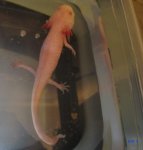
7 month old axie, really stressed looking, wounded tail, won't eat

HitmanSougo13

Member
Joined
Aug 11, 2008
Messages
281
Reaction score
7
Points
18
Country
Canada
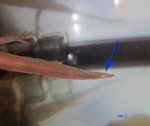
I did notice my new little one was not really eating and he got thin that he went upside down. so I got him to eat. The next day I noticed a bumpy white thing on his tail which looks a little mangled. I suspect he hurt his tail either by biting it himself and had an infection. So I gave him two salt baths and the white thing is gone but he is not keeping food down, he is biting then spitting it out. I did just force feed him now with some liquid form of the pellets, trust me it was the most difficult thing to do to one so young. He is upset of course but when I fed him his mouth looked clean, no signs of infections. Hopefully I got some food in him as that is half the battle to give them energy. Is there other reasons they may initially want to try to eat only to spit it all out?
 
More details: water temp is 16.3 C = 61 F
Parameters are fine : Ammonia-0, Nitrite-0, Nitrate-40
No tank buddy around to bite him
Nothing sharp in his tank to hurt him

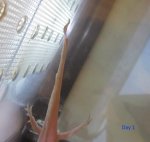
Here are some pictures
Left should be day 1, middle should be day 2, right should be day 3 (most current)

His tail looks pretty mangled up. But I don't think it is fungal
 

Attachments

  • 1.jpg
    1.jpg
    87.5 KB · Views: 768
  • 2.jpg
    2.jpg
    65.5 KB · Views: 1,339
  • 3.jpg
    3.jpg
    77.2 KB · Views: 2,504
He might have bitten his own tail. While a salt bath is good for fungus, it shouldn't be the first thing you try unless its severe. Try to get indian almond leaves because his skin in general looks a little irritated. Also the nitrates are a little high. 40ppm is usually the maximum allowed in a tank, you should be doing water changes to bring that down.
 
As above, skin looks burnt, salt bathing may irritate it, almond leaves would be kinder.
 
Did I miss a new trend with almond leaves? Never heard of this process. When was it discovered it has medicinal properties for axolotls?

He has the motivation to eat! :happy: I bought those giant raw scallops at the seafood sections and cut up pieces for him. Of course now that literally all he would be willing to eat during his sickness and now won't take pellets.

The tail looks even more mangled up at the end but no actual signs of infection. More like it was bitten to the point the bone is broken so it is kind of a twist garble of necrotic flesh. I am hoping the tail end will fall off or heal.

Duly noted about any more salt baths as his skin looks kind of thin.
 
Almond leaves are not a new trend, they are a proven to treat and prevent fungal infections, they are a milder treatment than salt bathing. As your axolotl has no signs of fungus almond leaves should suffice.
 
I don't know that anyone has actually studied the effectiveness of Indian Almond Leaves, but they have been used for ages by amphibian and fish enthusiasts and seem to be pretty effective, at least anecdotally.

As mentioned above, frequent water changes to get the nitrates under control are in order. Also make sure other things that could be stressing him are taken care of - does he have enough hides? Is the water filtered, and if so is the filter current slow enough?

Was he eating mostly pellets before?

I wouldn't worry about what he eats while he's recovering, so long as he is eating. Let him enjoy his scallops, and when he is feeling normal and looking healthy again, you can let him go a few days without scallops and try him on his normal food again.
 
Like everyone has said his skin looks irritated, dont do salt baths unless you know there is a bacterial infection
Do a decent size water change and keep his water parameters up and hopefully he will feel more comfortable and start eating

How are you dechlorinating your water?

as for studies...
just found this, not sure who did it but here is a small study done on a very small number of tilapia eggs

http://wwwlib.teiep.gr/images/stories/acta/Acta 678/678_25.pdf

CONCLUSIONS
Evidence to date has suggested that the water extract of the leaves of Indian
almond contains the positive effects for the treatment of fungi, bacteria, and fish
ectoparasite. Therefore, this could be used as an alternative treatment in place of
chemicals and antibiotics in treating fish pathogens. The immune response mechanisms of
these activities and the advanced methods to purify active ingredients should be further
studied. Additional toxicological and efficacy studies must be elucidated before
commercial use is accepted because this herbal extract should be recognized as safe for
both fish itself and consumers. Full-scale trials in farms subsequently will be conducted.
These results might be applied for other aquatic organisms.
 
General chit-chat
Help Users
  • No one is chatting at the moment.
  • Chat Bot:
    SSV has left the room.
    +1
    Unlike
  • Arlet:
    Hello, may I ask a question here? Or do I need to ask a question somewhere else?
    +1
    Unlike
  • Rorey132:
    Is this guy still available?
    +1
    Unlike
    Rorey132: Is this guy still available? +1
    Back
    Top