

Jefferson
Active member
- Joined
- Apr 21, 2012
- Messages
- 196
- Reaction score
- 84
- Points
- 28
- Location
- Southwest Missouri
- Country
- United States
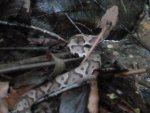
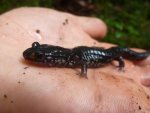
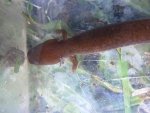
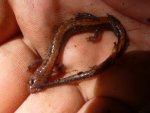
Last week, the Springsteen was blaring loudly as I rolled south across the Buckeye State back toward the ever-inviting hills and mountains of Appalachia. My adventure started in the Great Smoky Mountains, which were smoking as heavily as John Boehner when I arrived, mostly owing to the rain shower that had just passed. The Poplars, Rhododendrons, and Red Spruce filled the car with fresh, sweet mountain air at the first stream, where I found Imitators, Santeetlah Duskies, Black-Bellied Sallies, a few Gyro (Blue Ridge Spring) larvae and fresh bear scat, which halted my search there. After a long and beautiful drive out of the mountains, I bunked up and prepared to go into another holy land of salamandering, albeit an underrated one-let's just say it's the one where another young naturalist didn't have such good luck on the trails. The next day high in the misty mountains of North Carolina saw a Northern Gray-Cheek, a White-Spotted Slimy, a gaggle of Blue Ridge Mountain Duskies, a Weller's Salamander that could only be found by attempting the kind of rocky, ridiculous trails that Bear Grills finds himself on from time to time, but it was Worth it. We also found some Pygmies with the help of a kindly young naturalist, but one event earlier in the day still befuddles me. As I was flipping rocks in a little roadside seep before being scared into tumbling fifteen feet down the mountain by a boar-like grunt to my right, I spotted a Blue Ridge Red Salamander, six inches long and fat, just sitting on top of the leaf litter. Son of a gun, I thought, he won't stay like that long, I'd better get pics and video of him now. That I did, but what I didn't realize was that this salamander was dead in an area that I had not stepped in yet, with no visible signs of a struggle except an irregular-looking eye. In my seven years of herping, it's the darndest thing that I've ever seen. Anyway, that was a heck of a good day high in the mountains, but I was headed up into Central Virginia on I-77 and 81, which is a sort of monotonous drive. One sign, however, did catch my eye. As you drive I-77 north through the most rural land in the state of Virginia, a sign announces, "Now entering Virginia technology corridor." Let me just say that if the cattle, barns, and two-lanes that I saw in the distance constitute the technology corridor, Old Dominion is in some serious trouble. The next day, at a non-descript spot somewhere off of the Blue Ridge Parkway, I stopped at a springhead and was able to nab two-lined sallies, a dusky, and a Northern Spring larvae the size of Texas. However, that was nothing compared to my excitement an hour later, as a backwoods connector trail to the AT saw me find White-spotted Slimy and Peaks of Otter Salamanders, one endemic to a very small area and the other one of my target species! My brother later remarked that Roanoke probably heard me when I yelled "Peaks of Otter" and started doing a jig on the mountainside (in retrospect, probably not that smart to do on a steep hillside with Copperheads and Rattlers!). After that, I saw Appomattox, almost saw Monticello but scoffed at the $75 fee not because of the cost but out of principal. Just a quick aside, but isn't it the ultimate sign of our backward approach to public domain when we bail out banks and let the government take control of student lending but make education and our national heritage private enterprises? Well, that's that. Up in the sweltering Washington, D.C. area (a very pleasant place in July if your idea of paradise is the Sonora with some humidity), I only managed to see Bull Run battlefield and a few Green Frogs. The next day would see me back in Appalachia, but the northern Blue Ridge. I spotted a Shenandoah Salamander high on a talus slope after only seeing red-backs in the lowlands, got a Scarlet Tanager, and headed over the 15 mph curves of the Alleghenies of West Virginia, where the fragrant spruce forests were kind enough to yield Allegheny Mountain Duskies, Red-backs, and a gold-speckled, black-bellied Cheat Mountain Salamander, endemic to Eastern West Virginia, before I exited to the west and saw such signs as "Fink Run Road," "Speed Limit-0" and a rock with cones around it. Only in West Virginia. Although the Shenandoah and Cheat Mountain were stupefying and altogether invigorating, the thing about them is that they look so darn much like Red-backs. My Cheat Mountain had the usual gold flecking on the head, but only sparse flecking on the body, so I had to wait until we had cell coverage to confirm it by the fact that its belly was completely black, which was sort of anti-climactic. My next and last state was the Bluegrass State-Kentucky. The long drive out there was anything but exciting, but once off the highway in rural Eastern Kentucky, you sometimes wish for it back. Not only do these roads have switchbacks, they get narrower and wider without warning or purpose right next to fifty-foot drop offs. My Dad summed it up best with a Yogi-Berra-esque saying, "Why do these drop-offs have to be so droppy-offy?" It took us about an hour to drop into our first spot, where the horse flies are bigger than the salamanders. I only found Two-Lined Salamanders in the first stream, but hit Black Mountain Salamanders and a Northern Water Snake in the next one before hearing another loud noise. Still in search of Kentucky Spring Salamanders, I decided to try another creek that I had heard about before dinner. Well, after a few Duskies, I saw something much scarier than that Kentucky Spring in a side seep. As my brother and I were walking up the hillside seep flipping rocks, he looked up, grabbed my arm, and pointed only five or six feet in front of us. There sat a Northern Copperhead! After the initial fear, I got back close enough to get a shot or two with the camera, then hit the trail back thinking of how I had just remarked to one of my friends before the trip that I wanted to see a venomous snake from a safe distance in the wild. Yes, but, what's that blood on my leg? I saw a puncture wound with another small scratch about a third of an inch away! Had the snake tagged me and I had not felt it? I suddenly was filled with fear, and looked up Copperhead bite symptoms. Even though I was not in intense pain as most are, my mind began racing and I brought a severe headache on myself, further compounding my paranoia. However, when twelve hours passed without any neurological symptoms, I felt ready to hike and try for Green Salamanders. To that end, I was unsuccessful, finding only skinks, a few Box Turtles, and a few more Black Mountain Salamanders in four hours of staring into rock crevices with a flashlight. Good god, that is a kind of herping that requires patience beyond that of a monk! Filled with funny stories about stupid signs, curvy roads, salamanders, and snakes, we headed home. I have so many pictures it'll be difficult to pick just a few, but here it goes. Here's to another year of Appalachia-America's greatest wilderness and best-kept secret.
Attachments
-
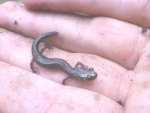 cheat 5.jpg74.2 KB · Views: 449
 -
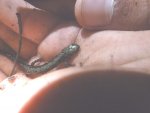 peaks 2.jpg64.1 KB · Views: 438
 -
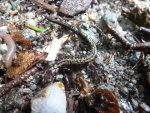 Vacation 2014 072.jpg144.5 KB · Views: 401
 -
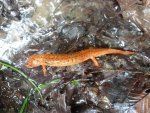 Vacation 2014 038.jpg147.4 KB · Views: 405
 -
 Vacation 2014 263.jpg171.6 KB · Views: 381
 -
 Vacation 2014 059.jpg68.3 KB · Views: 378
 -
 Vacation 2014 104.jpg89.8 KB · Views: 386
 -
 Vacation 2014 152.jpg149.5 KB · Views: 375

