Anaemia or something else?

Platterpus

Axolotl Enthusiast
Joined
Mar 24, 2008
Messages
80
Reaction score
3
Points
0
Location
Adelaide, Australia
Country
Australia
Display Name
Brendan & Kerri
We have been perplexed by the strange colour changing of one of our baby leucistics. :confused:
Of the approximately 60 axolotls we raised, most (about 50) were leucistics – a mix of xanthic and non-xanthics – plus about 10 albinos, including 2 xanthic albinos. They are now nearly 5 months old.
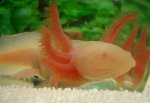
One of the babies caught our attention because it was ghostly white in colour, whilst all the others were a healthy pink colour with bright red gills (see our avatar pic/baby pics). The ghost baby has been isolated for some time now, and he seems to change colour quite regularly!!
Some days he is pink and indistinguishable from any of the other leucistics, other days he is ghostly white – even his gills! We suspect he may be anaemic?
 

Attachments

  • freak.jpg
    freak.jpg
    98.8 KB · Views: 1,024
HI,

it´s a very cute little axie and I don´t think that he´s anaemic. When axies are in rest they become paler, even the gills may become a whitish color. No reason to worry about.:D

-Tina-
 
Callina is right, and that is an exceptionally marvelous Axolotl you have there.
 
Thanks for you comments.
I still believe that the colour changes are way too dramatic to be just "resting" though. Infact, he was extremely annoyed and frantic before I took this picture - I had to wait several minutes for him to stop thrashing around to get a clear photo... He definitely wasn't resting!
His ghost phase can last for days, meanwhile he continues to eat and swim like normal. Then he turns pink again for a few days...
I will try to get a picture of him when he turns pink again for comparison! None of his 60+ siblings make this dramatic colour shift even when they rest - he was very obviously different from the all the others!
 
I do think this is a bit odd. As you.ve pointed out none of the others are like this. I have a gold who goes pale for a day or two, his gills lose colour and dont brighten even when feeding etc. A day or two later his gills are back bright red. I'm sure its nothing to worry about, but if you are concerned you could take him to a vet for a check up. Mel
 
Whatever the issue is, I can't get passed this axolotl's awesomeness...you definitely have a stunning and remarkable animal on your hands.
 
My axolotl does exactly the same thing, it seems to occur on the day I don't feed them as I feed every other day, as soon as he has eaten he goes nice and pink again so I don't think there is a need for concern unless there is any other sign of illness..

I have to agree with Shizeric - it certainly has exceptionally long fluffy gills!! CUTE!!
 
My axolotls (and even some of my other species) have gone pale for days at a time. I think it's just a fluke. My Triturus karelinii did it all the time.

Also, as a side note, can you be sure you had axanthics? Non-albino axanthics often fail to thrive and die within a few days of hatching.
 
Sorry for hi jack, but kaysie how can you tell an axanthic? Also i have some albino babies with non shiney eyes would these be melanoid albino?. I can make no sense of any of the genentics i've read! Mel
 
yes Mel, axies without a shiney eye ring are melanoid, because of the loss of iridiophores ( the shiney pigments)

-Tina-
 
Axanthics lack yellow pigment. They are intrinsically weak, and I believe the same chemicals present in xanthanin are integral in kidney function (although I could be mistaken).
 
How could you tell an axanthic from an albino leucistic? Mel
 
That would be difficult.

The way I determined I was getting axanthics is that I had a regular die-off of each clutch of maybe 10% of the offspring within a few days of hatching. The best I can figure is they are axanthics as they were definitely leucistics, and usually kind of pale looking.

Axanthism has nothing to do with albinism. An albino can be axanthic, and this combination thrives, while a leucistic axanthic does not thrive.
 
The problem is, that axanthism isn´t visible like the other color varieties. You can only guess that an axie is axanthic if much more of the hatchlings (siblings) died, than usually and from the offspring more larvae than usuallly failures, too.

-Tina-
 
I see, so its hard to actually determine. Thanks guys. The genetics baffle me! So are melanoid albino normalish? Mel
 
Melanoid albinos aren't super-common, but they're 'normal'. It's just expressing the recessive form of two different genes.
 
Hi all. Thanks for the responses and also exposing the shortcomings of my understanding of the genetics!
After discovering the two freaky albinos in our batch of babies, I studied the genetics pages on the axolotl site, in particular the albino page, and reached the conclusion (possibly incorrectly!) that they were axanthic. Hope you can clear this up for me once and for all!

We raised 62 axolotls. 12 were albino, 50 were leucistic. Both parents are leucistics, but have different eyes.

2 of the albinos were obviously different from the others - they were paler and at first appeared completely eyeless. As they grew, the eyes became more visible, yet they were not reflective like all the other axolotls. Now that they are grown the eyes appear VERY red, yet will not photograph clearly, even with a flash (?).
The other 10 albinos had red eyes too, but they reflected and showed up well in photographs. They also had the "gold ring" around the eye, which my 2 freaks didn't.

Are my 2 freaks actually melaniod albinos???

I noticed also that some of the leucistic babys had similarly empty-looking non-reflective eyes, and no "gold ring". These were slightly paler pink to the 'normal' leucistics, but still developed face-freckles - which I assumed was melanin (?).

My (amateur) conclusion was that these axies must be axanthic.
PLEASE help clarify the genetics of our axies - we are really confused now!!!
Have attached pics of the 2 different types of albinos for comparison.
 

Attachments

  • axie6.jpg
    axie6.jpg
    58.1 KB · Views: 1,082
  • axie10.jpg
    axie10.jpg
    56.1 KB · Views: 886
Hi. The ones that looked eyeless sound just like mine. No reflective rings. I've called these melanoid leucistic albino. By leucistic do you mean white with black eyes?. I would say that they are melanoid leucistic non albino. If any of this is wrong please someone shout up. I'm not good with genetics etc. Mel
 
Hi. The ones that looked eyeless sound just like mine. No reflective rings. I've called these melanoid leucistic albino.

Hi Mel,

leucistic albino is a contradiction.;)
Either they are leucistic (white with dark eyes) or albino (red eyes). What you mean is called a white albino and white albinos can be melanoid or/and axanthic, but never leucistic.;)

-Tina-
 
General chit-chat
Help Users
  • No one is chatting at the moment.
    There are no messages in the chat. Be the first one to say Hi!
    Back
    Top