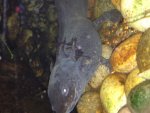
Axolotl gills

Roy

Member
Joined
May 2, 2012
Messages
30
Reaction score
0
Points
6
Location
Guadalajara, Mexico
Country
Mexico
Display Name
Roy
Hi everyone, thanks for reading this post.
I have a 2-year-old female Axolotl and I have noticed that their gills have been deteriorating slightly (they have lost a bit of feather but its stem is not shortened). Despite that the animal does not show other signs of disease (enjoys good appetite, there are no fuzzy lesions in their gills, is active and Is not thiny). The water parameters are in good condition except the pH (is in 8). I measured the pH of tap water and also is in 8 and I think my local waters are too hard. Does anyone know if the this pH affects thereby their gills or is another more serious condition? (sorry for my poor English):( I will post pics soon. Thanks
 
That pH is okay. It should range between the 6.5 to 8.0; with 7.4-7.6 being ideal. It's a little on the high end, so I would keep an eye on it.
I'm not sure if that causes any gill deterioration or not, with it being that level. What is the temperature of the tank? That might be contributing to it.

In my own personal experience, I have seen my albino male's gills fluctuate in fluffiness. Sometimes they suuuuper luscious while other times they seem to be less fluffy. It usually has something to do with the temperature of the water (for me at least).

Hope this helps!
 
Thanks for your answer ArdyBay, the water temperature ranges from 17-19 ° C using a PC fan, otherwise easily surpass 24 °C even in Winter. Ammonia levels are less than 0.02 ppm and nitrate less than 0.3 mg/L. I have live plants (amazonia, vallisneria and java moss attached to a piece of mangrove Tree, The substrate is red Fluorite covered with medium river rocks to avoid the risk of ingestion and impaction. Filter is a powerhead 480 liters / hour adding a bar space to supress the high water flow.
 
I'm no expert on powerhead filters, but your sound pretty powerful.
I'm guessing that your filter puts A LOT of oxygen into the water meaning that your axolotl doesn't need the extra surface area the filaments provide to obtain oxygen.

Hence, a lot of oxygen in the water --> less surface area required --> smaller gill filaments


I hope this makes sense and I used the correct terminology :)
 
Thank you very much for your reply Kim. I thought seriously about the oxygen in the water but not sure ...... perhaps the gills had been reduced in size and feathery because of the O2 but in this case it seems like she was being "bald". I attach some pics ....... Thanks, I'd like to know what is your opinion about
 
Here you can see the way as some of the filaments have disappeared making their gills look battered, note te "L" form and no filaments of the lower gill
 

Attachments

  • IMG_0549.jpg
    IMG_0549.jpg
    81.5 KB · Views: 426
I agree with Kim. If you have a powerhead or lots of aeration in the tank, I wouldn't be surprised that the gills are deteriorating. Try switching to just a sponge filter and see if they come back.
 
General chit-chat
Help Users
  • No one is chatting at the moment.
  • Chat Bot:
    SSV has left the room.
    +1
    Unlike
  • Arlet:
    Hello, may I ask a question here? Or do I need to ask a question somewhere else?
    +1
    Unlike
  • Rorey132:
    Is this guy still available?
    +1
    Unlike
    Rorey132: Is this guy still available? +1
    Back
    Top