Body shape genetics

What is she cutting herself on? I'd be trying to avoid having anything sharp in the tank. I have to do a lot of tank maintenance with these guys because I still have quite a few from their spawn housed together, so they're used to me moving them out of the way and don't struggle when I pick them up.
 
I wonder if the lack of 'fresh blood' in Australia might have something to do with a higher expression of mutations/hidden recessive genes. If there are few or no new imports, you are basically inbreeding axolotls (whether you're trying or not). Relatives mated to each other have a higher chance of passing on two copies of a recessive genes.
 
I've actually tried to be cautious about my breeders for the same reason, they come from three separate sources in two state capitals. I think I'll have to try breeding the sibling dwarves though - if for no other reason than to satisfy my curiosity.
 
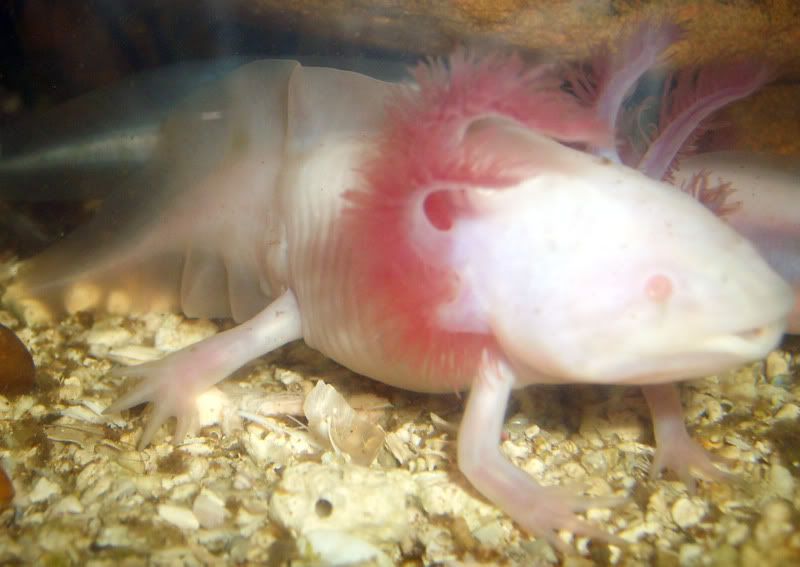
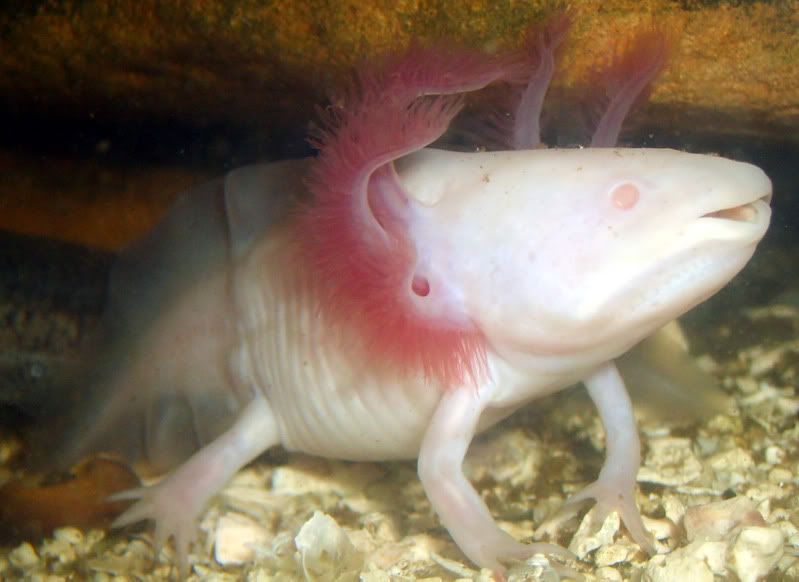
A sib to the those at the start of this thread was accomodating enough to sit at the front of the tank while I grabbed the camera. Apologies for the mucky glass and my lack of photographic ability.

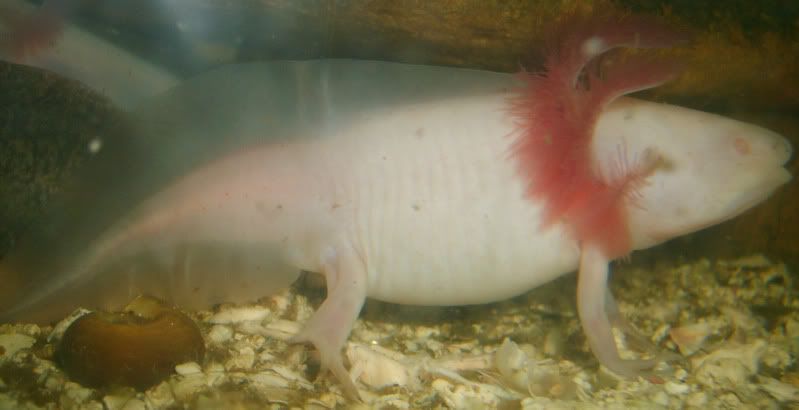
This is a short (dwarf?) melanoid albino - the third shot gives the best angle for seeing the difference in length to a normal axie.

MelanoidAlbinoDwrf.jpg


MelanoidAlbinoDwrf2.jpg


MelanoidAlbinoDwrf3.jpg


I'm still very keen to know if anyone else has these traits showing through as it's hardly likely to be a new mutation and I don't think it's conditions as these guys have smaller sibs kept with them that weren't short for their girth.
 
unrelated to the topic... what are you using for substrate? It looks like crushed shells.
 
The substrate is coral sand, but it's got a lot of shell in there too.
 
Hi peterJ,

You do indeed have a unique and special axolotl friend.

However, i would really recommend you switch your substrate to sand or keep it bare bottomed.

Coral sand isn't appropriate for freshwater tanks. There is another recent discussion somewhere in the forum (you can try the search forum function), to read more about it. In a gist, it can elevate your water's pH, and can render monitoring your water chemistry quite an arduous task, especially when you used it in large quantities exclusively. Furthermore, the sharp chunks may perforate or abrade your axolotl's skin or worse still from inside out, and also runs the risk of impaction.

Thank you for sharing the fantastic pictures and generate such an interesting topic of discussion.

Cheers.
 
Bit of a side issue here but I think that the axolotls look pretty stressed, particularly the melanoid albino. Is it just me?

-Eva
 
I share blueberlin's sentiments, especially with the extremely forward facing gills. Have you checked the water current flow in the tank?
 
Hi Ray,

you seem to be just overflowing with information that I'd be really grateful for if I'd started a thread about substrates. The point of this thread wasn't so much to display my
unique and special axolotl friend
but to discuss wether anyone had come across similar body shape traits (it's a lot easier to follow if you read from the beginning of the thread rather than haphazardly responding to posts). I've successfully raised several hundred axolotls in this setup and kept my breeders healthy for several years (not one perforation or impaction).

Thank you for sharing your condescending and misplaced expertise.

Cheers.
 
Hi PeterJ,

I apologise if my posts had offended you, but i assure you they were not posted with ill intent or to be patronising. I referred to your axolotl as special and unique because of its unusual body shape. In fact, i even thanked you for sharing the picutres and starting that interesting thread.

As for my post about using coral sand as substrate and the forward facing gills, they are also meant with good intention. I only wanted to see you happy with a healthy pet. Our opinions may differ somewhat but the goal is still the same, to raise happy healthy axolotls.

I would have much appreciated if you have contacted me to talk things over rather than receiving a nasty shock on my rep. However, i would take this as a learning experience to phrase my words more carefully.

Cheers
 
PeterJ, I almost pm'd you the first time instead of posting my question but I figured you're going to get lots of comments on your substrate anyways... sorry.

Getting back to the topic...
I raise crayfish and I use crushed coral and oyster shell substrate in my tanks to help keep the ph up. The crushed coral I buy here in the US doesn't look quite like yours but I suspected that's what it was. My ph runs between 8.0 and 8.2 in my cray tanks. I was just curious if your ph is that high as well and if so, any chance it may be effecting the developement of your axies? I've not seen a lot of info on ph effects on axies. If your ph is running high, any chance this is an adaptation? Obviously they have some capability of adaptation to their environments or else they wouldn't morph in poor conditions.
 
Interesting as this mutation is i have to say it saddens me to see that the genetics of this species have deteriorated so much.
Hybridation, cross-breeding, selection of mutants....all this while the original, true species is facing extinction...:(
The kinks on the tail might get worse with age, or can also be a sign that other problems have been transmited with the dwarfism trait.
Even though i know this is not going to have any effect whatsoever.....i would encourage you to avoid spreading this mutation, providing they are fertile or the resulting offspring re viable.

Anyway, fascinating mutation indeed. The dwarf tiger salamander is going to haunt me in my nightmares...Ô_o

On a different note, uncalled for as Darkmaverick´s advice might have been, it was good advice, and i can´t see why it has bothered you....bad reputation was not necessary in my opinion....
 
I'm still very keen to know if anyone else has these traits showing through as it's hardly likely to be a new mutation and I don't think it's conditions as these guys have smaller sibs kept with them that weren't short for their girth.

That's a neat phenotype. I think you'll have to do the crosses to see if it's genetic. If it is, it could be fortunate spontaneous mutation. You could probably do some fun studies with them. I wouldn't rule out conditions or pathogens just yet. The environmental condition doesn't have to result in a high or 100% penetrance. It could be that something was off that resulted in a low percentage of dwarfs in that batch. There's a dosage component that has to be considered
 
Thank you for sharing your condescending and misplaced expertise.
I see nothing either condescending or misplaced in Ray's remarks, or anyone else's. It is not in the spirit of this forum to characterize someone's remarks in these terms. Please don't get defensive, as this is a prescription for forum flames. Please consider the following and realize that others really are just trying to be helpful.

In most cases, forward-facing gills are a sign of serious stress in axolotls. This is well-accepted, and there is nothing wrong with suggesting this could be the case here. It also seems possible to me that these mutants may have oddly shaped gills due to their genetic alteration. We need to consider both possibilities.

Regarding the shell sand, this is well-known to increase pH. There is no harm in anyone questioning whether you are aware of this and monitoring it, or even suggesting other alternatives. If the pH is very high, it could cause stress to the animals. This may not be the case here, but there is no harm in raising the possibility.
 
My apologies Ray and Eva I would remove my previous post but I can't now. I know being overtired isn't an excuse and I'm sure you meant well. I have read axolotl.org and much of the forums here and wasn't looking to have it repeated at me.

The offending substrate was collected from a forested coral cay as part of a geomorph survey. It was part of the 'A' horizon and is estimated to have been in situ, exposed to air and rain, for about six thousand years (estimated from local, late holocene sea level changes). My tank is heavily planted with Valisnaria spiralis, Ceratopteris thalictroides and Dracaena sanderiana. The pH is about 7.5, the temperature sits at 19C (though it was 16C when this spawn hatches). I use a small internal filter with a spray bar so that flow across the bottom is minimal.

I'm not quite sure what 'high proportion' of my axolotls are 'visibly stressed'. There were 7 out of over 150 that show this short body shape, but I have't seen it any axies I've raised (under similar conditions previously). If they were the slowest to develop from the spawn I would have put it down to them being stunted, but they have smaller siblings with a normal body shape that have been slower to develop. I would imagine if it was conditions then other breeders would have seen this, which is why I originally asked if anyone had.
 
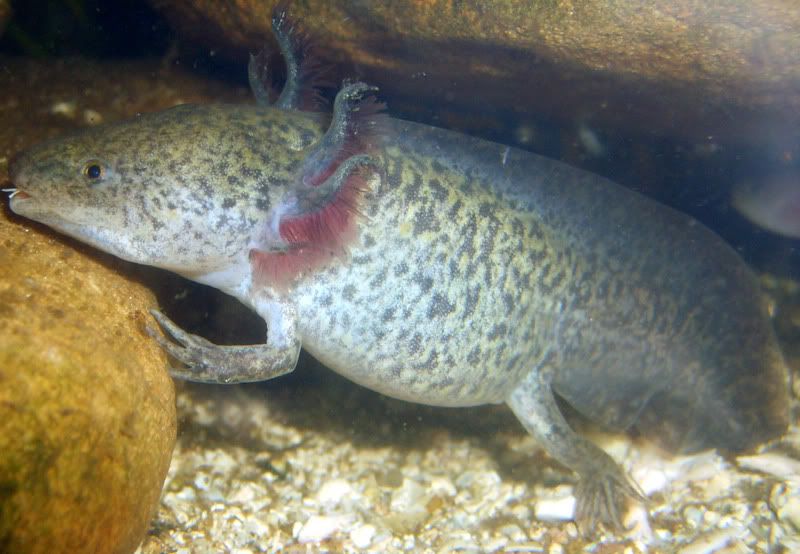
Here's a normal, speckled sibling with a similar body shape and shorter gills kept in the same conditions.

NormalDwrf.jpg
 
I think we can be pretty sure this is genetic. I concur with some though in that I don't think this trait should be perpetuated. It's quite likely a judgement on just how inbred axolotls truly are. I know the old Indiana University Axolotl Colony would have wanted that/those genes but I doubt the Kentucky shadow will be bothered. Still, you never know.

Thanks for sharing.
 
I'm not quite sure what 'high proportion' of my axolotls are 'visibly stressed'. There were 7 out of over 150 that show this short body shape, but I have't seen it any axies I've raised (under similar conditions previously). If they were the slowest to develop from the spawn I would have put it down to them being stunted, but they have smaller siblings with a normal body shape that have been slower to develop. I would imagine if it was conditions then other breeders would have seen this, which is why I originally asked if anyone had.

Just, to clarify my point, since this whole substrate thing popped into this thread, and it may confuse the point. When I said conditions I was meaning a non-genetic explanation such as a fluke pathogen or teratogen entering into your system when these eggs were developing. Like the water supply had a spike in some trace drug(s) at the time, you put a new rock in the aquarium at the time that had some pathogen on it, your cat knocked your Thalidomide bottle into the aquarium...these sort of things. I agree that if it was a simple pH or water quality condition this would be a more common occurance amongst breeders.

Have you bred the parents before and have they thrown a similar number of dwarfs? Are all your axolotls giving you dwarfs suddenly? I'm hesitant to give it a genetic basis until it's proven hereditable, and I think there is mounting evidence that number a number of things out in the environment that can screw with amphibian development. Actually, if it proves not to be hereditable it actually may be cause for some personal caution as you may not want to be exposing yourself to this "condition".

Regardless it is still a neat mutant. If it is genetic but they prove to be functionally sterile, you may have to maintain it in the parental line.
 
General chit-chat
Help Users
  • No one is chatting at the moment.
    There are no messages in the chat. Be the first one to say Hi!
    Back
    Top