Daphnia and brine shrimp questions.

Hi interesting stuff.

I'm not sure if this is allowed but I culture all types of daphnia, from the 6mm D.magna, right down to the Bosmina sp <1mm.

From the UK, I can post to almost anywhere. US included, much cheaper than most suppliers and higher quality cultures.
 
I plan on using daphnia, brineshrimp, and maybe monia. Which subspecies of daphnia is the best? How do I culture monia. Is it similar to daphnia? Is yeast and soy flour a good food source for daphnia? Alot of articles say it is. I dont want to use algae in my room. Also anyone have spare java moss?
 
I was lousy at dosing yeast but found a good alternative food. I used a tea made of stinging nettles as food for Daphnia. Pour boiling water over freshly picked stinging nettles and let it stand for 10 minutes, then drain. You can freeze it in ice cube trays and just use an ice cube at a time.

-Eva
 
Good point. It is actually winter here, too. :rolleyes:

-Eva
 
I would get the isopods, dapnia, and brine shrimp from carolina.com. I know people on this site do not like biological warehouses but they have a good selection and are the only available source for me.
The bio warehouses are OK for things like daphnia (though they will give you small portions compared to other sources). People on this site don't like them because of their treatment of amphibians, particularly wild-caught ones.

Other sources to look at: dallasdiscus.com, Brine Shrimp Direct, Sach's Systems Aquaculture, lfscultures.com, livefoodcultures.com etc. The smaller outfits will usually give you more personalized service than the big bio supply houses will. I've dealt with all of these and can say they are good.

Moina are exactly like daphnia, but smaller. I'd say just get daphnia pulex. The larvae can eat the small ones initially. Yeast and soy flour (I prefer soy protein powder) is fine, but you have to be really careful not to overfeed. Also, you need a pretty good-sized container to raise them.

Do you have a source of live blackworms? If so, you can skip all of this and just use chopped blackworms.
 
fishkeeper got a point - perhaps they are just too small, at least for some larvae and because they sit on a bottom of the tank if you give too much of them there might be no "quiet spot" for larvae to rest.

On the other hand, decapsulated cysts are not moving, so it looks kind of strange to me it that larvae are better of on cysts than moving feed. Movement of prey is very important factor to induce feeding. I didn't have much luck feeding larvae with frozen food just because the prey is dead and still - if I moved frozen daphnia/worms around the larvae usually attacked them without problem, but after few minutes, when everything settled the dead food was ignored.
Maybe you use some trick you can share with us ? :D


Cladocera are usually as good as food as they food - if you stuff your Daphnia with just east, they not as nutritious as they would be if fed algae or yeast/protein mix.
D. pulex babies are size of artemia (D. magna babies are not much bigger), while Moina/Bosmina/Ceriodaphnia adults are only about 0.5-2 times bigger than artemia. In a given volume of D. pulex only some percentage of them are young enough to be not much bigger than Artemia, so you should really sieve them to use as food for very small larvae. If you wont sieve them, the old ones will soon die not eaten and foul the water. With Moina/Bosmina/Ceriodaphnia you dont have that problem - they all small.
Optimum conditions for all Cladocera are similar, some of them need gentler or stronger aeration, a bit higher or lower temperature, a bit more or less light etc.
The best food I found so far is chicken manure fermented for few weeks and added directly to the culture. Horse manure should be just as good, but I've never tried. Manure is rich in microelements supporting very strong population of bacteria and algae (if there is light source) which can support pretty dense continous Cladocera population with no maintenance work involved for months! Longest running culture like this was operational for more than a year without maintenance at all. :D

Very good food are fairy shrimps. Unlike Artemia they live in fresh water, so wont die in few hours, you can have continous culture sieving out babies if you need realy small food.
Depends on species, they nauplea are from half a size to twice the size of freshly hatched Artemia.

DR, what species do you culture ? I am interested in species I dont have in my collection :D
 
So big bucket that you drop compost into every once in a while?

I maintained this local waterflea species(local as in occurs in my backyard in the winter). They get big...maybe 4-5mm but the most interesting thing is that they do not swim around like other daphnia. Most of their time is spent clinging to the sides of the container/on plants. When they do swim, it is not with a jerky motion but rather they move smoothly through the water.

I've tried moina but not much luck with them, or other daphnia besides these ones. 5 gallon bucket of greenwater caused by vegetable refuse, frequent harvesting and water replacement.
 
The bigger the better, I have about 20 litre container filled 3/4 with chicken manure and topped up with water. Its well fermented, so agrsive components of chicken manure are already gone, eaten by bacteria. Whenever I am starting new culture I use about 1-2 kg of manure from that bucket per 10l of water. You could expect drop in Daphnia population density in next 4-6 months, when it happen just add about 0.5 kg of manure without removing the old one. Because the containers are outside, apart of Daphnia you will get mosquito larvae, bloodworms, sometimes glassworms which all are great food source. From time to time you can find some predatory beetle or some Hemiptera (its easy to spot them as they are big) - make sure you wont introduce any of them to the larvae tank.


From description you gave it sounds like species you have is Simocephalus ventulus or closely related. I'll be very interested in ephippia if you can be bothered to force them to produce some :D
 
DR, what species do you culture ? I am interested in species I dont have in my collection :D

Hi pesco, you may have come across the link before or even made a purchase ;)

http://aquarist-classifieds.co.uk/php/detail51_68534.php

I only culture the main types to suit the main feeding 'guilds' of fish species.
I have never really subscribed to feeding a marine crustacean to a freshwater predator. In the case of juvenile amphibians, benthic types are best.
I have other types availlable in culture but not for supply at preseent, watch this space ;)

Nutritious as hatched brine shrimp are, on the down side they are labour intensive, highly polluting if left in the tank and extremely over-rated. Best kept to rearing marine fish and inverts IMHO.

You mentioned chicken manure pellets, these should be heated during the pelleting process so therefore 'safe' from pathogenic bacteria to humans, fish and amphibians. Westlands even produce health and safety data on their horticultural products.
Plus this organic means is free from the metal ions found in synthetic fertilisers that would easily cause a cladoceran culture to perish.
 
could store boughten aquatic plants contain disease? I want to get some for my soon to be larvae but want to know the risks.
 
could store boughten aquatic plants contain disease? I want to get some for my soon to be larvae but want to know the risks.

In a word yes, in the context of disease the mechanical items, plants, nets, equipment are referred to as fomites.

There are many diseases that can be transmitted, one that springs to mind is T.pyriformis

I have submitted a few articles to the UK guppy website. If you view the article 'Guppy disease one to avoid!'

http://www.fancyguppies.co.uk/page14.html

It is written in the context of fish, but juvenile amphibians and adults suffering from injury are likely to suffer.
 
Last edited:
I was lousy at dosing yeast but found a good alternative food. I used a tea made of stinging nettles as food for Daphnia. Pour boiling water over freshly picked stinging nettles and let it stand for 10 minutes, then drain. You can freeze it in ice cube trays and just use an ice cube at a time.

-Eva


Could I use false nettles to do this? It sounds like a very good idea but I don't have any stinging nettles around my house.
 
Could I use false nettles to do this? It sounds like a very good idea but I don't have any stinging nettles around my house.
I'm wondering if almost any harmless plant could be used for this. I'd avoid using spinach, as it contains oxalic acid, but maybe leaf-lettuce or carrot-tops could be used??
 
I see boiled hay infusion as a very common culture medium. Of course "hay" is a pretty broad term here in the U.S.- I have used Timothy hay in the past with success.


Other easy to "find" mediums: Strained Peas Baby Food mixed with a lot of spring water (20%/80%), Rabbit Pellet (Alfalfa Pellets) stewed into a tea, dried horse apples, though I do not recommend this one:eek:

I have great luck with bakers yeast, but I powder up a few rabbit pellets every so often and steep them into a "green tea" that seems to go over well in the daphnia cultures.

Stinging nettle is a new one to me, but soon as winter ends, I'm going to give this one a try.
 
I maintained this local waterflea species(local as in occurs in my backyard in the winter). They get big...maybe 4-5mm but the most interesting thing is that they do not swim around like other daphnia. Most of their time is spent clinging to the sides of the container/on plants. When they do swim, it is not with a jerky motion but rather they move smoothly through the water.

Your description sounds more like an ostracod (seed shrimp) than a cladoceran, which is the group that includes Daphnia. Some of the cladocerans, however, do more crawling than swimming, so without a little more information it's a guess. Typical cladocerans have large "arms" which are technically second antennae. They swim by moving these, which gives the jerky motion you noted for Daphnia. Ostracods lack these external "arms", and look more like tiny oval shaped swimming clams. Their body is enclosed in two valves. Most of them are a little smaller than you described. They are quite common but not often noticed. Clam shrimp, members of the Eubranchiopoda, are also enclosed in valves. The valves often have concentric growth lines. The lower end of their size range is about the size of your animals. Most of them are bigger. They are mostly found in temporary ponds. It would be interesting to see whether your creatures had the large external "arms" of a cladoceran. If it lacks these it's likely an ostracod or a clam shrimp. You might be able to tell with a magnifying glass.

There are many small freshwater crustaceans that might potentally be cultured as food for amphibians. The key word is potentially. It would be interesting to hear from someone who uses one of the lesser known species as a practical food source for their animals.
 
I have heard that beer is good as food for Daphnia, too. Never tried it, although it sounds logical.

-Eva
 
Last edited:
Helo Eryops:

I have none on me at the moment but I recall they had eyes(do ostracods have em?) and looked pretty similar to me to normal daphnia. They moved whatever appendages(I recall external arms though) they had alot faster so didn't swim with such a jerky motion. Maybe when I am home I'll try to find some to photo.

I have grown clam shrimp from some vernal pool dirt. Neat little buggers.
 
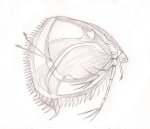
Ostracods do have eyes, but they are not very obvious. Cladocerans have more obvious eyes, and they are the ones with the external appendages. So it sound like maybe you had one of the many species of cladocerans. Here is a somewhat simplified drawing of one, Ilyocryptus spinifer, that spends more time creeping around the substrate than swimming.
 

Attachments

  • Ilyocryptus.jpg
    Ilyocryptus.jpg
    12.6 KB · Views: 991
General chit-chat
Help Users
  • No one is chatting at the moment.
  • Finpearce:
    Hey, are these still for sale? Thanks
    +1
    Unlike
  • Chat Bot:
    SSV has left the room.
    +1
    Unlike
  • Arlet:
    Hello, may I ask a question here? Or do I need to ask a question somewhere else?
    +1
    Unlike
    Arlet: Hello, may I ask a question here? Or do I need to ask a question somewhere else? +1
    Back
    Top