Fungus problem? Damaged slime coat?

AbysmalAxolotl

New member
Joined
Nov 25, 2012
Messages
23
Reaction score
0
Points
0
Location
Portland, OR
Country
United States
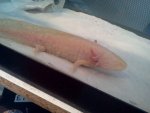
My axolotl is developing white patches on his skin. About eight months ago he had a few bits of fungus (columnaris) on his gill and foot that was fixed with salt baths, but this looks less fluffy and is mostly on the top of his head and his sides, and comes off when he moves vigorously. He had high ammonia levels in his tank briefly while I was on vacation, but they are now back to normal. He is acting fine, bright and eating and moving around, whereas with the columnaris he was very obviously sluggish and sickly. I gave him a salt bath yesterday and today but the patches quickly came back within an hour or two. Could this be the result of a damaged slime coat? Is there a treatment that would be effective to fix this? Does the type of water dechlorinator that I use matter, i.e Stress Coat or otherwise? Would it be helpful to move him to a tub with clean water outside of the tank for a while?
Thanks!
 
hi i had a few issues with water conditioners. i now only use reptasafe which is designed for reptiles and amphibians
 
Salt bath is for fungus. What it sounds like to me is slime coat issues. The best thing to repair slime coat is good water parameters, temperature and Indian almond leaves.

Can you post a picture?
 
Here is a photo from earlier today:
 

Attachments

  • sad1.jpg
    sad1.jpg
    72.8 KB · Views: 1,581
That looks terrible :( leave some Indian almond leaves in it's tank for a few weeks. It will be a little yellow but that's okay.
What are your actual readings now?
 
Just did about a 40% water change--ammonia is about 0.5, pH is 6.5, nitrites at 0 and nitrates just barely over 0. His filter broke last week and he got a new one, so I'm thinking that maybe part of the problem is a cycle crash.
Today he seems uninterested in food, but I left two smallish earthworms in his tank and when I came back 10 minutes later one was gone, so I'm hoping he ate it. Still moving around, seems maybe a little sluggish, and looking bright but I saw him gulping air a few times.
I'm not sure where to find Indian almond leaves, but until I get a hold of some I think I'll try adding some black tea to the water to see if that helps. I also added some of the Stress Coat+ dechlorinator.
Thanks for the advice--I'm really hoping it's a slime coat problem and nothing worse.
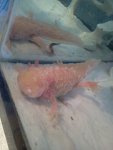
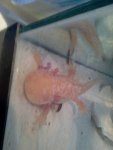
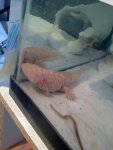
Here are more pictures from today:
 

Attachments

  • sicklotl.jpg
    sicklotl.jpg
    83.9 KB · Views: 993
  • siclotll.jpg
    siclotll.jpg
    77.5 KB · Views: 1,922
  • sickltol.jpg
    sickltol.jpg
    78.8 KB · Views: 804
Earthworms can bury in the sand... I've witnessed it before.

It most definitely is your water quality. You need to be doing daily water changes until your cycle is finished.

You can order them online on ebay.
 
Thanks for your input. I gave him a tea bath, and the other worm actually was burrowed in the sand but then I witnessed him eating it. I'll continue monitoring the water. How will I know when my cycle is finished?
 
You'll need to do daily water changes until they are reasonably safe for your axolotl to live in.
You could take him out and put him in a tub with 100% daily water changed and provide an ammonia source for your tank.

The cycle is complete when you have 0 ammonia and nitrites, and some reading of & less than 40ppm of nitrates. Then you can do weekly water changes.

Do you have liquid test kits? They are the most accurate and whilst they are expensive - they last a long time. Strips are useless.
 
General chit-chat
Help Users
  • No one is chatting at the moment.
  • Chat Bot:
    SSV has left the room.
    +1
    Unlike
  • Arlet:
    Hello, may I ask a question here? Or do I need to ask a question somewhere else?
    +1
    Unlike
  • Rorey132:
    Is this guy still available?
    +1
    Unlike
    Rorey132: Is this guy still available? +1
    Back
    Top