
Clarence
New member
Hi
We have an adult golden albino axolotl who for the past few days hasn't been very well at all.
It started about a week ago when he went off his food. We feed him a diet of manufactured pellets and the occasional cube of blood worms and we have fed him this diet (aside from the occasional minnow or guppy) since we got him four years ago and he usually loves his food.
He seemed to be generally lethargic and withdrawn but with no visible signs of illness - ie. no fungus, wounds, no bloating or visible veins etc. His gills all look fine.
He is the only inhabitant of his tank which is 110 Litres and equipped with a filtration system with bio balls and ceramic tubes together with wool. Water flow is mild and it is the same filter he has always had. It is summer here and we live in a hot climate (Perth WA) and the temperature of his tank has been sitting around 25 degrees Celsius. I know this is not optimum and we do try to cool the water with ice and by running our air-conditioning directly at the tank. That said, the water temp is no higher than it has been in previous summers and he coped fine before.
We have fine sand as a substrate and the only other things in his tank are a large bridge, log and a plastic plant.
Two nights ago I noticed that his tail was curved and also wavy along the top. His gills were slightly forward facing. I know this is a sign of stress and I know how dangerous stress can be for axolotls. All I can think of is that we have a 10 month old who is just learning to walk and we have caught her on occasion banging on his tank quite vigorously.
I did a partial water change and we covered the tank with damp towels to keep him in the dark and try to cool him down.
In the morning he was floating and not moving but also not bloated in any way. When I touched him gently he did swim away slowly but floated back up pretty much straight away. He stayed in the same position in the tank the entire day and his mouth was slightly agape.
We contacted a vet specialising in fish and amphibians and they advised against fridging but suggested we drop the water level in his tank so that we had a smaller volume to deal with and place frozen bottles in the water to try to cool him and give him time to bounce back. The filter is also not running as the water level is too low.
We did this last night and this morning he does look a little better. He is not floating any more and his tail has virtually gone back to normal. I could not get him to eat anything though and we're worried that he might start dropping weight. I looked for some garden worms but we just moved house and the soil is terrible so I had no luck there. I would say the last time he ate anything would be about 5 days ago. He is usually quite the chunky fellow so he isn't looking skinny yet but we don't want him to go too long without food.
I don't know his exact age as I got him from a pet shop. When we got him I would day he was between 4 and 5 inches long but the tips of his toes were already black which I know indicates sexual maturity. We have owned him for four years and he is now around 8-10 inches long.
Sorry for the long post. I guess I'm just after some advice on what else we could do and whether anyone knows what might be wrong with him as we really love the little guy and don't want to lose him.
Thanks
We have an adult golden albino axolotl who for the past few days hasn't been very well at all.
It started about a week ago when he went off his food. We feed him a diet of manufactured pellets and the occasional cube of blood worms and we have fed him this diet (aside from the occasional minnow or guppy) since we got him four years ago and he usually loves his food.
He seemed to be generally lethargic and withdrawn but with no visible signs of illness - ie. no fungus, wounds, no bloating or visible veins etc. His gills all look fine.
He is the only inhabitant of his tank which is 110 Litres and equipped with a filtration system with bio balls and ceramic tubes together with wool. Water flow is mild and it is the same filter he has always had. It is summer here and we live in a hot climate (Perth WA) and the temperature of his tank has been sitting around 25 degrees Celsius. I know this is not optimum and we do try to cool the water with ice and by running our air-conditioning directly at the tank. That said, the water temp is no higher than it has been in previous summers and he coped fine before.
We have fine sand as a substrate and the only other things in his tank are a large bridge, log and a plastic plant.
Two nights ago I noticed that his tail was curved and also wavy along the top. His gills were slightly forward facing. I know this is a sign of stress and I know how dangerous stress can be for axolotls. All I can think of is that we have a 10 month old who is just learning to walk and we have caught her on occasion banging on his tank quite vigorously.
I did a partial water change and we covered the tank with damp towels to keep him in the dark and try to cool him down.
In the morning he was floating and not moving but also not bloated in any way. When I touched him gently he did swim away slowly but floated back up pretty much straight away. He stayed in the same position in the tank the entire day and his mouth was slightly agape.
We contacted a vet specialising in fish and amphibians and they advised against fridging but suggested we drop the water level in his tank so that we had a smaller volume to deal with and place frozen bottles in the water to try to cool him and give him time to bounce back. The filter is also not running as the water level is too low.
We did this last night and this morning he does look a little better. He is not floating any more and his tail has virtually gone back to normal. I could not get him to eat anything though and we're worried that he might start dropping weight. I looked for some garden worms but we just moved house and the soil is terrible so I had no luck there. I would say the last time he ate anything would be about 5 days ago. He is usually quite the chunky fellow so he isn't looking skinny yet but we don't want him to go too long without food.
I don't know his exact age as I got him from a pet shop. When we got him I would day he was between 4 and 5 inches long but the tips of his toes were already black which I know indicates sexual maturity. We have owned him for four years and he is now around 8-10 inches long.
Sorry for the long post. I guess I'm just after some advice on what else we could do and whether anyone knows what might be wrong with him as we really love the little guy and don't want to lose him.
Thanks


 and I'm getting really worried. He is also gulping at the surface more often and when he does it is quite loud, like a cough.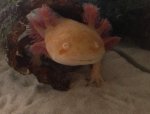

 Axolotl Enthusiast