alpenglow
New member
- Joined
- Jun 8, 2018
- Messages
- 10
- Reaction score
- 1
- Points
- 3
- Location
- Washington
- Country
- United States
- Display Name
- alpenglw
Hi all, I have a newt that I got at a pet store in the USA about 12 years ago, and I've been under the impression that his species is Pachytriton labiatus. However, all of the sources that I can find listing this species are now over a decade old, and I can't find any Pachytriton labiatus on the genus's Wikipedia page. Looking on the IUCN website, I see that Paramesotriton labiatus is listed as Critically Endangered, and it notes "This is a restricted concept of this species following the split of the broader concept into this, Pachytriton granulosus and Pachytriton inexpectatus (Nishikawa et al. 2011). Paramesotriton ermizhaoi has also been synonymised with this species (Nishikawa et al. 2011)." I assume Pachytriton labiatus wasn't involved in this split?
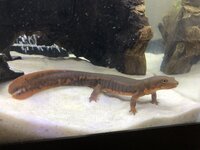
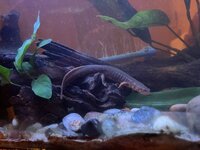
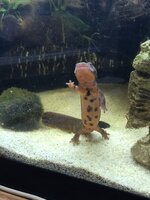
All this to say, I'm uncertain which species my newt actually is. I hope he isn't critically endangered! Can anyone help clear this up for me? I'm used to bird taxonomy, which also goes through splits and lumps quite often, but those changes are usually very public, and I'm struggling to find much on these newts without access to the journals I assume this research is going though. I've included some photos of him to help with the ID as well.
All this to say, I'm uncertain which species my newt actually is. I hope he isn't critically endangered! Can anyone help clear this up for me? I'm used to bird taxonomy, which also goes through splits and lumps quite often, but those changes are usually very public, and I'm struggling to find much on these newts without access to the journals I assume this research is going though. I've included some photos of him to help with the ID as well.