Is my axolotl sick? please help

valentina

New member
Joined
Feb 15, 2015
Messages
5
Reaction score
0
Points
0
Location
Fl
Country
United States
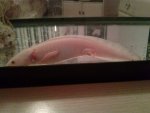
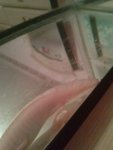
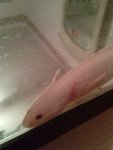
I've only had her for a few days and her condition is getting worst. When we first introduced her to the 10 gallon tank I'm guessing there were too many chemicals in the water (poor circulation as well) because the next morning she was laying in the corner, pale and the filaments on her gills were white and falling off. I took her out and put her into a smaller tank. Since then the 10 gallon tanks water has been changed and a new filter was added. She's a bit more active than she was before the water was changed. But she hasn't eaten in 2-3 days now. I think the clear part on her tail is getting smaller, she barley moves her left arm now, she's so inactive she'll let me pick her up. She's also going to the top of the tank for air every so often. Please help me.
 

Attachments

  • CAM03115.jpg
    CAM03115.jpg
    62.9 KB · Views: 672
  • CAM03112.jpg
    CAM03112.jpg
    98.6 KB · Views: 360
  • CAM03114.jpg
    CAM03114.jpg
    93.3 KB · Views: 331
  • CAM03117.jpg
    CAM03117.jpg
    174.7 KB · Views: 307
  • CAM03118.jpg
    CAM03118.jpg
    127.7 KB · Views: 293
Your axolotl isn't looking great, but axolotls are tough, fortunately. Sometimes axolotls won't eat for a few days, especially after a change - they can go for quite a while without eating.

First, the best place to post this is in the sick axolotl forum, since you will get a lot more knowledgeable people looking there. That forum is Axolotls (<i>Ambystoma mexicanum</i>) - Sick Axolotl? at Caudata.org Newt and Salamander Portal

Next, you did the right thing by getting her into a new container and changing the water. But I am wondering if your water was really the cause of the gill problems. So, question time:

1. Did you buy her at a local store or was she shipped to you? If she was shipped, do you know he long she was in transit? (I am wondering if ammonia build-up in the bag or lack of oxygen is the true cause of if the filament loss.)
2. Did you dechlorinate the original water in the 10 gal tank? If so, with what product?
3. What temperature is your tank at?
4. What chemicals did you suspect were the problem in your tank?

Next, how experienced are you regarding aquatics in general:

4. Are you familiar with "cycling" a tank? (Monitoring growth of good bacteria to convert ammonia and nitrite to nitrate, etc..)

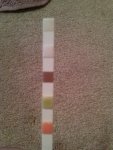
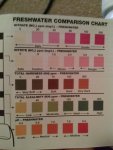
It is good that you have test strips, but a liquid test kit would be better. Also, you need a test for ammonia. It is hard to figure out the readings from the pictures - it looks like your nitrite is not zero? That isn't expected in a brand-new tank set-up.

5. Is this a new tank or a tank that is already cycled?

Regarding her not-eating:

6. What are you trying to feed her and how?

It looks like her arm has been injured. Fortunately, axies heal well.

7. Was her arm moving properly when you got her?

Frankly, I think your axolotl wasn't in the best of shape when you got her. The best thing now is to try to keep the water conditions perfect and allow her time to heal. If your tank isn't cycled, that means daily large water changes, or keeping her in a smaller container with 100% daily water changes, using an appropriate dechlorinator. Keep the water cool - a fan blowing across the top will drop the temperature a few degrees below room temp, usually. Remove uneaten food so it doesn't foul the water.

We'll help you out however we can. :happy:
 
I bought her from a breeder when she came she was in perfect health, her gills were red, she was swimming and eating. She was in transit for 2 days.
The first time I set up the 10 gal tank I used API water dechlorinator , tank stability and some other cleaner I don't recall. She stayed in the tank for about 6-8 hours maybe longer, and that's when her gills started looking so bad. I changed the water and started using only AquaSafe dechlorinator for reptiles. Right now the tank is at 22°C.
I'm not at all familiar with cycling the tank. I bought the tank from someone (secondhand) but the filter is new.
Since Thursday when I got her I fed her 3 salmon pellets that day and 3 on Friday :/ I don't think I should have done that but since she was supposed to eat 6 pellets every other day I didn't think it would be so bad.
And yes all of her limbs were fully functional when I got her. After the first night in the bad tank water I noticed her arm looked funny and she was barely using it.
 
The feeling I have is that the cleaner you used to clean the tank was poisoning her. I know you said that you can't remember what you used.
But many cleaners these days are pretty toxic, and leave a residue for a very long time. You should never use anything other than a weak bleach/water solution or white vinegar/water for deep cleaning. And even then, rinse well.
Keep her in clean water and give her time... she may end up making a full recovery. Best of luck :happy:
 
Also, try to cool her tank down closer to 60 or 65. Install a small fan over the tank with a mesh lid for circulation and ventilation. Or move the tank to a cooler area of the house.
 
My biggest concern right now is that she isn't eating. Today will make three day in a row that she refuses to eat. I don't think I overfed her since she's been with me.
 
Axolotls can go for quite some time without eating, so her lack of appetite isn't a major concern yet. The major concern is keeping her in cool, clean water so that she can heal. You are most definitely right that it was chemicals in the tank, if you used a cleaner in there.

Is she in the 10 gal or the smaller tank? I'd recommend the smaller tank for now so you can do large water changes easily. Reason for the water changes: the tank is uncycled, so you will get ammonia building up in the water just from your axolotl living there. And if she starts eating and pooping, it will build up faster. Ammonia is toxic. So, you will need to do frequent, large water changes to keep the ammonia low. (Always use a dechlorinator and match the temperature of the water.)

Start reading about cycling the tank. If you have her in a different tank you can do a fish-less cycle in the 10 gal while she recovers in the smaller tank. Ask question if you have them. Don't let "cycling the tank" instructions intimidate you - it really isn't hard.

Trick for feeding: Drop the pellets so that they just skim her nose. She may instinctively snap at them, and once they are in her mouth, she may swallow them. Remove uneaten food right away - you don't want them fouling the water.

She may have injured her own arm if she started thrashing in the tank. Hopefully it will heal on its own. If not, well, there are no predators in your tank, so it shouldn't affect her lifespan. :happy:
 
I tested the water and it turns out the ammonia was WAY too high. So I changed 50% of the water.
 
I tested the water and it turns out the ammonia was WAY too high. So I changed 50% of the water.

Good job testing and changing the water right away. The high ammonia could be the cause, or a contributing factor to her illness. It does build up quickly in an un-cycled tank. How high was the ammonia?

*I also recommend getting a liquid test kit that includes ph. The ph looks a little low on the test strip, but it should be checked again using a liquid test. The API master test kit is great.
 
Last edited:
Turns out the tap water has ammonia in it. She started dying so I put her in dechlorinated bottled water because its the cleanest water I have right now apparently. Her gills aren't moving anymore but she's holding on. :/ I don't think she will for much longer
 
:sad: Your tap water must be sanitized with chloramine. Typical dechlorinators won't neutralize the ammonia in it. You need a dechloriator that states that it will neutralize chloramine also.

Putting your axie in bottled water was excellent emergency treatment. Make sure it is not distilled or reverse osmosis water - you want water with some mineral content to buffer the pH. Do daily 100% water changes.

I believe that this is one of the cases where refrigeration may help your axolotl. If you have room in your fridge, and if your fridge has a good thermostat, and if you have a thermometer to check the temperature. I have read (but don't know if this is a proven fact) that axolotls heal better in cooler conditions, and cold water holds more oxygen. See http://www.caudata.org/forum/f46-be...ick-axolotl/85263-axolotl-fridging-guide.html
 
It sounds like Laura is right about your water. Try to check with your local water treatment plant to confirm on what they add to the water.
Fridging axolotls can be hit or miss. It's worth a try for maybe 4 days or so. See if she shows any signs of improvement. I sure hope she pulls through.
 
I'm a brand new Axi owner and was just skimming through the sick forum to see what some of the most common things going on were. I don't have any advice on the situation but I hope you are able to update your thread soon! I'm rooting for your Axi!
 
22c is too hot are you trying to cook it alive?

Steven, 22C is certainly not ideal and is on the high side. It would be good to lower the temperature in the OP's tank. However, it is not as dangerously high as it could be and I find your comment quite rude and not helpful or considerate to the OP who has come here looking for assistance.
 
General chit-chat
Help Users
  • No one is chatting at the moment.
  • Chat Bot:
    SSV has left the room.
    +1
    Unlike
  • Arlet:
    Hello, may I ask a question here? Or do I need to ask a question somewhere else?
    +1
    Unlike
  • Rorey132:
    Is this guy still available?
    +1
    Unlike
    Rorey132: Is this guy still available? +1
    Back
    Top