Lark
New member
Hi,
Our axolotl, Spotswood, is in very poor health and we are desperate for advice on the best way to care for her and any potential treatment options. We've tried 4 different vets local to us (we're in Aberdeen, Scotland) and they've ether said they're unable to help or they've not returned my calls or e-mails.
This is a summary I sent to a vet on Wednesday morning who I was advised could help us (they've still not replied and there was no answer when I called):
On Wednesday night the bloating had got worse (last 3 pictures attached) so we put her back in the fridge as we thought at the very least that would make her more comfortable and delay her deterioration even if it doesn't reverse the problem. I'm worried it may be a problem with her liver. Is there anything that can be done for her at this stage? Is there any test or treatment that we could specifically request from a vet, even one that's inexperienced with amphibians if we're unable to find one with specific training?
Is there anyone from the North East of Scotland that knows of a vet with axolotl experience close by? Any vets from further afield that wouldn't mind helping us out?
Thank you in advance for anyone that can help little Spotswood.
Our axolotl, Spotswood, is in very poor health and we are desperate for advice on the best way to care for her and any potential treatment options. We've tried 4 different vets local to us (we're in Aberdeen, Scotland) and they've ether said they're unable to help or they've not returned my calls or e-mails.
This is a summary I sent to a vet on Wednesday morning who I was advised could help us (they've still not replied and there was no answer when I called):
- She's about 3 years old and has never had any noticeable health problems before.
- We used to feed all of our axolotls crickets but after a death in February we researched whether there was anything we could do to improve their conditions and adjusted how we were caring for them. We switched them to earthworms as we'd read they're more nutritious (and they seemed to like them more). We also invested in a more thorough water testing kit.
- About a couple of months ago we noticed she'd lost a bit of weight (belly not as wide as her head). She'd previously looked quite chubby, but healthily so.
- About a month-6 weeks ago she seemed to have a bit of trouble dealing with whole worms. She'd bite them but seemed to struggle with the wiggliness of them so would spit it out and give up so we fed her worms that had been chopped in half for about a week and she found that more manageable.
- We then put her back on whole worms which she seemed fine with again.
- About 2 weeks ago she stopped eating entirely, whole or half worms.
- She also started to look like she was trying to scratch her side with her foot where there was a bit of a white patch.
- She was swimming about quite erratically on the 18th
- Then the next day she'd become very lethargic and was worryingly unbalanced. She also had little white patches all over her which we suspected might be a fungal infection.
- We put her in the fridge (water temp 8 degrees Celsius) to aid her recovery(although we've since read this may have been wrong and we should have salt bathed her? There seems to be conflicting information on this) on the 19th.
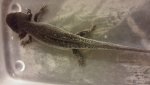
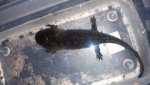
- This is how she was looking on the 20th when we were doing a water change : (picture attached below)
- It's hard to tell in the picture but the whiter spots on her tail an back weren't part of her normal colouration, there were also some fluffy bits on her gills.
- Testing the aquarium revealed water that we had had an ammonia spike. It was up at 4ppm. We've done water changes every 1-2 days since then and it was down to 0.5ppm yesterday and all her tank mates seem fine.
- The suspected fungal infection seemed to clear up quickly so Spotswood came out of the fridge on the 22nd.
- After taking her out of the fridge we moved her to a little hospital tank (after letting her re-acclimatise in her fridge tub) with a bubble stone to oxygenate it and have been doing water changes every day to keep it clean.
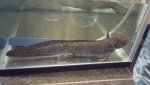
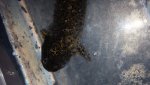
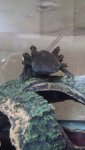
- When she first went in she was barely moving, struggling to balance and just wanted to rest her head against the corner of the tank. She was pretty much rooted to the bottom and limping along as her lack of energy and balance made swimming too hard (second picture attached).
- You can see her arms an legs look limp like she's not got the energy to rest on them normally
- She managed to push herself up to the surface to take a gulp of air but it seemed the exertion made her throw up what little was left in the stomach.
- After seeing that she wanted to get to the surface we reduced the water level and made a little step to stand on to make it easier for her to stick her head out.
- We thought she was maybe improving a bit as she seemed more comfortable with this arrangement.
- On Monday we noticed that she'd become a bit bloated around her neck and she was floating on the top rather than rooted to the bottom.
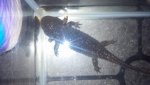
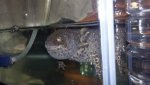
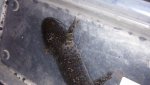
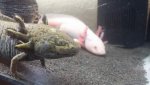
- This is how she was looking yesterday night (Tuesday), you can see her neck is a lot wider than the previous pictures and her head is looking quite spherical (third and forth pictures)
- She was briefly back down on the ground last night but she was floating about on the surface again before I went to bed and when I checked on her this morning.
- We've tried her on small pieces of chopped up earthworm and bloodworm to see if we could encourage her to eat a tiny bit but she's having none of it and doesn't seem interested at all.
On Wednesday night the bloating had got worse (last 3 pictures attached) so we put her back in the fridge as we thought at the very least that would make her more comfortable and delay her deterioration even if it doesn't reverse the problem. I'm worried it may be a problem with her liver. Is there anything that can be done for her at this stage? Is there any test or treatment that we could specifically request from a vet, even one that's inexperienced with amphibians if we're unable to find one with specific training?
Is there anyone from the North East of Scotland that knows of a vet with axolotl experience close by? Any vets from further afield that wouldn't mind helping us out?
Thank you in advance for anyone that can help little Spotswood.