Illness/Sickness: New appearance of black spots

BugLady

New member
Joined
Jul 3, 2014
Messages
3
Reaction score
0
Points
0
Location
Oklahoma
Country
United States
I have a white/yellow/genetically engineered (to glow green under black light) axolotl that is about 3 years old and about 9 inches long. No cloacal "package" so I assume female. Recently black/dark brown spots have suddenly appeared: bottom of her feet over toe joints; across inner "thighs" and cloacal region; and the tips of her toes. In addition, I noticed that her gills have gotten shorter. She remains active, healthy eater (frozen bloodworm cubes), curious. The absolutely only change in her environment is that I've been gone from the lab (I teach college) for 6 weeks and a colleague has been feeding her.

Is this a normal development, maybe now she's sexually mature? Is she trying to metamorphose (though I've read this is an unusual event in a non-manipulated environment)? Or is there something wrong with her?
 
Photos would really help here.
Is your axie albino or leucistic? Leucistics can have dark markings that come and go at odd times. Dark toe tips are normal for both types, and do not indicate maturity as they develop these as early as 4 months old.
Adults should be fed on earthworms or pellets rather than bloodworm, as bloodworms do not contain the right balance of minerals and nutrients.

If you can get some photos posted we can help you further.
 
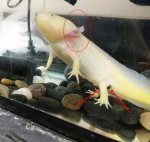
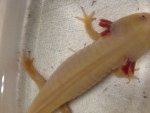
I had a chance to go to the campus and take pictures: I haven't used this site before, but I think I attached two pictures. The first, ChuyBlackSpots&Gills, shows the black areas around the cloaca, red arrows added for emphasis; these black blotches extend a bit down her inner "thighs." Then I circled the gills; her gills have distinctly gotten shorter since I last saw her 6 weeks ago. The second picture, "ChuyBlackToes," shows that each toe is tipped in black, and then there are small black spots on the foot pads. If you look to the far right of the picture, you can just see one of the black blotches behind her hind leg. Otherwise, as I said before, Chuy is swimming, eating, and curious (I had a tough time getting her to turn away from the camera so I could take the side shots!).
 

Attachments

  • ChuySpots&Gills.jpg
    ChuySpots&Gills.jpg
    149.4 KB · Views: 5,309
  • ChuyBlackToes.jpg
    ChuyBlackToes.jpg
    68.2 KB · Views: 1,025
The pigmentation on the gill rami are normal and usually become darker with age.

The area around the cloaca appears to be a bacterial infection. The feet are the most concerning, as they may be abscesses similar to the axoltol in post: http://www.caudata.org/forum/f46-be...icanum/f58-sick-axolotl/63082-lumpy-toes.html

Would it be possible to get more pictures of the feet?

I would isolate this axoltol from any others and contact a vet for identification and treatment.
 
Update and more questions. I took Chuy to the only vet within 200 miles who treated exotics, which it turns out she was familiar with reptiles and frogs, not axolotls. However, she thought bacterial infection. For the last 3 weeks, Chuy's been getting a 10-minute salt bath (3 tsps/liter) followed by 10 mins in an antibiotic bath (17 mg amikacin in 1 liter). I've also doubled the size of her tank, added decorations, decreased water flow and feed her earthworms every 2-3 days (usual bloodworms otherwise). The extensive black blotches are gone though there's still a smudge of grey around her cloaca, and the black spots on her feet are improved but still there. I'm almost out of antibiotic. How should I proceed now, do you think? Stop the salt baths when I run out of antibiotics and see how she does? Continue daily salt baths? Get more antibiotic and keep up the regimen? Thanks! I attach a picture from while she's in her bath; you can see the dark grey spots on the sides and ends of toes.
 

Attachments

  • image.jpg
    image.jpg
    209.4 KB · Views: 856
I would give the vet a call, update on her progress, and see what the treating vet suggests. You don't want to stop antibiotics too soon, as that encourages the evolution of antibiotic resistant strains of pathogens. But if the vet thinks it's just residual tissue damage and the infection is gone, you may be able to just let her heal.
 
General chit-chat
Help Users
  • No one is chatting at the moment.
    There are no messages in the chat. Be the first one to say Hi!
    Back
    Top