New to Chinese fire bellies

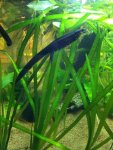
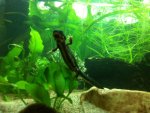
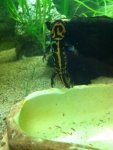
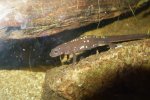
Well it took a while but there are finally three fire bellies in the tank. The first guy I was supposed to get them from completely disappeared on me, but luckily I found someone who has fire bellies and had bred them in 2013 so I was able to get three little guys (or girls). They have already returned to water and were even brave enough to dive right in after I brought them home. I'm very surprised how curious and social they seem to be. I was expecting them to hide in the plants most of the time, but they often come to the glass to check out what's going on in the room. One of them has even been following me when I move outside the tank and is very eager to investigate everything.

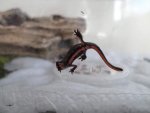
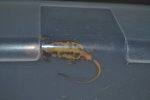
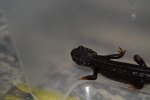
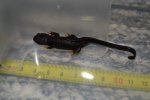
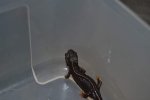
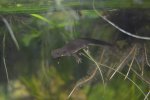
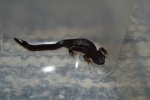
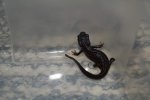
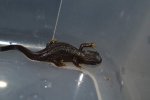
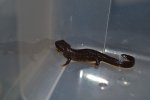
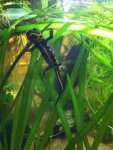
I'm not sure what kind of fire bellies they are because the seller didn't know. I think they look most like C. pyrrhogaster, but I've only seen pictures so I'm not sure at all and from what I've heard they're pretty rare in Finland so it would be a lot more likely that they are C. orientalis. They are now about 8 cm long. I'll try to get better pictures of them later and see if someone on here could identify them for me. Meanwhile here are a few bad pictures of them.
 

Attachments

  • 2014-11-09 19.40.06.jpg
    2014-11-09 19.40.06.jpg
    230.3 KB · Views: 287
  • 2014-11-09 19.39.37.jpg
    2014-11-09 19.39.37.jpg
    236 KB · Views: 268
Not Hypselotriton orientalis, that's for sure. They are Cynops pyrrhogaster, but which subspecies is difficult to say.
 
I would guess sasayama, they look very much like some of my juveniles.
 

Attachments

  • sasayama.jpg
    sasayama.jpg
    51.8 KB · Views: 245
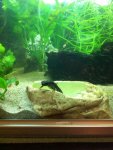
My tank is getting ready slowly but surely. I'll post a picture and would be grateful for any comments if there's anything I should do differently. I'm still waiting for a background I ordered online, think it'll make the newts feel a bit safer if all the sides aren't see through. Currently the tank is cycling and will probably be ready in about a week. I had a small sponge filter running in an established tank for about a month and then put in the new tank to help cycle it. I won't be turning it on, but at least there's a bit more bacteria in the sponges to keep the water clean. The plants seem to be growing already pretty nicely so hopefully they will cover the tank even more in a little while. The temperature is also steady at 18-19 C.

Very nice! Putting that water hyacinth to good use, huh? :happy:
 
Not Hypselotriton orientalis, that's for sure. They are Cynops pyrrhogaster, but which subspecies is difficult to say.

Great, thanks! That's what I thought.

I think they might be sasayama like Chinadog said. I was reading the Cynops pyrrhogaster article at Caudata Culture and the description of the sasayama race sounds most like what I have. The one in the picture earlier has the most black in its belly out of the three, the second one has two dark lines down the belly and the third one has only two lines of dark spots.

And yes, they loooove the water hyacinths. They sometimes get out of the water for a few minutes and are usually only hanging out on a water hyacinth. The plants are big enough for all of them to fit on one comfortably together which they seem to like. The big cork island with java moss I got for them was almost completely unused so I already switched it to a smaller one.

One thing I was wondering is if there's anything I can do about their color. They're very yellow without even a hint of orange/red and I was told it's most likely due to their diet growing up. So is there anything I could do to get some color in them or are they fine the way they are?
 
The fact that they're yellow just means they've been raised on a diet lacking in Caroteinoids, They can't prouduce the red colour themselves, so It has to come from what they eat. It's really no detriment to their health, but to get them redder you can feed them things like Daphnia, brine shrimps or even earthworms gut loaded with reptile colour suppliment or Paprika.
As far as race goes, sasayama males almost always place a hind foot on the females neck during courtship, but you'll have to wait a while before theres any of that! :)
 
Thanks! I'll try to remember to keep an eye out for that hind foot on the neck thing when it's time for that. :)
 
They seem to have settled in pretty well. They all have their favorite places where they hang out and they definitely have learned where the food bowl is. :D

And some pictures. This is Hawking, the biggest one of the three at over 9 cm.
 

Attachments

  • DSC_0355.jpg
    DSC_0355.jpg
    36.9 KB · Views: 244
  • DSC_0332.jpg
    DSC_0332.jpg
    45.1 KB · Views: 234
  • DSC_0336.jpg
    DSC_0336.jpg
    58.6 KB · Views: 241
  • DSC_0343.jpg
    DSC_0343.jpg
    33.6 KB · Views: 228
  • DSC_0364.jpg
    DSC_0364.jpg
    50.8 KB · Views: 268
This is Darwin, about 8 cm.
 

Attachments

  • DSC_0370.jpg
    DSC_0370.jpg
    49.1 KB · Views: 241
  • DSC_0373.jpg
    DSC_0373.jpg
    49.9 KB · Views: 246
  • DSC_0395.jpg
    DSC_0395.jpg
    46.2 KB · Views: 231
  • DSC_0402.jpg
    DSC_0402.jpg
    41.6 KB · Views: 223
  • 2014-11-08 22.57.12.jpg
    2014-11-08 22.57.12.jpg
    230.1 KB · Views: 266
  • 2014-11-08 22.57.38.jpg
    2014-11-08 22.57.38.jpg
    116 KB · Views: 224
And then there's Tesla who refused to be measured and photographed today, but he's around 8 cm too.
 

Attachments

  • 2014-11-10 23.51.40.jpg
    2014-11-10 23.51.40.jpg
    208.2 KB · Views: 257
They look great. :) Now I've seen them properly, I'm not convinced they are pyrrhogaster. I think they look more like Cynops ensicauda ensicaua. especially in the fifth picture of your first post today. Not that it makes any difference to their care of course.
 
They look great. :) Now I've seen them properly, I'm not convinced they are pyrrhogaster. I think they look more like Cynops ensicauda ensicaua. especially in the fifth picture of your first post today. Not that it makes any difference to their care of course.

Thanks. :) Could be. I have no experience on them so all I can do is compare pictures. And to be honest at first all the pictures and species looked the same to me. :D
 
It's their short toes, and long tails that make me think ensicauda, It would be very unusual for a pyrrho to have such a long tail.
 
They look great. :) Now I've seen them properly, I'm not convinced they are pyrrhogaster. I think they look more like Cynops ensicauda ensicaua. especially in the fifth picture of your first post today. Not that it makes any difference to their care of course.

That last one does look a bit like either Cynopos ensicauda ensicauda or Cynops ensicauda popei, doesn't it?
I will attach a picture of one of my juvenile Cynops ensicauda popei that looks similar to the one in the last picture ( dirty glass, sorry ). I would think though that at least one of your juveniles would have gold flecking or at least more defined stripes if they were one of the previously mentioned species. Also, the head shape looks a bit wrong to me.
 

Attachments

  • P1160167.jpg
    P1160167.jpg
    103.7 KB · Views: 238
I've just looked again, I'm certain they are C. ensicada, probably C.e ensicauda. Their tails are too long and their toes are too short for pyrrhogster and they don't have quite the same eyes.
 
Haha I posted some pictures on another forum and there they seem to think they are C. pyrrhogaster, because the head looks wrong for C. ensicauda. I guess I'll have to wait and see how they develop when they grow some more. :D

I guess previously they've been fed pretty much only bloodworms because that's the only thing they seem to want to eat. I'm trying to mix cut up earth worms in with the bloodworms to trick them to eat those, but they are really picky. I've also tried giving them just blanched and chopped earth worms at which point they didn't eat at all. So I was wondering if someone could suggest something else to try too? They've now been eating pretty much only bloodworms for the week I've had them and I know the bloodworms are not very good for them so I was thinking that at least some variation until I can get them to eat the earth worms would be good.
 
In those new pictures they certainly look unusual for pyrrhogaster. I agree they may well be C.ensicauda. It should be much more clear once they mature.
 
They are cuties :) I'm no expert at all but in sammakkolampi (a Finnish care sheet) there are quite similar ensicaudas, aren't they? Just thinking they look "Finnish"... :)
Have you tried tropical quintet (ruto)? It's a frozen food with cubes of red, white and black mosquito larvae, daphnia and brine shrimps (artemia). That was found in at least some bigger aquarium shops. My guys that were also used to blood worm diet in previous homes, ate these too before we got all goodies in our back yard in the spring. Do you have an earth worm culture or where do you get them now?
 
Bump! Time for an update, surely?! :)
Did they turn out to be C. ensicauda in the end? I'd love to see some up to date pics!
 
General chit-chat
Help Users
  • No one is chatting at the moment.
    There are no messages in the chat. Be the first one to say Hi!
    Back
    Top