• Did you know that registered users see fewer ads? Register today!
  • Welcome to Caudata.org, the Newt & Salamander Information Portal.

    We are the longest running community for amphibian enthusiasts on the Internet. Our primary goal is the sharing of information on the maintenance and breeding of newts and salamanders in captivity.

    Right now you are viewing our community as a guest. This gives you limited access to our forum and resources. For example, your ability to view conversations in our "Advanced Topics" section is restricted, and guests can view but not respond to "for sale" or "want" ads. Join our free community and get full access, post questions, your own photo albums, message other members, and other features. Registration is fast, simple and totally free so please, click the register link today! Problem? Please use the contact link at the bottom of the page.

    For care info, Caudata Culture is the site for you. Axolotls? The Axolotl Site is the best on the net.

Newts on roads!

Peter Parrot

New member
Joined
Mar 1, 2009
Messages
21
Reaction score
5
Points
0
Country
United Kingdom
Following the post regarding the new Toad crossing site that we are looking after http://www.caudata.org/forum/showthread.php?t=60169 I thought that I would report on the increasing numbers of palmate newts on the road also.

Yesterday evening`s result;

Toads total 49 (14 pairs, 15 singles, 6 heading back to woods)
Dead toads - 5
Frogs going back - 7
Palmate newts - 69
Dead palmate newts - 7
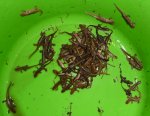
 
Here is the bucket full of newts collected and released on the aquatic habitat side of the road.
 

Attachments

  • newts.jpg
    newts.jpg
    315.8 KB · Views: 11,425
Good work, Peter! Thanks for sharing.
 
Wow, that is a lot of newts. Do you help them across the road every night? More people should help amphibians across roads. It is sad to see fatalities.
 
Thanks all. :cool:

AJ, during the toad breeding season we are out on any wet night. We were this evening but it was too dry and cold and very few amphibians were moving. The newt breeding season is a good deal more protracted and they may journey to the breeding ponds throughout March and April over here. It is not so obvious as in the case with frogs and toads so I imagine a great many newt crossing sites are not identified. Combine that with the fact that predators and scavengers such as buzzards and corvids operate a pretty good clean up response so by removing the evidence so to speak, many caudate crossing sites more than likely go unidentified.
 
Last edited:
A good night's work Peter!
 
You are doing a great service to the future of those newts (and frogs/toads) in general! You are a credit to all REAL herpers! Thank you!

-jbherpin-
 
General chit-chat
Help Users
  • No one is chatting at the moment.
    There are no messages in the chat. Be the first one to say Hi!
    Back
    Top