springee
New member
- Joined
- Mar 13, 2013
- Messages
- 6
- Reaction score
- 0
- Points
- 0
- Country
- United States
Hey everyone,
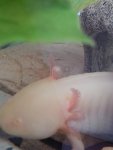
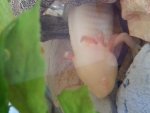
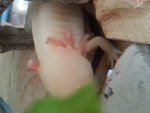
I've never had a health issue with my axolotl before and we've been together for almost two years now!! A week ago it looked as though he had lost a very small amount of his red gill fimbriae, but I thought nothing of it because I could see that they were growing back properly. However, I noticed this morning that he now has an area of white "fluff" (see 3 attached pictures, these are the best quality i could get) around the area that was previously damaged!! I haven't had any other type of aquatic organism before, but from just reading online, to me it looks like some type of bacterial or fungal infection (although I can't say for certain). My water temperature is a little high for an axolotl, probably ranges about 69-70 F at the absolute highest of temps, but it cools down during the night time considerably (63-64 F). I just moved him today to a colder location in my apartment, where the water should be much cooler for him (59-60 F at the lowest), which I read might help with his fighting off the infection.
The only other issue I can think that might have caused an introduction or flourishing of a bacteria or fungus would be that I use live blackworms from California as his food source. He ABSOLUTELY REFUSES to eat anything else, and I have tried EVERYTHING!! I had just received the shipment about 3-4 days ago, but I have never had any trouble with these blackworms before and I have been ordering them from the same place for almost a year now! I am a biochemistry major and have taken microbiology courses before and also observe what appeared to be orange bacterial colonies on the "glue-like" material that holds the four corners of his tank together, but not on the actually glass itself. I have never observed these colonies before, which makes me think even more that this is a bacterial infection.
I have read about salt bathes, but have heard mixed reviews as to how they can be stressful transferring in and out of tanks. After taking microbiology, I'm familiar with antibiotics but I'm not sure if that is the best method or whether that will be stressful on my axolotl. He seems to be eating okay and besides for that little white spot everything else is normal. Water conditions are perfect and I use liquid testing to confirm regularly. Like I said I just noticed this white "fluff" this morning and spend time with him regularly, so it is a new development. Should I wait it out and see what happens for a few days or should i begin salt bathe or antibiotic treatments right away??
Thanks for the help guys, I really appreciate it!
Evan
I've never had a health issue with my axolotl before and we've been together for almost two years now!! A week ago it looked as though he had lost a very small amount of his red gill fimbriae, but I thought nothing of it because I could see that they were growing back properly. However, I noticed this morning that he now has an area of white "fluff" (see 3 attached pictures, these are the best quality i could get) around the area that was previously damaged!! I haven't had any other type of aquatic organism before, but from just reading online, to me it looks like some type of bacterial or fungal infection (although I can't say for certain). My water temperature is a little high for an axolotl, probably ranges about 69-70 F at the absolute highest of temps, but it cools down during the night time considerably (63-64 F). I just moved him today to a colder location in my apartment, where the water should be much cooler for him (59-60 F at the lowest), which I read might help with his fighting off the infection.
The only other issue I can think that might have caused an introduction or flourishing of a bacteria or fungus would be that I use live blackworms from California as his food source. He ABSOLUTELY REFUSES to eat anything else, and I have tried EVERYTHING!! I had just received the shipment about 3-4 days ago, but I have never had any trouble with these blackworms before and I have been ordering them from the same place for almost a year now! I am a biochemistry major and have taken microbiology courses before and also observe what appeared to be orange bacterial colonies on the "glue-like" material that holds the four corners of his tank together, but not on the actually glass itself. I have never observed these colonies before, which makes me think even more that this is a bacterial infection.
I have read about salt bathes, but have heard mixed reviews as to how they can be stressful transferring in and out of tanks. After taking microbiology, I'm familiar with antibiotics but I'm not sure if that is the best method or whether that will be stressful on my axolotl. He seems to be eating okay and besides for that little white spot everything else is normal. Water conditions are perfect and I use liquid testing to confirm regularly. Like I said I just noticed this white "fluff" this morning and spend time with him regularly, so it is a new development. Should I wait it out and see what happens for a few days or should i begin salt bathe or antibiotic treatments right away??
Thanks for the help guys, I really appreciate it!
Evan