Please help - I don't think my axie is ok

ThisFish

Member
Joined
Nov 26, 2015
Messages
55
Reaction score
1
Points
6
Location
Minneasota
Country
United States
Please help me, I don't know whats going on or what to do.

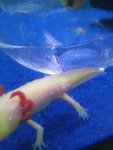
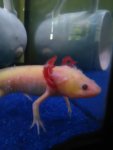
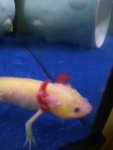
This morning I woke up and took my dog for a walk. When I came home I looked in my axie tank and saw one of my axies, Jupiter, had weird fuzzy white things all over.

Its really hot in here for an axie so I immediately turned on the AC. I dechlorinated two bowls of water for both my axies and poured half tank water in with them.

It appears that Jupiter rubbed off a bit on my other axolotl and now he has a bit of the white stuff on his side.

I don't know what else to write, I'm going to go test my water now. It was changed fairly recently.
IMG_20160811_124201.jpg
IMG_20160811_124239.jpg
IMG_20160811_124249.jpg
 
Ammonia - 0ppm
Nitrite - 0ppm
Update: some of the little things attached to Jupi are falling off into the bowl.
also it's a really bad time for this because I live with my dad and he just went camping (he'll get home Sat) and I need his help to clean the tank.
 
Ok, I read a bit online and it seems like fungus. Is it a good Idea to do a salt bath and then fridge my axolotl until my dad gets home to clean the tank?
How should I clean my tank? Is there anything special I need to do? (Clean extra well, do a really big water change, etc.)
Im sorry if this is unorganized or has errors, Im really worried and was typing kind of fast.
 
Here is my plan since no-one has replied yet.
My mom is going to get me salt to make a salt bath in one hour and then I will follow this websites instructions: http://sillyaxolotls.wixsite.com/sillyaxolotls/saltbath Ill do the salt bath everyday until the fungus is gone.
After that I'm going to fridge my axolotls A. because its to hot and B. because they have been having a little bit of trouble with floating. Ill do that using this: http://www.caudata.org/forum/f46-be...ick-axolotl/85263-axolotl-fridging-guide.html Ill fridge until my dad gets home and can help me change and cool off the tank.
If you have any suggestions please reply.

Thanks.

I feel really stupid. My dad and the guy at the fish store said that they would probably be alright at the water temperature they where at so I didn't really worry.
 
Please don't panic.
If in any doubt keep your axolotl in a container in the fridge (make sure it's not too cold) and do 100% daily water changes with dechlorinated water that is the same temperature - keep somein the fridge ready for the water change.
The fuzzy bits do look like fungus. This can also be treated by using tap water without dechlorinator, which some people say is less irritating that a salt bat, but follows the same principles. If you use a salt bath keep them to less that 15 minutes to make sure you don't irritate the gills and skin too much. 10 minutes will probably be long enough.
I'm not sure what the white spots are on your axolotl. You may need to take a closer look at them to try to work out what they are.
Be careful when you clean your tank. Make sure that you do not over clean as this will disrupt the beneficial bacteria and setart a mini-cycle. Clean your tank by using a syphon to remove any debris from the substrate. Perform a water change. Perhaps test your water daily, or every other day, tho make sure that the parameters are fine.
When your axolotl return to the main tank, if you need to keep your tank cool you can always use a fan pointed at the surface of the water to help evaporation, plus a mesh lid (same reason), and float frozen water bottles (plastic only) in your tank. Make sure that the temperature is constant as fluctuations in temperature can also cause stress.

Best of luck and please keep us posted on your progress.
 
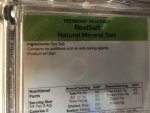
I prepared two salt baths with a little over one liter of water in both containers, mixed with 1 tsp of plain sea salt into each one. I bought the salt especially for today. here is the label:
IMG_3394.jpg
My larger axie started twitching right at the end of the ten minutes to I immediately scooped him out. The smaller axie on the other hand tolerated the bath. Both shed a lot of fungus in the bath.
Now I have them in separate bowls in my fridge witch when I tested seemed about 60 degrees. Im going to keep checking on them and do another salt bath and water change tomorrow.
Thanks for your help.
 
That was not typical fungus that was " ick 100% ick!". ( most fungus is white hairy) and salt bath is Fantastic choice. (Good call !) Ick caused by many things , like bacteria parasites and wrong kind of chemical mixing In water like soap residue , etc. Quick salt bath is the only way, also sometime heat stress or your water is too soft. Just keep using salt bath and fridge till it looks better. Cycling your aquarium water with fresh water in and out , till you can be sure there isn't anything else to irritate your axolotl left. :nono: When you touch your axolotl with ick you can feel the slime is almost all gone and crumble out like dead skin sticking to your fingers. It could be quite shocking and you freaking out is actually a natural reaction. I still freaking out with ick even now cause it is deadly. So deadly I can't effort to be scare with salt bath. Once one axolotl get it the rest will follow. So best to keep watch .
 
Sorry I don't mean to freak you out too much :eek: Don't worry cause once the white stuff are gone ( your axolotl gills might not looks so good after many salt bath) everything will gets better. There are many things you can do to get your axolotl slime coat and gill health back like Indian almond leave or black tea bath later after the recovery. :cool:
 
Overnight the fridge temp got to 41 degrees. My lager axie seems ok but my smaller isn't moving. Im going to stop fridging now. The fungus (or what ever it is) is getting ALOT better on both of them, I just gave them salt bathes for the second time.

Update: I let them sit out a bit and Jupiter (smaller) moved his leg.
 
Great to hear that the fungus/ick is looking better, and that Jupiter is starting to move after the fridging.
I'm keeping my fingers crossed for Jupiter. These little fellas are amazing and I known quite a few people who have nursed them back from what seems like an awful situation to fully healthy and happy axies.
Keep up the good work, you're doing a great job nursing Jupiter. :happy:
 
Im sorry to say it but Jupiter didn't make it. I went to check on him and his normally pink gills had turned white and completely covered with fungus. The night before he had been lively and I had high hopes, I gave him a salt bath everyday, but he still passed away.
I buried him in my back yard, RIP Jupiter.

My larger axolotl on the other hand seems to be back to full health! :D
 
So very sorry to hear that. Ick is fast deadly and hard to bounce back , you have done the best you could but it was too late . Don't beat your self up cause that is not easy thing to deal with. At least there won't be next time cause now you know what to expect and how to spot the first sigh of it.
Ichthyophthirius multifiliis (commonly known as freshwater white spot disease, freshwater ich, or freshwater ick) is a common disease of freshwater fish.[1] It is caused by the protozoan Ichthyopthirius.[2] Ich is one of the most common and persistent diseases in fish. The protozoan is an ectoparasite. White nodules that look like white grains of salt or sugar of up to 1 mm appear on the body, fins and gills. Each white spot is an encysted parasite.[2] It is easily introduced into a fish pond or home aquarium by new fish or equipment which has been moved from one fish-holding unit to another. When the organism gets into a large fish culture facility, it is difficult to control due to its fast reproductive cycle and its unique life stages. If not controlled, there is a 100% mortality rate of fish. With careful treatment, the disease can be controlled but the cost is high in terms of lost fish, labor, and cost of chemicals.[3]

Whitespot is very damaging to the gills and skin. In heavily infected fish it can cause a rapid deterioration of condition, considerable distress and death. Infected fish have small white spots on the skin and gills (Fig. 2 and Fig. 3) and produce excess mucus, due to irritation. Whitespot causes most damage when entering and leaving the tissues of the fish. This can lead to the loss of skin and ulcers. These wounds can harm the ability of a fish to control the movement of water into its body. Damage caused to the gill tissue of an infected fish can also reduce respiratory efficiency. This means it is more difficult for the fish to obtain oxygen from the water, and becomes less tolerant to low levels of dissolved oxygen.[4]
 
I am so sorry Jupiter did not make it! I hope your other axolotl is recovering well.

Fungus can kill fast as you unfortunately ran into... IME, too warm of water is the fastest way to kill these guys. When I started keeping axolotls a number of years ago, I lost two to heat the first summer I had them before I knew what I was doing. For several summers, I was using frozen 2-liters and big water changes to keep the temperature down. I was successful until we had two summers in a row with record breaking heat lasting for weeks so I finally had to give in buy a chiller.
 
General chit-chat
Help Users
  • No one is chatting at the moment.
  • Chat Bot:
    SSV has left the room.
    +1
    Unlike
  • Arlet:
    Hello, may I ask a question here? Or do I need to ask a question somewhere else?
    +1
    Unlike
  • Rorey132:
    Is this guy still available?
    +1
    Unlike
    Rorey132: Is this guy still available? +1
    Back
    Top