Possible illness?

AshleeRW

New member
Joined
Dec 21, 2008
Messages
12
Reaction score
0
Points
0
Country
United States
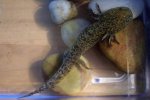
I have a 4.5yr old wild-type male Axie named Abe. As I'm sure you'll see from the pics ... he is missing 1.5 limbs (one complete rear leg and half a front limb) but has been this way for at least 4 years and manages just fine!

The reason I'm posting is ... lately Abe's colors seems to be lightening! At first I thought it might be a fungus but, he doesn't really have anything growing on him (I put him in a salt bath last night and it didn't seem to make a difference.). He is eating normally and acting very typically (wiggles like crazy when he sees someone!). I'm wondering if someone could help me figure out whats going on!

the first two pics are abe now...the third is abe a year or two ago. The color fading is most noticeable on his nose and back, please let me know what you think! thanks!
 

Attachments

  • 100_1823.jpg
    100_1823.jpg
    67.1 KB · Views: 409
  • 100_1824.jpg
    100_1824.jpg
    59.4 KB · Views: 407
  • little Abe.jpg
    little Abe.jpg
    70.3 KB · Views: 373
What is the temperature in your tank? It could be heat stress.
 
His tank is in the basement and it is the middle of winter here in New York. I don't have a thermometer but his water is cold (55-60 degrees F). I also have 2 golden albino's in another tank and they seem fine - although i wouldn't be able to tell if they were loosing color! Would low temperatures cause him to loose pigment in his skin? I've checked on him multiple times today and he is still acting normal.

I'm just concerned ... he's my best little axie!
 
The colors and patterning can change over time and with age. If it is just color and no noticeable fungal growth, weight or behavior changes. I wouldn't worry too much. How fast did his color change?

Oh, I see the pale spots. Nevermind, that looks to be not normal. Could it be a bacterial infection? Have you checked your water's parameters?
 
What kind of sand is that? How's his diet? The axie looks generally unhealthy, but it's hard to say what it might be. I also notice that his tail looks rather kinked, and he hasn't been particularly plump, even a year ago. How does his body weight compare to your other two?
 
Have you changed the substrate ? When I changed mine from dark sand to a bare base my wild type axolotl's colour lightened.
 
He has always been skinnier than my other two (and they are fed the same thing at the same time). They are fed frozen brine shrimp cubes 2 times a week with an occasional earthworm in the summer when I find them! They will only eat by hand and I'm not sure if brine shrimp gives them everything they need. I do not know what is best to feed them, brine shrimp is what they got in the laboratory where I got them.

How do I check his water parameters? Are there kits I can buy? He currently has a low flow whisper filter (has had it since I got him 3.5yrs ago) and a bubble stone in his tank. His sand is a non-salt water sand ... the same sand I've used for years, his sand was completely changed about 9months ago and he got a new filter on Sunday.

I was a Chemistry/Biology major in college and a professor I had was studying Axolotl regeneration properties. I got Abe when he was 6mons, after he had been used in research (which is why his limbs are not right - a de-nervation experiment with unexpected results!). He is special to me and I really want to help him live a long happy life!

He is still acting normally, I gave him another salt bath last night (I figured it couldn't hurt, only help). Thanks for all of your help!

Here are my other babies: Amadeus and Annabelle
 

Attachments

  • amadeus in his hiddy-hole.jpg
    amadeus in his hiddy-hole.jpg
    137.1 KB · Views: 338
  • annabelle!.jpg
    annabelle!.jpg
    123.1 KB · Views: 352
Hi Ashlee,

I would change the staple diet to earthworms (earthworms contain all the nutrition an axolotl needs) and only feed brine shrimp on occasion if at all. Brine shrimp is very messy and can contribute to water quality issues.

Further information on suitable menu options for an adult axolotl can be found here and most importantly information on the best source of nutrition there is for axolotls: worms. For nutritional information this article is most helpful: Nutritional Values.

You can check on the water parameters by testing for Ammonia (Most important), Nitrite (Important as well - but Ammonia is the priority) and Nitrate (handy to know). Ammonia and Nitrite must read at '0' - anything higher is toxic to an axolotl.

The most reliable test kits are the liquid test tube kits. Don't buy test strips as these are notorious for giving woefully inaccurate readings and you really do need accuracy as water quality is most important to an axolotl's health.
 
General chit-chat
Help Users
  • No one is chatting at the moment.
    There are no messages in the chat. Be the first one to say Hi!
    Back
    Top