
mikebenard
New member
- Joined
- May 7, 2007
- Messages
- 49
- Reaction score
- 13
- Points
- 0
- Country
- United States
- Display Name
- Mike Benard
In the middle of February I visited California to do some research with colleagues in Napa County, California. By the day I arrived, Napa County had received lots of rain, the ponds were full, and the California Newts and Pacific Chorus Frogs were in full reproductive action.
One of the male California Newts that we saw had an interesting set of deformities. His right hind foot was split, and he had an unusual pair of protuberances coming out of his tail. The hind foot deformity was no real shocker; while this is the first time I've seen a limb deformity out of thousands of Taricha torosa I've looked at, limb deformities have been described in many amphibians. I've also seen occasional limb deformities in frogs and salamanders. What really caught our attention were the strange protuberances on the salamander's tail. I had never seen deformities like this before, and they are not commonly reported in many of the papers I've read. It left us wondering what caused them ... parasite infection? . . . tumor? If you've got an idea of the cause, I’d be interested in hearing it.


After a couple quick photos, we released the newt; despite his deformities he appeared healthy and ready to continue on with his quest for mates. He wasn't the only amphibian who felt that romance was in the air. We visited a few more ponds, and found newts and chorus frogs in full mating mode.
Here is a male newt on the edge of a pond; he almost appears to be waiting for a female to approach:

Here is a different male newt, floating underwater. He was slowly working his way around the edge of the pond, presumably sniffing for a mate.
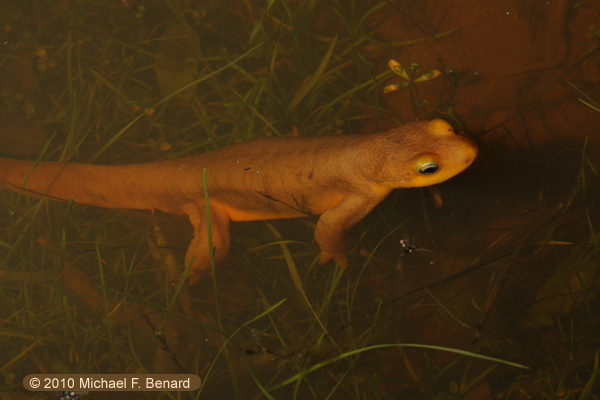
Here is a female California Newt trying to lay eggs. Despite her focus on egg-laying, a male clung to her back in amplexus, perhaps in the hope that she would still mate with him.


In case the still photos don't capture the mood of the newts enough, here is a video of California Newt breeding activity. In the first part of the video, you can see some of the courtship behavior of the newts. A male newt clings to the back of a female, and uses his hindlimbs to repeatedly stroke her body and hindlimbs. This behavior can go on for well over an hour; if the male does things right, the female may accept him as a mate.
newt mating frenzy video
Clearly plenty of newt breeding activity had already happened by the time we visited this pond. Here is a clump of California Newt egg masses.

This post wouldn't be complete without acknowledgment of the true king of North American herps: The Pacific Chorus Frog (<i>Pseudacris regilla</i>). Here is a photo of a male calling his heart out, as well as a video of the little dude.

Pacific Chorus Frogs
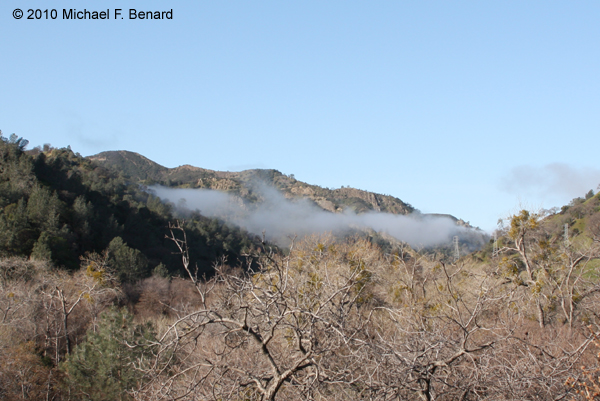
Finally, for anyone not fortunate enough to have herped California's Coast Range, here are a few habitat photos.

Mike
One of the male California Newts that we saw had an interesting set of deformities. His right hind foot was split, and he had an unusual pair of protuberances coming out of his tail. The hind foot deformity was no real shocker; while this is the first time I've seen a limb deformity out of thousands of Taricha torosa I've looked at, limb deformities have been described in many amphibians. I've also seen occasional limb deformities in frogs and salamanders. What really caught our attention were the strange protuberances on the salamander's tail. I had never seen deformities like this before, and they are not commonly reported in many of the papers I've read. It left us wondering what caused them ... parasite infection? . . . tumor? If you've got an idea of the cause, I’d be interested in hearing it.
After a couple quick photos, we released the newt; despite his deformities he appeared healthy and ready to continue on with his quest for mates. He wasn't the only amphibian who felt that romance was in the air. We visited a few more ponds, and found newts and chorus frogs in full mating mode.
Here is a male newt on the edge of a pond; he almost appears to be waiting for a female to approach:
Here is a different male newt, floating underwater. He was slowly working his way around the edge of the pond, presumably sniffing for a mate.
Here is a female California Newt trying to lay eggs. Despite her focus on egg-laying, a male clung to her back in amplexus, perhaps in the hope that she would still mate with him.
In case the still photos don't capture the mood of the newts enough, here is a video of California Newt breeding activity. In the first part of the video, you can see some of the courtship behavior of the newts. A male newt clings to the back of a female, and uses his hindlimbs to repeatedly stroke her body and hindlimbs. This behavior can go on for well over an hour; if the male does things right, the female may accept him as a mate.
newt mating frenzy video
Clearly plenty of newt breeding activity had already happened by the time we visited this pond. Here is a clump of California Newt egg masses.
This post wouldn't be complete without acknowledgment of the true king of North American herps: The Pacific Chorus Frog (<i>Pseudacris regilla</i>). Here is a photo of a male calling his heart out, as well as a video of the little dude.
Pacific Chorus Frogs
Finally, for anyone not fortunate enough to have herped California's Coast Range, here are a few habitat photos.
Mike
