AjaMich
New member
- Joined
- Jan 10, 2011
- Messages
- 15
- Reaction score
- 1
- Points
- 0
- Country
- United States
The Problem:
My male axolotl has been acting strangely. Yesterday he was floating and seemed to have something coming out of his mouth. I tapped on the tank, and he didn't respond. I agitated the water with my feeding tongs, and he didn't respond. Either of these actions typically get his attention. Then I poked him. He didn't seem to be breathing. He didn't respond. I rolled him onto his back... no response. He just buoyed onto his side. I thought he was dead for like ten minutes. I had seen him swimming before he started floating. I went to take him out of the tank and before I even touched him, he coughed releasing a number of large and very obvious air bubbles. Then he swam back down to the bottom of the tank.
I was shocked.
He's been acting a bit lethargic since this occurred. He's very personable and interacts with me all the time, and he's basically ignoring me. I fed him last night; he wasn't as excited about it as he normally is, but he ate anyway. His meal consisted of three trout worms and two night crawlers. I found the night crawlers in the tank this morning, so he regurgitated them. He's spent most of the day in his hiding spot, which is also strange.
The female axolotl I have seems to be completely fine. She's active, eating with zeal, and behaving normally.
Husbandry:
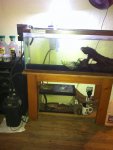
The male is an adult and almost 11 inches, total length. The female is a sub-adult (toe tips are black) and about 5 inches. Both are leucistic. They share the same water but are contained in different tanks. The tanks are connected via an overflow siphon. The system has two filters. One is an AquaClear "hang on back" filter intended for use with a 30 gallon tank. The other filter is is a Fluval 205 canister filter rated for 180 gallons. I use the HOB to oxygenate the water in the male's tank, and I rely on the Fluval to actually filter the water. The fluval media consists of carbon and biological media.
The male's tank is about 30 gallons. The female's tank is 5 gallons. The filter holds about 3 gallons. So the system is about 40 gallons.
Each tank contains some washed play sand as a substrate. I also have some aquatic plants in the male's tank. I use tap water and a water conditioner (Prime). The pH is typically 7.4 to 7.8. I don't test for nitrites or ammonia. Nitrates are always high. I've replaced about 15 gallons of water in the last 24 hours. I did 5 gallons yesterday at 1pm, tested the water at 4:30pm, did another 5 gallons. I tested last night at about 11pm, then did another water change today (5 gallons) at 2:30pm. I'll test again soon. The water temperature NEVER goes above 72 degrees Fahrenheit and never fluctuates rapidly. It's usually 66 to 68*F and then gently rises to about 70*F in the afternoon, where it stays for about 3 hours then it drops back down to the 60's.
I got some Salvinia about a month ago and put it in the tank. The HOB filter makes a mess of it so I turned it off. I have a feeling that the male has been acting strangely because the water isn't being agitated, and therefore may not be as oxygenated as he requires. However, his gills don't seem to be getting any longer.
He is fed abut every other day. His diet consists of night crawlers, trout worms, snails, beef heart (occasional), blood worms (live and frozen), and the San Francisco Bay brand freshwater multi-pack (brine shrimp, water, cyclops, daphnia, watercress, sodium alginate, spirulina algae, astaxanthin, yucca, wheat flour, brine shrimp, mysis, krill, plankton, spinach, romaine lettuce, red leaf lettuce, spirulina algae, menhaden oil, sodium alginate, etc.). However, night crawlers make up the bulk of his diet.
Any ideas as to what else this could be?
I am indescribably attached to this axolotl, and unfortunately, I haven't been able to find a vet where I am located.
Last edited: