LSuzuki
New member
- Joined
- Mar 20, 2014
- Messages
- 926
- Reaction score
- 12
- Points
- 0
- Location
- Ohio
- Country
- United States
- Display Name
- Laura
I search the forum and can't find anything like this. :sad:
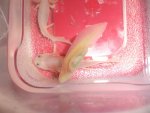
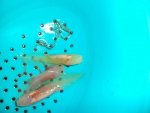
I will try to post pictures after I get home from work late this evening.
To make a long story short, the main symptom is gills back, legs back, twitching, with mouth gaping open, for a short period, followed by a period of lethargy and floating. This is triggered mainly by being jostled, but has also been seen to occur without being jostled.
I have 3 groups of babies, all about 7 weeks old. All have been growing well. I have been keeping them in small containers in small groups with 100% water changes 2-3 times a day, water dechlorinated either via aging or via API Tap Water Conditioner. Have been feeding exclusively live black worms for about 4 weeks
Two days ago in the morning water change, one of the babies reacted very badly. It acted stunned - gills back, legs back, twitching. It gradually started to make a recovery but began to be "floaty". I figured it had gotten jostled too hard during the water change or something.
That evening, the stunned one seemed to be mostly recovered but a bit slower than they typically are. However, a couple of other ones in the same batch did the same thing after the water change. In addition, sometimes their mouths gape open when this begins.
Yesterday, I started observing very carefully, and noted that it isn't the water change that is doing it, since this symptom starts before they get into the new water, sometimes before they are out of the old water. It has also "spread" to another batch, so it is not likely to be a genetic thing.
It seems to be triggered by being jostled. Sometimes it occurs when they are not being disturbed (except maybe by their siblings).
None of them have died (yet).
It looks like I would expect an epileptic fit to look like in an axolotl, so I'm wondering if something toxic with neurological symptoms is involved. Alternatively, perhaps it is something viral or bacterial. Ideas anyone?
Recently, I bought a new batch of black worms from a different source. They spend an extra day in transit (thanks FedEx), but seemed OK when i got them. I started feeding them about 3 days before this started. Has anyone ever had a problem like this associated with black worms?
Ammonia varies, since no filter. But 100% water changes 2-3 times a day should keep it low.
Nitrite 0 in yesterday's water before water change.
Didn't check nitrate
pH about 8.0-8.2
Water changes are done with water the same temperature.
Don't know the temp, but in the basement so in the low 60s.
Things I am already trying:
Switching to water that hasn't gone through the water softener.
Changing their diet to pellets
Putting them in larger containers so more water (and less rise in ammonia)
Any ideas anyone? If this continues, I will bring them into a vet, but if it is something environmental, I'd rather get the problem fixed asap.
I will try to post pictures after I get home from work late this evening.
To make a long story short, the main symptom is gills back, legs back, twitching, with mouth gaping open, for a short period, followed by a period of lethargy and floating. This is triggered mainly by being jostled, but has also been seen to occur without being jostled.
I have 3 groups of babies, all about 7 weeks old. All have been growing well. I have been keeping them in small containers in small groups with 100% water changes 2-3 times a day, water dechlorinated either via aging or via API Tap Water Conditioner. Have been feeding exclusively live black worms for about 4 weeks
Two days ago in the morning water change, one of the babies reacted very badly. It acted stunned - gills back, legs back, twitching. It gradually started to make a recovery but began to be "floaty". I figured it had gotten jostled too hard during the water change or something.
That evening, the stunned one seemed to be mostly recovered but a bit slower than they typically are. However, a couple of other ones in the same batch did the same thing after the water change. In addition, sometimes their mouths gape open when this begins.
Yesterday, I started observing very carefully, and noted that it isn't the water change that is doing it, since this symptom starts before they get into the new water, sometimes before they are out of the old water. It has also "spread" to another batch, so it is not likely to be a genetic thing.
It seems to be triggered by being jostled. Sometimes it occurs when they are not being disturbed (except maybe by their siblings).
None of them have died (yet).
It looks like I would expect an epileptic fit to look like in an axolotl, so I'm wondering if something toxic with neurological symptoms is involved. Alternatively, perhaps it is something viral or bacterial. Ideas anyone?
Recently, I bought a new batch of black worms from a different source. They spend an extra day in transit (thanks FedEx), but seemed OK when i got them. I started feeding them about 3 days before this started. Has anyone ever had a problem like this associated with black worms?
Ammonia varies, since no filter. But 100% water changes 2-3 times a day should keep it low.
Nitrite 0 in yesterday's water before water change.
Didn't check nitrate
pH about 8.0-8.2
Water changes are done with water the same temperature.
Don't know the temp, but in the basement so in the low 60s.
Things I am already trying:
Switching to water that hasn't gone through the water softener.
Changing their diet to pellets
Putting them in larger containers so more water (and less rise in ammonia)
Any ideas anyone? If this continues, I will bring them into a vet, but if it is something environmental, I'd rather get the problem fixed asap.
 They also seemed to be overall acting more "normal", but I can't quantify the difference in behavior between this morning and now.