Sick babies - twitching, gills and legs back

LSuzuki

New member
Joined
Mar 20, 2014
Messages
926
Reaction score
12
Points
0
Location
Ohio
Country
United States
Display Name
Laura
I search the forum and can't find anything like this. :sad:

I will try to post pictures after I get home from work late this evening.

To make a long story short, the main symptom is gills back, legs back, twitching, with mouth gaping open, for a short period, followed by a period of lethargy and floating. This is triggered mainly by being jostled, but has also been seen to occur without being jostled.

I have 3 groups of babies, all about 7 weeks old. All have been growing well. I have been keeping them in small containers in small groups with 100% water changes 2-3 times a day, water dechlorinated either via aging or via API Tap Water Conditioner. Have been feeding exclusively live black worms for about 4 weeks

Two days ago in the morning water change, one of the babies reacted very badly. It acted stunned - gills back, legs back, twitching. It gradually started to make a recovery but began to be "floaty". I figured it had gotten jostled too hard during the water change or something.

That evening, the stunned one seemed to be mostly recovered but a bit slower than they typically are. However, a couple of other ones in the same batch did the same thing after the water change. In addition, sometimes their mouths gape open when this begins.

Yesterday, I started observing very carefully, and noted that it isn't the water change that is doing it, since this symptom starts before they get into the new water, sometimes before they are out of the old water. It has also "spread" to another batch, so it is not likely to be a genetic thing.

It seems to be triggered by being jostled. Sometimes it occurs when they are not being disturbed (except maybe by their siblings).

None of them have died (yet).

It looks like I would expect an epileptic fit to look like in an axolotl, so I'm wondering if something toxic with neurological symptoms is involved. Alternatively, perhaps it is something viral or bacterial. Ideas anyone?

Recently, I bought a new batch of black worms from a different source. They spend an extra day in transit (thanks FedEx), but seemed OK when i got them. I started feeding them about 3 days before this started. Has anyone ever had a problem like this associated with black worms?

Ammonia varies, since no filter. But 100% water changes 2-3 times a day should keep it low.
Nitrite 0 in yesterday's water before water change.
Didn't check nitrate
pH about 8.0-8.2
Water changes are done with water the same temperature.
Don't know the temp, but in the basement so in the low 60s.

Things I am already trying:
Switching to water that hasn't gone through the water softener.
Changing their diet to pellets
Putting them in larger containers so more water (and less rise in ammonia)

Any ideas anyone? If this continues, I will bring them into a vet, but if it is something environmental, I'd rather get the problem fixed asap.
 
Are they having enough calcium? the twitching makes me think that it is calcium related (I DON'T KNOW MUCH ABOUT AXOLOTLS BTW!)
 
Xavier - you might be right. I hope you are, since I can "fix" that. :happy:

I'm raising them very much the way I did the first batch (unsoftened water for the first few weeks, then softened) but last time, I was feeding bloodworms, brine shrimp, and pellets at this age. It looks like blackworms are on the low end with respect to calcium content. Caudata Culture Articles - Nutritional Values

Do you think putting them back into unsoftened water would be sufficient, or am I going to need to supplement the blackworms with something with a higher calcium content? (The unsoftened water is a pain since only one faucet in the house has it, and I don't have a hose hookup.)
 
I search the forum and can't find anything like this. :sad:

I will try to post pictures after I get home from work late this evening.

To make a long story short, the main symptom is gills back, legs back, twitching, with mouth gaping open, for a short period, followed by a period of lethargy and floating. This is triggered mainly by being jostled, but has also been seen to occur without being jostled.

I have 3 groups of babies, all about 7 weeks old. All have been growing well. I have been keeping them in small containers in small groups with 100% water changes 2-3 times a day, water dechlorinated either via aging or via API Tap Water Conditioner. Have been feeding exclusively live black worms for about 4 weeks

Two days ago in the morning water change, one of the babies reacted very badly. It acted stunned - gills back, legs back, twitching. It gradually started to make a recovery but began to be "floaty". I figured it had gotten jostled too hard during the water change or something.

That evening, the stunned one seemed to be mostly recovered but a bit slower than they typically are. However, a couple of other ones in the same batch did the same thing after the water change. In addition, sometimes their mouths gape open when this begins.

Yesterday, I started observing very carefully, and noted that it isn't the water change that is doing it, since this symptom starts before they get into the new water, sometimes before they are out of the old water. It has also "spread" to another batch, so it is not likely to be a genetic thing.

It seems to be triggered by being jostled. Sometimes it occurs when they are not being disturbed (except maybe by their siblings).

None of them have died (yet).

It looks like I would expect an epileptic fit to look like in an axolotl, so I'm wondering if something toxic with neurological symptoms is involved. Alternatively, perhaps it is something viral or bacterial. Ideas anyone?

Recently, I bought a new batch of black worms from a different source. They spend an extra day in transit (thanks FedEx), but seemed OK when i got them. I started feeding them about 3 days before this started. Has anyone ever had a problem like this associated with black worms?

Ammonia varies, since no filter. But 100% water changes 2-3 times a day should keep it low.
Nitrite 0 in yesterday's water before water change.
Didn't check nitrate
pH about 8.0-8.2
Water changes are done with water the same temperature.
Don't know the temp, but in the basement so in the low 60s.

Things I am already trying:
Switching to water that hasn't gone through the water softener.
Changing their diet to pellets
Putting them in larger containers so more water (and less rise in ammonia)

Any ideas anyone? If this continues, I will bring them into a vet, but if it is something environmental, I'd rather get the problem fixed asap.


Doing as you are seems a reasonable approach (changing environment and diet) for the moment unless things get worse, or fail to improve in a few days. The main possibilities I would consider are (in no particular order):

- Toxicity associated with that batch of blackworms - the history and timing is suggestive though far from conclusive
- Environmental toxicity
- Nutritional deficiency (blackworms seem to have a very poor calcium to phosphorous ratio, and hypocalcaemia (low blood calcium) could cause signs like that. Or it could be other deficiency)
- parasites
- other infection.
(genetic) - you say different batches but are they different parents?)

Of these, you're covering blackworm or environmental toxicity with your changes.
Diagnosing nutritional deficiency would ideally require radiography and/or blood tests, even possibly biopsies, but the size of your axies probably precludes these. Pellets probably (check your product) have a reasonable calcium-phosphorous ratio so they should improve that slowly, and/or a vet could give you suitable treatments.
Checking a faeces sample for parasites might be useful (since gut parasitism could contribute to nutritional deficiencies) but is unlikely to pick up a parasite directly affecting the central nervous system (CNS)
Infections purely of the CNS are difficult to diagnose/prove. I wouldn't expect the signs to be intermittent, and would expect them to get worse if it were systemic infection, so that would be less likely.

In essence, doing what you're doing is probably the best initial approach unless they get worse. Realistically diagnostic information may be difficult to come by, apart from the faeces parasite check - probably worth getting that anyway, which I assume will involve a vet anyway and you can discuss it with him/her.

Hopefully won't happen of course, but if it does come to it that you get any deaths, getting a post-mortem exam will provide the most diagnostic information.

Hope this helps,

Bruce.
 
Hurray! With this evening's water change, none of the babies had seizures. :D They also seemed to be overall acting more "normal", but I can't quantify the difference in behavior between this morning and now.
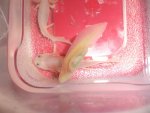
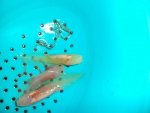
I've attached pictures from last night. In the strainer picture, two of the babies are on their sides with their mouths open looking dead, and the third is acting normally. In the "in water" picture, one is just drifting, looking dead. Note: there have been no deaths from this.

The key environmental changes from last night to this is that this morning: 1) I did a water changes with non-softened water (in half of the containers) and 50/50 softened (in the rest of the containers. 2) There is more volume of water per axolotl. I only changed from blackworms to pellets in 1/2 of the containers.

I have no idea how much calcium is absorbed from the water by axolotls. Does it make sense that a calcium deficiency could resolve itself that quickly? Is it possible that the calcium in the water was sufficient to take them out of the danger zone even though they are still deficient?

The three batches are from 3 different pairings, so this is unlikely to be a genetic problem. Only two of the batches had individuals that had seizures. The third batch is growing noticeably slower than the other two, so I am wondering if a rapid growth rate combined with a calcium deficient food and calcium deficient water could account for the problem.

Hopefully, they are recovering, but I am open to more info on possible causes. It would be nice to know with greater certainty what the issue is/was.

I will bring in a stool sample to the vet sometime soon before it is time to find them homes. If parasites are contributing to the problem, I don't want to spread it to other tanks.

Thank you, Xavier and Bruce! The info helped a lot!
 

Attachments

  • DSC00745.jpg
    DSC00745.jpg
    87.8 KB · Views: 648
  • DSC00748.jpg
    DSC00748.jpg
    48.6 KB · Views: 450
(snipped)Hurray! With this evening's water change, none of the babies had seizures. :D They also seemed to be overall acting more "normal", but I can't quantify the difference in behavior between this morning and now.

The key environmental changes from last night to this is that this morning: 1) I did a water changes with non-softened water (in half of the containers) and 50/50 softened (in the rest of the containers. 2) There is more volume of water per axolotl. I only changed from blackworms to pellets in 1/2 of the containers.

I have no idea how much calcium is absorbed from the water by axolotls. Does it make sense that a calcium deficiency could resolve itself that quickly? Is it possible that the calcium in the water was sufficient to take them out of the danger zone even though they are still deficient?

The third batch is growing noticeably slower than the other two, so I am wondering if a rapid growth rate combined with a calcium deficient food and calcium deficient water could account for the problem.

Hopefully, they are recovering, but I am open to more info on possible causes. It would be nice to know with greater certainty what the issue is/was.

Just with regards to your queries about calcium:

Blood calcium deficiency can resolve quite quickly, although whether there is enough in your water naturally to cause that I'm not sure. With calcium, the body tries to keep blood levels normal at the expense of taking it from the bones if necessary, so if blood calcium is low their overall calcium status is generally very bad.
Access to calcium (which they can absorb from the water, yes) can rapidly correct this, but bony density (which would show up on a radiograph, but yery difficult on these size of babies) will take longer - weeks to months - to build back up. So yes, they could be out of the hypocalcaemia danger zone but still very deficient.
More rapid growth rate could certainly contribute. In a batch of youngsters in reptiles, for example, on deficient diet, you get some that seem to grow slowly, almost to the available calcium, and don't show signs of metabolic bone disease; some that grow normally and may or may not show signs; and some that grow faster than their siblings and almost always show signs.

It would be interesting to know the calcium content of the water (and also other things - e.g. phosphate can affect levels of available calcium, and high phosphate water has been though to be involved in metabolic bone disease problems).

Hope this helps,

Bruce.
 
Just a thought, and I know NOTHING about axis except what I learn here (which actually, it's quite a bit lol)... But could it be a defensive/scared/anxiety reaction? I know... Probably stretching it, but...
 
Water changes with softened water are so much easier due to plumbing reasons in this house. So, time to get the stuff to make a Holtrefeter's Solution, at least until they are old enough for earthworms. Axolotls - Requirements & Water Conditions in Captivity

I don't know the cacium levels in unsoftened water, but I think I can find it on line after work. It is pretty high though.
 
Wow. That is a lot to read. Dechlorinating by sitting water out usually does not work. Most cities have chlorine and chloramine in the water. The chloramine needs to be chemically unlocked. Most normal aquarium dechlorinators will do this.
 
Fortunately, we don't have chloramine. :happy: (We used to live in an area with chloramine, so I'm well aware of those dangers.) I have 2 10 gal tanks to age water in, so I can let it sit a few days to dissipate the chlorine. If I'm not sure, I add some dechlorinator too. (I happen to know that when this started, the water had been treated with dechlorinator, so it definitely wasn't chlorine. I did suspect the dechlorinator, though.)

I can't find the instructions for the (ancient) hardness water test I have. While the chemicals may be too old to use, I had recorded the values for hardness when I first purchased the kit. However, I know there is a lot of calcium in the water, since it is ground water and there is lots of limestone in the area.

The axies seem perfectly fine again. I would love to conclude that these symptoms were due to a calcium deficiency, but I don't want to jump to conclusions. I can't be the only one raising babies on blackworms in water-softened water, so I would have expected to find that someone had had a similar problem in the past in this forum.
 
General chit-chat
Help Users
  • No one is chatting at the moment.
  • Chat Bot:
    SSV has left the room.
    +1
    Unlike
  • Arlet:
    Hello, may I ask a question here? Or do I need to ask a question somewhere else?
    +1
    Unlike
  • Rorey132:
    Is this guy still available?
    +1
    Unlike
    Rorey132: Is this guy still available? +1
    Back
    Top