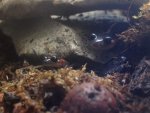
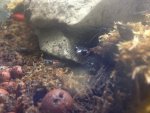
Surprise baby Plethodon jordani

Neotenic_Jaymes

Active member
Joined
Oct 28, 2007
Messages
971
Reaction score
58
Points
28
Location
Detroit
Country
United States
While doing a feeding today I noticed a couple baby Red Cheek Salamanders. I usually don't give that tank a very thorough look, it kind of gets ignored because of the placing of the tank. Lower level a couple inches off the floor. Today I sat on the floor and did a feeding and noticed a couple babies poking their heads out.

Here is a picture of a baby with an adult.
 

Attachments

  • image-1.jpg
    image-1.jpg
    91.3 KB · Views: 874
  • image.jpg
    image.jpg
    100.8 KB · Views: 804
Congrats! That means you're doing it right :p Very interesting species I wouldn't have known about if it weren't for your avatar. Look at those massive eyes
 
That's awesome!! How long have you had them, and where did you get the adults?
 
Congratulations. It is always good to hear of Plethodon breedings.
Chip
 
I already told you on fb how cool that was. Could you give a little bit of details on setup, temps, humidity, possible trigger? That would be great - I hope the only group in europe I know of will have some success in the future as well...
 
They occur in other places than the Great Smokey Mountains National Park. And from what I remember he told me a couple places he was visiting and one of the places had a Native American name. Thats all I remember and if he said GSMNP I would have remembered. He wasn't in any National Park or Nature Reserve I tell you that.It would be silly to post something about the salamanders if they were i'll caught.


Gsmnp ...

Are you saying they are from the GSMNP? Or asking? Well I don't see any question marks...
 
I'd just suggest you do some research into the distribution of that species as it is currently described.
 
Yep, taherman nailed it. I figured he knew the answer based on his short question.

Mike
 
Congrats. You're obviously doing something right.
 
I'd just suggest you do some research into the distribution of that species as it is currently described.

I've read a couple saying that they only occur in the Great Smokey Mountains National Park. But I've come across range maps and other article snippets with other locale information.

Here's a link to a range map of Plethodon jordani. It shows GPS coordinates, longitude and latitude. There are many locations outside the GSMNP.

BerkeleyMapper

So after we get through the 2 issues, ill collecting and their range are you going to say anything about the breeding? Or you just here to test the quality?
 
That map is not accurate and is based on old distributions before P. jordani was split into multiple species. The red cheeked variety, is the only one which kept the name P. jordani, and is only found in the park at higher elevations. Now there are some other species which can have the red cheek a bit also, but in general, it is not very pronounced, and you find more red typically distributed on their legs also.

Mike
 
Do you have sources to back that the map is false? At least Jaymes presented sources.
 
Do you have sources to back that the map is false? At least Jaymes presented sources.

Sure. Here is a better map which is more up to date.

AmphibiaWeb - Plethodon jordani

I am not sure what that isolate in Georgia is all about. I have doubts that is really P. jordani. You can also look at other species which were considered to be jordani in the past, such as shermani or cheoah. There is also the Highton and Peabody 2000 paper published in The biology of Plethodontid Salamanders. This book is full of a number of manuscripts and is super expensive. It is also very hard to get those manuscripts outside of that book. I could also recommend some articles on the evolution and relationships of Plethodon, but they do not really address geographic distribution.

Also, while Berkleymapper apparently did get an upgrade recently, which is kind of cool, their collection is not always up to date with the taxonomy. For instance, this next map is the map for Eurycea multiplicata. This species is only found in the Ouachita mountains, however in this map, it has the species ranging into the Ozarks also. However, the species in the Ozarks are actually E. tynerensis. This is described in Bonett and Chippindale 2004. "Speciation, phylogeography and evolution of life history and morphology in plethodontid salamanders of the Eurycea multiplicata complex" Interesting enough, even if they did update the map to what I just said, in a few more years, species in the Ozarks and Ouachitas are going to be split more based on genetics. This work will come out of the lab I work in, Dr. Ron Bonett.

I don't mean to pick a fight with anyone, but if those are P. jordani, then they were collected from within the park. I am not going to report anyone or anything, I am just saying. I am very familiar with Plethodontid salamanders in that area of the country. Especially, Desmogs, which often share similar distributions with Plethodon. For example, Desmognathus imitator also is primarily with the park, except for one place I know of where they do not look like imitators and it is on private property. Taherman also probably knows that place well since I am pretty sure he has collected from the park himself. Also interesting, is the specimens he collected may represent distinct species. He should really publish his thesis.

Now if you want me to comment on Plethodontid breeding, I will.

Does anyone ever have any issues with little white mites crawling on their Plethodontid eggs?

Mike
 
I already told you on fb how cool that was. Could you give a little bit of details on setup, temps, humidity, possible trigger? That would be great - I hope the only group in europe I know of will have some success in the future as well...

The group experienced simulated whether conditions. Dryer in the summer and very cold in the winter. Basic forest floor set up with dirt substrate, moss, wood logs and rocks. I actually don't know when the eggs were laid and how old the juveniles are. I'll definitely be keeping a closer view point.
 
General chit-chat
Help Users
  • No one is chatting at the moment.
    Sclater94: Could anyone tell me what likely morph my baby axolotl is? +1
    Back
    Top