
-
Did you know that registered users see fewer ads? Register today!
- Advanced Discussion
- Species, Genus & Family Discussions
- North American Newts (Notophthalmus & Taricha)
You are using an out of date browser. It may not display this or other websites correctly.
You should upgrade or use an alternative browser.
You should upgrade or use an alternative browser.
Taricha torosa eft journey
- Thread starter dorm.room.biology
- Start date

dorm.room.biology
New member
- Joined
- Oct 1, 2025
- Messages
- 22
- Reaction score
- 12
- Points
- 3
- Location
- Terre Haute, Indiana
- Country
- United States
He grew 2 cm (in the tail, but still) from yesterday. Incredible. It appears the question of whether or not torosa needs calcium on an earthworm diet has been answered.
ctenosaura
New member
- Joined
- Oct 24, 2019
- Messages
- 11
- Reaction score
- 3
- Points
- 3
- Location
- California
- Country
- United States
- Display Name
- Ctenosaura
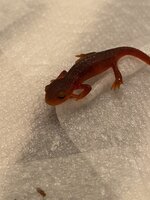
clover
New member
You could also start a white worm culture or get black worms. They're much smaller than earthworms but not as good nutritionally. They love eating them at this age because they're alive and will have that satisfying wiggle until you teach them to eat dead food. They will grow much faster on these than they will on just fruit flies. Until mine got a little bigger I fed them on white and black worms and kept fruit flies in their enclosure for free range snacking. Your newt is very cute.Just feed flightless fruit flies. You can get these at Petco and petsmart. When they get older then pinheaded crickets which may be harder to find.
My baby T. Sierrae is pounding down the fruitflys.
dorm.room.biology
New member
- Joined
- Oct 1, 2025
- Messages
- 22
- Reaction score
- 12
- Points
- 3
- Location
- Terre Haute, Indiana
- Country
- United States
Mine won't eat flightless fruit flies, on the rare occasions that he does try to eat them he usually misses and eats nearby dirt instead. He's big enough by now to eat most earthworms.Just feed flightless fruit flies. You can get these at Petco and petsmart. When they get older then pinheaded crickets which may be harder to find.
My baby T. Sierrae is pounding down the fruitflys.
ctenosaura
New member
- Joined
- Oct 24, 2019
- Messages
- 11
- Reaction score
- 3
- Points
- 3
- Location
- California
- Country
- United States
- Display Name
- Ctenosaura
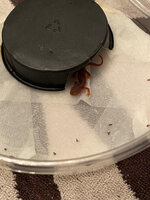
I keep my sierra newt on damp natural paper towels (no bleach / chemicals) in a semi large container with a lid. It allows me to see the flies and monitor how much he eats and craps and allows me to give it a 100% clean enclosure once or twice a week with a paper towel change. When he/she gets larger, I may move it to a more naturalistic aquarium. I don't have a source for worms.Mine won't eat flightless fruit flies, on the rare occasions that he does try to eat them he usually misses and eats nearby dirt instead. He's big enough by now to eat most earthworms.
This newt was pulled out of someone's swimming pool in Placer County by my pool guy and was told he left me another one now which ill see in a week when we go back to our place there.
Attachments
clover
New member
Oh wow thank you for rescuing him. Another supplemental food you could do if you don't have access to worms is frozen blood worms and just leave some in there on a paper towel at night. If you're planning to keep them permanently you can look into vermiculture. I'm doing it and I think dorm.room.biology is also doing it. I have European nightcrawlers and they're pretty easy to care for.
dorm.room.biology
New member
- Joined
- Oct 1, 2025
- Messages
- 22
- Reaction score
- 12
- Points
- 3
- Location
- Terre Haute, Indiana
- Country
- United States
I have mine on some zoo med creatures soil with moss, springtails and small soil insects, and small earthworms. I set it up like this so that he could hunt his own food since the worms do explore around the enclosure pretty often at night, I figured it'd make a good emergency food supply if for some reason I was unavailable to feed him. Also he likes to hide under the moss more than any of the other three hides of varying sizes that I've tried to give him. Newts produce a surprising amount of waste, which I hope by now the moss and detritivores have grown to take care of but your setup does sound more hygenic.I keep my sierra newt on damp natural paper towels (no bleach / chemicals) in a semi large container with a lid. It allows me to see the flies and monitor how much he eats and craps and allows me to give it a 100% clean enclosure once or twice a week with a paper towel change. When he/she gets larger, I may move it to a more naturalistic aquarium. I don't have a source for worms.
This newt was pulled out of someone's swimming pool in Placer County by my pool guy and was told he left me another one now which ill see in a week when we go back to our place there.
Growing worms is very easy, you need a box of dirt with some optional drainage, worms, and any non-toxic compost material. I personally keep red wigglers since they're hardy and mostly edible size for amphibians. For gut-loading nutrition I use the uncle jim's worm farm food which is extremely cheap and complete, but they'll eat anything especially if you buy a starter soil sample that has other small soil animals. Most worms you can buy online come shipped in mature soil that seeds your setup with all the organisms required for a healthy soil ecosystem.
There are all sorts of other bells and whistles you can buy and many online vermiculture guides are oddly complicated for some reason, but a box of dirt and some food is literally all you need. It's tremendously convenient to have an infinite supply of pet food on hand, so I highly recommend it if you're interested. I do the bare minimum of maintenance on my vermiculture setup, often not opening it for days at a time, and have never had a problem with it.
dorm.room.biology
New member
- Joined
- Oct 1, 2025
- Messages
- 22
- Reaction score
- 12
- Points
- 3
- Location
- Terre Haute, Indiana
- Country
- United States
Eft weighs over 2 grams by now, though weight fluctuates significantly with defecation. This morning I found his stool inside of the water bowl for the first time, he usually poops on land. It was oddly round and definitely greater than the width of his cloaca, so he might've decided to use the water to soften it a bit so he could pass it easier. Usually his waste is somewhat oblong but this was basically spherical. I might dial back the calcium a bit.
Defecating in the water to make it easier to pass large waste products is a fascinating adaptation; honestly this probably evolved because amphibians have a propensity to happily swallow any soil that may be coating their slimy prey at the time of eating it, and it's an interesting way to deal with potential impaction problems. Though at this time I'm absolutely not going to purposely impact my newt to test whether this theory is correct, my mind now rests slightly more at ease whenever I watch him repeatedly miss the worm sitting millimeters in front of him to bite the dirt next to it instead.

Since I now have enough data for some basic analysis, I plotted his weight over time and tried a linear vs exponential fit to get a better idea of his growth trends. Somewhat to my surprise, the exponential fit was a good bit more accurate, suggesting his growth will only continue to accelerate.
Most importantly, note the large uptick in growth starting around the beginning of February when I started providing calcium again. Granted, this is a correlation between only two points (so far), but this is a growth rate of about 0.0375 g/day over a period of 8 days. This is 3.1x faster than the average of all previous intervals (0.012 g/day), and 3.6x faster than the linear model's constant rate (0.010 g/day), In just 8 days, he gained 0.30g, compared to 0.65g over the previous 58 days. The linear model predicts 0.083g growth, while the exponential model predicts 0.128g growth over this time period. The actual growth was 0.300g. This means the spike exceeded even the exponential model (which assumes accelerating growth) by 134%.
The February 7 data point sits 2.03 standard deviations above the linear trend line. In statistics, deviations greater than 2 SD are considered highly significant, and given the long trend of consistent growth before this, it's highly unlikely to be just random variation. The next highest growth rate in any previous interval was 0.040 g/day (October 12-15), and the most recent spike starting when calcium was supplemented again was still nearly double that rate.
This is probably the most significant result I've gotten so far in terms of scientific insight. I'm obviously going to continue measuring and if the growth continues at the highly elevated rate that it's been at recently, then I believe we've anecdotally answered the question of whether or not calcium is required for torosa on a diet of earthworms. Something else that might be interesting would be to test the effects of calcium dust with vitamin D3 vs calcium dust without it, but a comparative analysis like that would require a much larger sample size. Next fall I plan to buy at least 20 efts, ideally from the same clutch, to test this.
Defecating in the water to make it easier to pass large waste products is a fascinating adaptation; honestly this probably evolved because amphibians have a propensity to happily swallow any soil that may be coating their slimy prey at the time of eating it, and it's an interesting way to deal with potential impaction problems. Though at this time I'm absolutely not going to purposely impact my newt to test whether this theory is correct, my mind now rests slightly more at ease whenever I watch him repeatedly miss the worm sitting millimeters in front of him to bite the dirt next to it instead.
Since I now have enough data for some basic analysis, I plotted his weight over time and tried a linear vs exponential fit to get a better idea of his growth trends. Somewhat to my surprise, the exponential fit was a good bit more accurate, suggesting his growth will only continue to accelerate.
Most importantly, note the large uptick in growth starting around the beginning of February when I started providing calcium again. Granted, this is a correlation between only two points (so far), but this is a growth rate of about 0.0375 g/day over a period of 8 days. This is 3.1x faster than the average of all previous intervals (0.012 g/day), and 3.6x faster than the linear model's constant rate (0.010 g/day), In just 8 days, he gained 0.30g, compared to 0.65g over the previous 58 days. The linear model predicts 0.083g growth, while the exponential model predicts 0.128g growth over this time period. The actual growth was 0.300g. This means the spike exceeded even the exponential model (which assumes accelerating growth) by 134%.
The February 7 data point sits 2.03 standard deviations above the linear trend line. In statistics, deviations greater than 2 SD are considered highly significant, and given the long trend of consistent growth before this, it's highly unlikely to be just random variation. The next highest growth rate in any previous interval was 0.040 g/day (October 12-15), and the most recent spike starting when calcium was supplemented again was still nearly double that rate.
This is probably the most significant result I've gotten so far in terms of scientific insight. I'm obviously going to continue measuring and if the growth continues at the highly elevated rate that it's been at recently, then I believe we've anecdotally answered the question of whether or not calcium is required for torosa on a diet of earthworms. Something else that might be interesting would be to test the effects of calcium dust with vitamin D3 vs calcium dust without it, but a comparative analysis like that would require a much larger sample size. Next fall I plan to buy at least 20 efts, ideally from the same clutch, to test this.
jle
New member
- Joined
- Feb 18, 2025
- Messages
- 17
- Reaction score
- 7
- Points
- 3
- Location
- Houston, TX
- Country
- United States
I love this thread and appreciate the data-driven updates!
- Advanced Discussion
- Species, Genus & Family Discussions
- North American Newts (Notophthalmus & Taricha)
General chit-chat
- No one is chatting at the moment.