White Spot?

School Tech

New member
Joined
Oct 11, 2012
Messages
15
Reaction score
0
Points
0
Location
Perthshire, Scotland
Country
Scotland
A couple of our juvie Axolotls seem to be displayng something simillar to white spot (ich) that you might see on fish. Is this possible with axolotls?

I have recently decanted them from tubs to a small tank, they are around 3 inches long and have been reared from eggs. It was only when I put them in the tank that I could see the small white specs, maybe a twenty, on the tail of a golden albino. I've since noticed a small patch of half a dozen white spots on the tail of another golden albino. The spots seem to be spreading to the belly on the first axolotl I found them on. The Axolotls themselves seem prefectly heathy, feeding well and no signs of stress. They are back in tubs now "isolated" from the other juviniles.

I had put some floating plants and java moss from a (what appears to be a very healthy) fish tank into the axolotl tank - I suspect that the white spots probably pre-dated the plants but I can't be sure.

I've tried to get photos but just can focus enough. I've looked at loads of pictures on here but have not seen anything simillar. As I mentioned looks very much like white spot that you'd see on fish.

Anyone any experiance of simillar or advice on what to do? I'm reluctant to try treat it with any of the fish remedies....
 
Thanks for the link, don't know how I missed the previous whitespot discussion. I think it probably solved where the white spot has come from, if nothing else. I cheated with the cycling of the tank and had "seeded" the sponge filter by placing it in an external fishtank filter box. I suppose that the white spot could have been introduced that way.

Think I'll stick to keeping the axolotls in isolation and monitoring before statring out on any treatment. I've just started feeding eath worms maybe that has stressed them out a bit and resulted in an outbreak - certainly stress seems to be the trigger in fish.
 
Once white spot is in a tank it could potentially lie dormant or exist at very low levels, the inhabitants develop a resistance and show no sign of symptoms.This happens with fish, a tank with low levels of white spot infects new fish who have no resistance to it, they become infected , the levels of white spot increase in the tank infecting the original inhabitants. People often think that the new fish are the cause of the introduction of white spot but they arnt, it was already there, the new ones are just vulnerable to infection from a lowered immune system caused by being messed about in the pet distribution system or have not been infected before. You may want to restart your cycle after cleansing the tank and treating the axolotls.
 
I've moved the two axolotls back to containers (and daily water changes), hoping that may be enough to clear the white spot but if not I'll get out the Methelyne Blue - I've already emptied the tank they were in and will start again once the white spot is gone..
 
Golden axolotls quite often have shiney patches of white pigment on their tails and gills. It may be normal colouring. Would it be possible for you to post a picture of them?
 
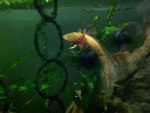
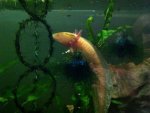
Found a use for the clear cover on my water test kit and used it as a clear "tank" so I could attempt a decent photo.

The first image shows the whole axolotl, I'm now fairly confident that the spots on it's abdomen that I first thought were "spread" is actually just the natural colouring.

P1030296.jpg


This image shows the larger white spots on the tail, that I think are Ich or some sort of parasite.

P1030297.jpg


Just can't get a better photo though, the micro setting on my camera just won't focus on the area. The axolotl seems happy enough feeding well and not displaying any signs of stress.

Happy to hear your thoughts....
 
It looks like normal reflective pigment to me, however I am squinting on a phone so can't see an enlarged photo.
 
I go with it being the normal pigment on the abdomen but the bigger clumps of white on the tail, seem suspicious to me. They stand proud of the skin and are more prominet on one side of the tail. I don't have enough experiance of axolotls to be sure though. If you guys think it is just natural pigmentation then I'm happy to go with that.
 
That's normal iridophore pigment for a golden albino. Mine have those spots that are much bigger than that and have had them their whole lives :eek:
 
Me too. When people have come to adopt my juvies they often select the ones with the most pigment. One person named hers Glitter and Sparkles.
 
Ya, that is just pigment. He should be really pretty when he grows up big.
 
Here's a couple of shots of one of KerryM (above) goldens - they all show beautiful iridescent sparkles
ImageUploadedByTapatalk1362365387.450435.jpgImageUploadedByTapatalk1362365403.882143.jpg


<3 >o_o< <3
 
I love all your pictures Nikki. They are the best shots of my little ones so I am madly saving them on my phone. The axies look even prettier in your lush green tank, they are in paradise :)
 
General chit-chat
Help Users
  • No one is chatting at the moment.
  • Chat Bot:
    SSV has left the room.
    +1
    Unlike
  • Arlet:
    Hello, may I ask a question here? Or do I need to ask a question somewhere else?
    +1
    Unlike
  • Rorey132:
    Is this guy still available?
    +1
    Unlike
    Rorey132: Is this guy still available? +1
    Back
    Top