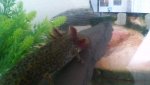
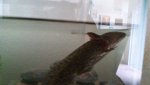
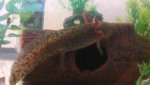
Illness/Sickness: Wild Type W/ Shiny White Spots

CortAndCat

New member
Joined
Apr 7, 2016
Messages
9
Reaction score
0
Points
0
Location
Wa, US
Country
United States
This is Abe. Came home from work today and the tank was at 63.5 degrees F. The white spots have been there since we got him when he was about 2 inches and 6 weeks old. They have grown with him (he is now over 5 inches), don't stick out, and have a luster to them instead of a cloudy or fuzzy appearance. So, to my husband and I, those are normal (though we are starting to worry that it my be something else since we have never seen a wild type with the white spots). His stomach is almost black and his color is waaaaaaaay darker today than normal. He is usually a light green and his tummy should be super light in color too. It's hard to describe but his stomach should be like a white-gray or kind of creamy and sort of transparent so, when he eats it gets all red.
My husband and I would feed him twice daily a diet of blood worms but it was hard to keep the water clean so last week we changed his feeding to a slightly bigger portion of blood worms once a day.
Honestly, I don't know the levels of ammonia and stuff in his tank. The pet store was out of stock on the AquaMaster water test kit when we were in last. But we do change 50ish% of the water every other day and he has two little rock and sponge filters in his 10 gallon tank that are hooked up to an air line. I also learned from another post I did a while ago to establish that slimy bio-filter on the rocks(because I would clean everything in there before) so, that bio-filter is pretty healthy looking now and I even put extra plants in there for it to build on.
He was fine yesterday! I just came home and he looks like a different axolotl. The only things that look the same on him are his white spots. He even looks too thin and has ridges down his that resemble ribs. He did not look like that before.
Do I need to take him to the vet? Or fridge him? Or salt bathe him?
 

Attachments

  • WIN_20160526_092635.jpg
    WIN_20160526_092635.jpg
    49.8 KB · Views: 466
  • WIN_20160526_092548.jpg
    WIN_20160526_092548.jpg
    63.3 KB · Views: 569
  • WIN_20160526_092602.jpg
    WIN_20160526_092602.jpg
    62.7 KB · Views: 467
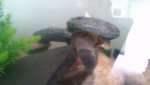
Bad pictures. Sorry. I tried. But, here is a picture of him from three days ago so you get an idea of what his color should look like.
 

Attachments

  • WIN_20160523_103456.jpg
    WIN_20160523_103456.jpg
    61.9 KB · Views: 498
Whatever you do, don't fridge him or salt bath him.

I have only been keeping axolotls for 3 months, but out of the 6 I have, 1 is a mature wild type and 1 is a juvenile wild type. Looking at your pictures I would say that your fella looks normal. The ridges on the sides are normal and can be seen on all axolotls as they mature. The shiny patches are irridiphores, again perfectly normal. Axolotls do change colour and their markings usually darken as they mature, so the colour change you see is also normal.

So, my (admittedly not hugely experienced) diagnosis is "normal". It would be worth you having a look at the pictures and information in the link, Axolotls: The Fascinating Mexican Axolotl and the Tiger Salamander
and waiting for the more experienced keepers to offer their advice, as there may be something I'm missing that is obvious to them.

Best of luck and please keep us posted on progress. :happy:
 
Thank you, Donna, that really makes me feel better :) The drastic darkening of his skin over night still worries me though :( It has been a few hours and he still looks weird. Poor guy.
 
With my guys I don't clean everything, or do large water changes so often. I have 3 mature males in a 200L (50G) tank and 3 juveniles (approx. 6 inches) in another 200L tank. I poop hoover before feeding and clean up any uneaten food after. I do weekly water changes of around 15-20% at most. I don't clean any of the hides or bogwood, but move them to clean around and underneath during the weekly clean. I've had mine since early March, and cycled the tanks prior to adding the axolotls. My water parameters are 0 ammonia, 0 nitrite, and 40 nitrate (nitrate levels same as my treated tap water). My tank temperature is usually 19C. Again, I'm not very experienced, but spent several months researching axolotls on various sites, and hanging around this forum as a guest, before getting my gang, and this is what I do based on what I've read previously. I also keep a few fish tanks, so the nitrogen cycle stuff and cleaning tanks was also carried over from that.
Looking at the pictures of Abe, in the first set of pictures he looks like my juvenile wild type when it was a bit younger. Mine has darkened a lot since I've had him. In the picture in the second post Abe looks a lot lighter, more close in colour, but a little darker, than my juvenile coppers, so perhaps Abe is a light wild type. He is a very handsome fella, and utterly adorable. I have quite a few pictures in my album, if you want to take a look and see what I mean.
As long as your tank parameters are good, and Abe is behaving, eating and pooping as normal, I wouldn't be too worried for now. Hopefully the more experienced keepers will also be in touch, and offer some more advice.
:happy:
 
I agree with Donna. It sounds like he is just maturing into his adult colours. Which leads me to... how old is he?

I have 3. Female wild 4yrs, male golden albino 18 mths and female wild/melanoid 12mths. I only do 50% water change once week

Sent from my SM-G920I using Tapatalk
 
Btw depending on how old your little guy is. . I'd say he's a she ☺

Sent from my SM-G920I using Tapatalk
 
That coloration looks normal to me, and if they are iridescent, they are iridiphores as already mentioned. And as they mature, they get darker in color so that is not in and of itself cause for alarm.

As soon as you can, pick up an ammonia and nitrate test kit though. If there is any ammonia, use Prime to detoxify it and do frequent water changes to remove it until the system is processing it correctly (i.e. ammonia is 0ppm). Long term, you are aiming to keep your nitrates at 20ppm or below (having trouble doing this myself as the tank has been up 10+ years so doing frequent large water changes over the last couple of months).

Salt baths are really hard on them and would only do if absolutely necessary. My wild types have light patches that have never cleared up and with vet approval am finally doing every other day salt baths for 4 treatments. Observing them firsthand, they are not appreciating it at all and are under the weather.
 
Thanks for all the help, guys! We got a test kit and just the ammonia is a little high. Still doing weekly water changes and Abe is doing good. He(or she?) is still dark but acting normal.
Abe was born about Feb 11th. So, he is roughly 4 months old. I guess I didn't expect maturity so soon.
I appreciate everyone helping us figure out what's going on with our cute little guy!
 
General chit-chat
Help Users
  • No one is chatting at the moment.
    There are no messages in the chat. Be the first one to say Hi!
    Back
    Top