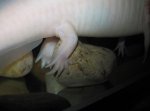
Wrinkly arms and legs

bunny27

Member
Joined
Oct 24, 2009
Messages
173
Reaction score
7
Points
18
Location
Minnesota
Country
United States
Hi, I was wondering if someone can help me with this. When I first got her, I noticed some wrinkles where her arm met with her body and thought that was normal but yesterday, I've been notcing that my axolotl's arms and legs were kind of wrinkly down to the toes. I also noticed that there were some pieces of transparent flakes floating in the water, which probably came from her skin. So I guess she's shedding.

She's a 7 inch juvie in a 20 gallon tank. The temperature is 58-60 degrees F. She eats mainly earthworms every other day. The water parameters are:

NO3- 40 ppm
NO2- 10 ppm
PH- 6.5
KH- 80 ppm
GH- 0 ppm

I am using the cheap API test strips, which I know aren't the best but it's better than nothing. I will try to obtain a better testing kit.

Any help will be appreciated! Thanks!!
 
Hi, not sure about the wrinkly arms but the nitrite no2 needs to be down to 0. Whats your ammonia reading? I think you need to do a water change to get the nitrite down. Mel
 
I have no idea what the ammonia reading is since there wasn't an ammonia slot to test the strip on. I've been changing water daily to try to get the NO2 down for sure though. I hope that works.
 
It shows that the tank is cycling. Your doing right by doing frequent water changes. You could do with gettin a master test kit which is the ones with the little test tubes. The master one includes ammonia too. Mel
 
The test strip ones are not too accurate. The colourimetric solution ones would be much better.

Could you provide some photos? When in doubt, always best to isolate and fridge the axie with clean dechlorinated water. Tea baths will be useful with skin shedding.
 
I didn't provide photos because it was hard to see the wrinkles, but here they are:

wrinkles.jpg wrinkles3.jpg wrinkles2.jpg

It looks like her skin is pruny and twisted around her leg and arms and not just where her body meets with her leg and arms. They look kind of dry looking.

I think the skin shedding may be coming from her arms and legs, since they were just little pieces of skin, but I could be wrong. She's not shedding a lot either.

And how do I perform the tea bath? I've never heard of that before! What kind of tea should I use? and do I put axolotl in the tea bath in the fridge? I would like to try this if it turns out I have to.

And when you say to but her in the fridge, should I do this until the nitrate levels go down?

Thanks!
 
Actually your axie looks fine. I really think its just normal skin shedding. But here are the instructions for fridging and tea baths.

Axolotl Sanctuary


The following is an extract from Caudata Culture by Daniel.

I mainly use teabaths for minor skin problems. It may also be used with fungal problems but on that account I prefer salt baths. Tea has a slightly antifungal and antibacterial effect (resulting from tannins) and additionally it closes the pores in the skin a little bit (mainly resulting from tannin and caffeine). The skin tightens and gets some kind of protective layer, making it harder for fungi and bacteria to intrude the body. On the other hand it makes it harder for salt or medicine to reach pathogens which are already inside the body - that is the reason I do not use it on fungal infections, although a tea bath is sometimes recommended as a cure for fungal infections by some people.
The medication is as follows: I take one bag of black tea without any additional aroma (it is important to use black tea because this kind of tea is fermented and so it has tannins) for every 10 litres of water (preferably used in a quarantine tank). This tea gets dashed with boiling water in a seperate bowl - I leave it there for at least 10 to 15 minutes so the tannins are resolved into the water. The tea has to cool down and is finally added to the quarantine water. After a week I make a bigger change of water (60% at least), the rest of the tea is removed over time by normal water changes. If you have to make more regular water changes (f.i. in a small bowl or tank) the tea concentration can be refilled. As far as I know there are no negative effects even for long term treatment.
A similar effect (although not as strong) may have the addition of dried oak or beech leafs now and then as a precaution.
 
General chit-chat
Help Users
  • No one is chatting at the moment.
    There are no messages in the chat. Be the first one to say Hi!
    Back
    Top