Preventing Escape
Compiled by Jennifer Macke
Escape is one of the leading causes of death for captive newts and salamanders. Unfortunately, most most of us have learned this lesson the hard way. We don't realize the hazard until losing an animal this way.
There are several things you can do to reduce this risk.
- Always keep lids closed. Compulsively.
- Never walk away from a tank with an open lid, even if you are coming right back.
- Engineer tank lids to make escape absolutely impossible.
- Never think that a newt or salamander "couldn't". These animals are Houdini-like in their ability to find a way out! Even large caudates (tiger salamanders and 10-inch ribbed newts, for example) have been known to climb glass and get out.
The photos below show specific things that you should do (or avoid) when designing a tank lid for a newt or salamander.
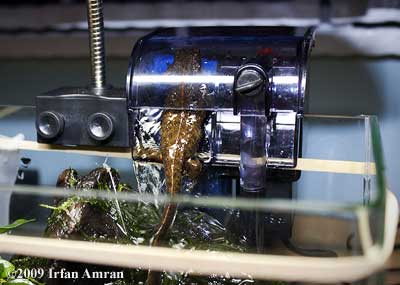 |
No Filters that hang on the back of the tank are not suitable for use with newts. The newt shown did, in fact, escape (but was luckily found alive). The filter was removed and the situation was remediated, as shown on this photo. |
 |
Yes Run tubing through holes just barely big enough. |
 |
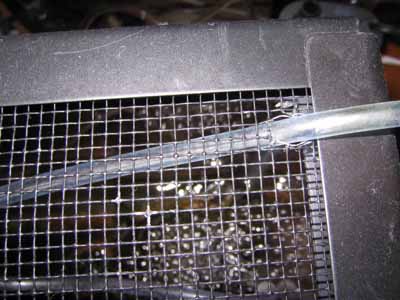
No Don't run tubing or cords under a screen lid - not even at the corner. This creates a large enough gap under the lid to allow small newts to escape. This method is OK for large newts. |
 |
Yes Large tubing for canister filters can be put through holes cut in the screen. |
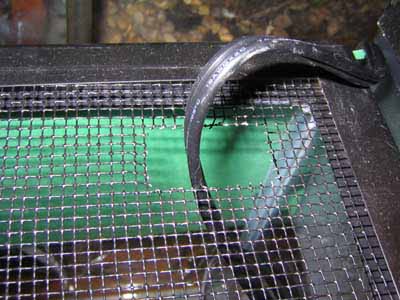 |
No Don't leave a hole like this open, as newts can climb the cord, like a monkey up a rope! |
 |
Yes Seal gaps with electrical tape. (Note that tape may not stick well to a screen lid. Foam, as shown below, is better.) |
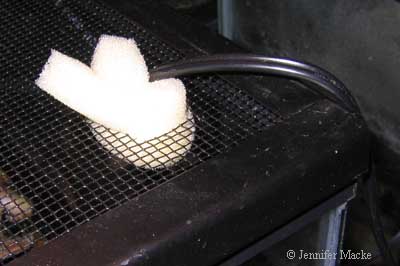 |
Yes Seal small gaps with soft foam, wedged firmly into place. |
 |
Yes Seal small gaps with soft foam, wedged firmly into place. |
 |
Yes Gaps around tubing can also be sealed by glueing pieces of plastic into place. |
 |
Yes Make homemade screen tops that fit flat against the entire top edge of the tank. |
 |
Yes Make homemade acrylic tops that fit flat against the entire top edge of the tank. Note that some forms of acrylic/plexiglass will warp when they are moist on one side, leaving gaps for escape; thus acrylic is generally not recommended for making lids, unless you are sure that it will not warp. |
 |
Yes Electrical cords can sometimes be accommodated by making a carefully-sized slot. |
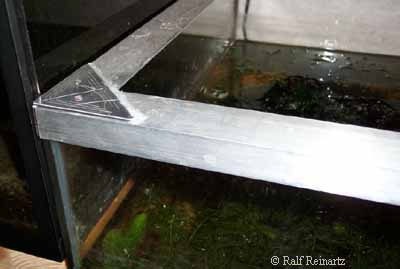 |
Yes A wide rim is enough to prevent escape. The standard rim on a standard manufactured tank is NOT enough to prevent climbing out. The tank shown here has an extra-wide rim added. For a temporary quick-fix, a rim can also be made with duct tape. |
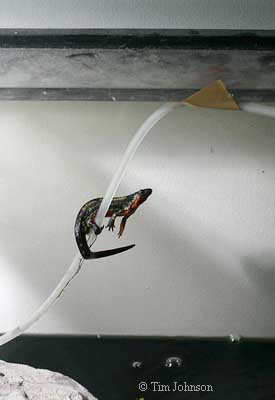 |
No A wide rim, as shown here, is worthless if cords or tubes are available for climbing. |
 |
Yes Large cut-outs in hoods can be covered with window screen material glued in place. |
 |
Yes Plastic tubs should have secure, tight-fitting lids. To improve ventilation, cut small holes. |
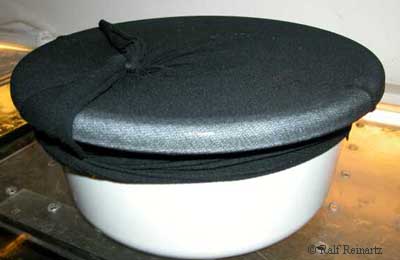 |
Yes In an emergency (larvae near metamorphosis and no tank available), panty hose can be used to cover a tub. |
 |
Yes In this unusual example, a cat litter box was used as a temporary tank. Duct tape was used to create a wide rim to prevent escape. |
 |
Yes Another example of a rim. In this case it is a rim of sturdy tape, placed along the top edge of the aquarium, UNDER a screen lid. |