
Shipping Caudates
By Jennifer Macke
One requirement for the long-term success of captive breeding is the ability to exchange animals among breeders. Fortunately, shipping adult newts and salamanders isn't difficult, as long as their temperature requirements are met.
Before you even think about shipping
Find out what the laws are in your country/state and the receiving country/state. Even if the animals are captive bred, this doesn't preclude legal restrictions. Several US states have very strict policies, and it is essential to know those policies before you even consider shipping an animal.
Shipping policies on animals.
Shipping carriers may change their rules about shipping animals at any time, so this article cannot give specifics about policies. It is very important to ask questions at your local shipping office before you pack up the critters!
Before you ship - checklist
- Research your local carriers to make sure that they offer the service you want. For example, the US Postal Service cannot do overnight delivery to certain zip codes. Ask about restrictions on shipping live animals.
- Find out the cutoff time. In most cases, packages don't move until evening, regardless of what time of day you bring it to the office, but cutoff times vary from one carrier and location to another. In some remote locations, you may need to get the package there as early as 1 PM for the package to get on the truck that day; in urban locations the cutoff may be as late as 5 PM.
- Set up a clear line of communication between sender and recipient. Getting their phone number is recommended; some carriers require it, and it's good to be able to contact them if there are last-minute problems.
- Double check the recipient's shipping address. You might be surprised how often their address in paypal is wrong!
- Determine whether the recipient is willing to pick up the package from a shipping hub, or if they need residential delivery. Pickup from a hub or post office is generally a better option, if they are willing and able to do that.
- Check the weather forecasts at the sending and receiving locations. Be prepared to postpone if the predicted weather is extreme.
- Find suitable shipping materials ahead of time (insulated box, temperature pack, etc).
Shipping Services
- US Priority Mail.Costs US$10-20 and takes 2-3 days (or longer; no guarantee). For most of the US, it is only safe to ship by this method during the spring and fall (above freezing, but below 75F).
- US Priority Express Mail. Costs US$40-80 and takes 1-2 days (with guarantee, for what it's worth).
- Fedex. They require shippers of animals to have a Fedex account with a special endorsement to be allowed to ship animals. They are generally 2-3 times more expensive, depending on the type of account you have, but are more reliable.
- Pack-n-ship shops. These places ship through a variety of carriers, but policies vary widely. Some will refuse live animal shipments, regardless of the policies of the carrier.
- Reptile shipping services. There are services that will provide you with all the shipping materials and labels you will need. The best-known is ShipYourReptiles.
How to pack
- Use a plastic container (deli-cup, etc.) of a suitable size and punch holes in it. Punch the holes going from inside toward the outside, so that the rough part of the hole faces the outside.
- Fill the container with damp substrate: moss, paper towels, or wet styrofoam peanuts. The damp substrate serves two purposes: it prevents the animals from drying out, and prevents them from bumping around when the box gets tumbled. Don't use heavy materials (like thick layers of wet paper towels), as these can weigh heavily on the animals if the box gets turned over.
- Put the deli cup inside an insulated container. Fill any empty space with packing material, such as bubble wrap or crumpled paper.
- Some carriers require that styrofoam boxes be covered by an outer cardboard box. This is another thing you may need to ask about beforehand.
- Even if the package says "this side up", carriers often ignore this. The animals should be packed well enough to withstand the box being turned over in any direction.
Summer shipping
In summer, add a frozen cold-pack, but be sure to put a layer of insulation between the deli cup and the ice pack so that the animals don't get too cold next to the ice pack. Pack securely with bubble wrap or crumpled paper. Don't ship if the expected weather is excessively hot.
Winter shipping
If you use an insulated container, you can avoid freezing by including a cold-pack, but start the cold pack at room temperature, not frozen. It will provide a bit of warmth that will delay any possible freezing. Do NOT use a heat pack, these are likely to warm the caudate too much, and that's more dangerous than cold. You just want to prevent freezing, not warm them. Don't ship if the expected weather is excessively cold.
Labeling the package
It can be labeled "harmless live animals". Or, perhaps better, just label it as perishable and handle with care.
Where to get shipping materials
Insulated boxes can be purchased online. If you want free boxes, you can request insulated shipping containers from local Freecycle or Buy Nothing groups. A lot of people receive such boxes and are happy to pass them along for reuse. Some veterinary clinics and labs are willing to pass them along.
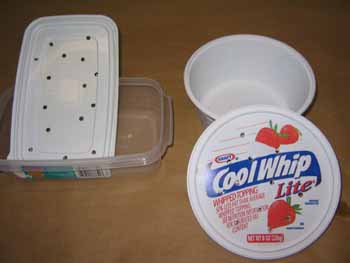 Containers for shipping. |
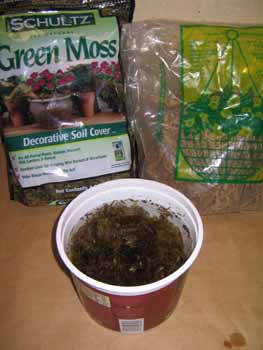 Moss soaking in preparation to use as padding around the animal. |
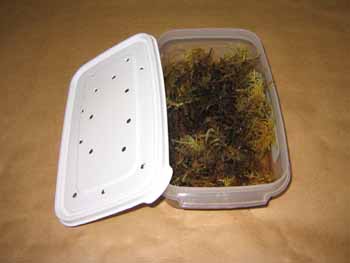 Container ready for shipping. |
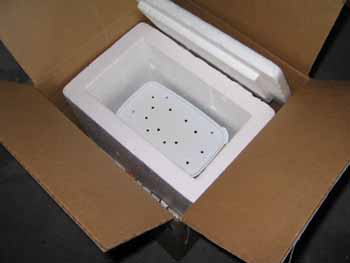 In hot weather, place container in insulated box with cold pack. |
Shipping eggs.
Eggs in early development can be shipped, and are able to survive several days in shipment. Cut off small pieces of plant leaves or plastic strips containing the eggs. Eggs laid on rocks can be carefully removed with a razor blade. Note that eggs in late development (close to hatching) often die during shipping, so plan ahead.
Method 1: Place the eggs into a tightly-sealed plastic bottle (approximately 8 oz / 250 ml) filled to the top with tank water. Don't leave air-space, as the sloshing may damage the eggs. There will be enough oxygen in the water to keep them alive for several days.
Method 2: Place eggs on a piece of wet paper towel inside a plastic audio cassette box, VHS box, or similar small firm box. Ship in an envelope lined with bubble wrap or inside a zip-close plastic bag.
Method 3: Place eggs and a small amount of water in a small breather bag, with no air. Breather bags can be purchased online, and they are made of plastic that allows air to transpire. Seal the bag with a firm knot and place it inside something crush-proof, such as a deli cup or other small container.
 Eggs ready for shipment in bottle (Method 1). |
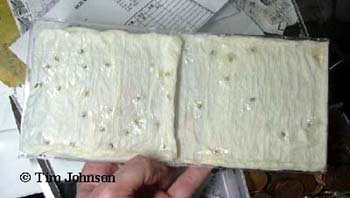 Eggs ready for shipment in plastic CD box (Method 2). |
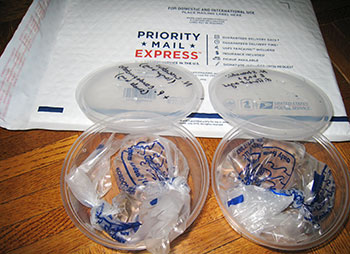 Eggs ready for shipment in breather bags (Method 3). |
|
Shipping larvae (or axolotls).
These are the hardest to ship because they need to be shipped in water.
Method 1 (for small larvae only): Put the larvae in a plastic soda bottle filled completely to the top with tank water. Pack in a box and ship as quickly as possible. The larvae can die from lack of oxygen if they are too crowded, so it is better to err on the side of sending fewer. Do not include plants, because in darkness plants consume, rather than produce oxygen. Do not include air, as the sloshing may do damage. For a small number of larvae, there will be enough oxygen to survive 1-2 days.
Method 2: Place water and an equal volume of air into a 1-gallon zipper-seal bag. Seal shut, then seal it again with packaging tape. Place into one or two addition bags, again sealing them doubly with packaging tape, in addition to the zipper seal. Pack snugly in a box.
Method 3: Use breather bags, which allow air to transpire. Do NOT include any air in the bag. Breather bags are the BEST way to ship, but the bags need to be purchased online ahead of time.
Posted January 2010. Revised March 2016. Revised August 2021.