
| Cynops orientalis | |||||||||||
| Chinese Fire-bellied Newt | |||||||||||

|
|
||||||||||
Description
A small newt (6 - 10.3 cm; 2.2 - 4 inches) which ranges in color from dark brown to black above with an orange to scarlet belly with numerous black blotches. There can also be small spots of orange coloration on the dorsum and particularly on the upper surfaces of the limbs. Some individuals possess a faint orange to brown dorsal stripe. The skin is relatively smooth, and C. orientalis has distinct parotoid glands. Males are smaller and thinner overall than the females and tend to be squarish in cross section in comparison with the larger, rounder females. Sexual dimorphism is also seen in the tail, with males having shorter tails with slightly higher tail fins. Like most newts, males have a swollen cloacal region which is especially pronounced during the breeding season.
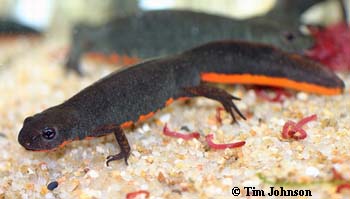 Male C. orientalis. |
 C. orientalis with light ash-white coloration. |
Some individuals of C. orientalis periodically lighten in color, and the resulting coloration can range from a ground color of ash-white, grey, tan, or even slightly burgundy. This color change is often accompanied by the appearance of a faint orange, red, or brown dorsal stripe and darker marbling along the flanks and extending onto the tail. The bright ventral coloration remains unchanged. There does not seem to be any consistent explanation for why this occurs, and the duration varies from hours to months. Some individuals may have these variant colors on a permanent basis.
This species is often labeled and sold under other names. It is often incorrectly identified as the Japanese firebelly newt, Cynops pyrrhogaster. It can be distinguished from C. pyrrhogaster by its smaller size, smooth skin, and the rounded shape of the tail. Additional features that can be used to distinguish these 2 species can be found in What Kind of Firebelly Is It?. C. orientalis is also sometimes sold under the name Trithoides chensis, though this name appears to be a creative invention, with no basis in any legitimate taxonomy.
 |

|
Natural Range and Habitat
These newts occur in the Chinese provinces of Jiangsu, Zhejiang, Jiangxi, Anhui, and Hubei. Researchers have described the natural habitat as “suitable water bodies at various altitudes, mountain ponds, small brooks, flooded fields in mountain valleys...” and "cold still ponds, wells, terraced fields, and ditches". Early researchers also stated “Always the water is cold and quiet, in the shade of grass, with a mud bottom free from stones, and the animals frequently swim up to the surface, darting back and forth actively.” Though this information is limited, it gives clear hints on how to approach keeping this species in captivity.
 Three color types are commonly encountered. The most common color is solid black, but some individuals may be mottled brown or silvery-gray. |
 |
Housing
A cool (14-20°C/58-68°F), planted aquarium with small land areas is needed. Dense aquatic vegetation and mats of floating plants are very much appreciated by this species. Land areas can consist of stacked rocks which break the surface of the water or more elaborate, planted land areas can be provided. Temperatures above 23°C (74°F) should be avoided. Once established and fully comfortable in their new surroundings, the adults tend to be highly aquatic, often only resting on rocks or floating vegetation for short amounts of time at night. Water depth is generally the choice of the owner.
Whether this species is terrestrial for long periods of time in the wild is uncertain, but some individuals and particularly newly purchased individuals will commonly refuse to enter water for long periods of time. The cause of this is generally poor captive conditions and stress experienced prior to purchase such as fouled water, high temperatures, and being housed with larger, aggressive species of amphibians. While this can be the behavior of an ill newt, it is also common in healthy individuals, so if your newt shows no apparent signs of illness in conjunction with this behavior then don't worry unnecessarily. This is often more of an inconvenience to the owner than a real health problem and once settled, most individuals eventually make their way back to the water. Individuals can also be persuaded to return to the water by providing land areas where the newts cannot fully emerge from the water or resting areas with only 1-2 mm (0.1 in) of water . If the newt cannot keep its skin completely dry, this often reverses the "terrestrial" urge.
 Male C. orientalis. |
 Female C. orientalis. Captive bred animals may have belly color that is yellow rather than orange, depending on diet. This difference does not appear to have any health consequences. |
Feeding
Very little is known about the prey items of these newts in their natural habitat, but they probably feed on a variety of invertebrates and amphibian larvae and eggs in the wild. Methods of prey capture have been shown to be active hunting-foraging and/or ambush. In captivity they will eat a variety of food items including earthworms, chopped nightcrawlers, tadpoles, glass shrimp, waxworms, bloodworms (live and frozen), and freeze-dried tubifex cubes. Though some will eat commercial newt pellets or other processed foods, many will not and if your animal does not appear interested in them, try something else.
Newly purchased individuals may refuse to eat for several days. While this can be a sign of illness, it is also a common behavior of healthy newts when faced with the stress of a new captive environment. If your newt does not appear ill, then the best course of action is to remain patient. Eventually, the instinct to eat will prevail.
 C. orientalis eggs. |
 C. orientalis egg. |
 C. orientalis young larva. |
 C. orientalis older larva. |
Breeding
This species seems to be uncommonly bred in captivity when one considers that it is probably the most commonly kept species of newt. This is probably because many people keep them at unnaturally high temperatures.
Courtship behaviour consists of the males actively following females, tail fanning, and sometimes biting. Eggs are laid singly on aquatic vegetation and when possible, the females will fold the leaves of aquatic plants over the egg to conceal it in a manner similar to Triturus newts. In my own experiences, true hibernation is not necessary to induce breeding though cooler temperatures in winter (5-15°C/40-60°F) undoubtedly help to promote courtship activity.
Natural observations of these newts in the Changsha region of China show these newts breed from March to July while water temperatures range from 15-23°C (59-73°F). The females were found to lay 10-236 eggs in a single season, with an average of 96 eggs per female and an average rate of 2.8 eggs produced per day. The average hatching rate was about 74%.
The eggs, larvae, and metamorphs of C. orientalis are easily cared for using the methods found elsewhere on this site. The terrestrial juveniles can take 1-3 years to reach sexual maturity. Some keepers prefer to keep the metamoprhs semiaquatic in tanks of very shallow water (1-2 cm; 1 inch) with lots of aquatic plants such as java moss and Elodea as this tends to speed up growth rates.
 C. orientalis juveniles are usually terrestrial after metamorphosis. |
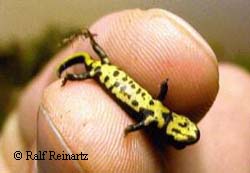 C. orientalis juvenile. |
References
Anthony, C.D. and Formanowicz, Jr., D.R., and Brodie, Jr., E.D. (1992) The effect of prey availability on the search behaviour of two species of two species of Chinese salamanders. Herpetologica 48 (3): 287-292.
Sparreboom, M., and Faria, M. M. (1997) Sexual behaviour of the Chinese fire-bellied newt, Cynops orientalis. Amphibia-Reptilia 18 (1): 27-38.
Thorn, R. (1968) Les Salamandres d'Europe, d'Asia, et d'Afrique du Nord. Paris: P. Lechevalier.
Yang, D. and Shen, Y. (1993) Studies on the breeding ecology of Cynops orientalis. Zoological Research 14 (3): 215-220.
Related Resources
Raising Juvenile Cynops orientalis
© Nate Nelson. Written December 2000. Revised December 2003. Revised October 2004.