
| Pleurodeles waltl | |||||||||||
| Spanish Ribbed Newt | |||||||||||

|
|
||||||||||
Description
Spanish ribbed newts are relatively large newts, reaching up to 30 cm (12 in) in the wild. Typical captive specimens reach 15 - 20 cm (6 - 8 in). These newts have a flattened appearance, with a large flat head with eyes that look slightly upward. Their flat shape is an adaptation that enables them to slip under rocks to hide. They typically have a plump abdominal region, especially the females. Their tail is about the same length as their body is, snout to vent, and it is laterally compressed. They also have very granular skin, which is good at conserving water.
Spanish ribbed newts range in color from dark to light gray and are covered with darker blotches with a brown tint. Their bellies are typically lighter than their backs, usually a cream color, with the same blotched pattern. Each newt has a row of tubercles running down each flank. These are where their sharp ribs can puncture through, acting as a defense mechanism. This apparently causes little harm to the newt. Ejection of the ribs rarely occurs in captive animals.

P. waltl can reach very large sizes, up to 30 cm (12 inches). Photo used with permission, www.mediterranea.org.

P. waltl in the wild
Natural Range and Habitat
Spanish ribbed newts are found throughout the Iberian Peninsula and Morocco. These regions are very arid and known for periodic droughts. Ribbed newts are almost entirely aquatic and prefer little or no current. They inhabit any standing water they can find, including ponds, lagoons, damns, and irrigation systems. If their water dries up, they will hide under rocks or in crevices, anywhere they can stay moist.
 P. waltl habitat in northern Spain. |
 Habitat |
Housing
The most suitable housing for ribbed newts is an aquarium, heavily planted, with a small floating land mass. Water level should be at 15 - 20 cm (6 - 8 in) outside of breeding season. It can be raised to higher water levels when breeding is desired. Gravel, if used, should be a size that will not be swallowed with food.
Temperatures are best kept below 21°C (72°F), as some animals become stressed at high temperatures (see information below about the effect of elevated temperature on eggs and larvae). This species encounters temperatures around freezing in the wild, so adults are able to tolerate cold.
Feeding
These newts are opportunistic eaters. They will eat a variety of invertebrates and small fish and carrion in the wild. In captivity they can be fed shrimp pellets, chopped earth worms, newt pellets, turtle pellets, and also slugs and insects. Feeder fish are not recommended as a regular diet, as feeder fish have a tendency to carry disease.
 P. waltl juvenile. |
 Leucistic P. waltl. |
Breeding
Captive breeding is easy to achieve in this species. In fact, this species is widely bred for laboratory research, including microgravity experiments on eggs and larvae in space. In the wild, they breed biannually, once in spring and once in the heat of summer. To encourage breeding, a period of cooling is recommended along with a reduction in light intensity and photoperiod. Some keepers choose to keep this species in the dark during winter. Courtship and breeding is brought about by rising water levels, light intensity, increasing day lengths, and increasing temperature. Many captive animals only need their tank flooded to convince them to breed.
During courtship, the male is adorned with black nuptial pads on his arms. Courtship is divided into two distinct phases. During the first phase the male will grasp the female from underneath with his arms around hers. This hold, known as amplexus, can last for several minutes or even hours. During the second phase of courtship the male releases his amplexus but continues to hold the female with one arm, positioning himself in front of her. He makes a series of circular turns holding the female and on the final spin he deposits a spermatophore. A further half turn positions the female over the sperm packet which she picks up. Successful breeding can be assisted by providing sufficient tank space for this behaviour. The female will later lay between 100 and 1000 eggs, depending on her size and age. Eggs are normally laid strewn amongst aquatic vegetation. In captivity adults do not usually feed on eggs, they will however cannibalise larvae and juveniles.
 Courtship begins with amplexus. |
 The male manoeuvres in front of the female. |
 Spinning before sperm packet deposition. |
 P.waltl larva. |
Eggs and larvae should be reared at temperatures as close as possible to 20°C (71°F). Female larvae reared at high temperatures (30°C / 86°F) undergo sex reversal, and develop as males. Elevated temperature during the larval period is also associated with skeletal abnormalities. Eggs raised at cold temperatures (8°C / 45°F) undergo cold stress responses, so very low temperatures should also be avoided.
 P. waltl eggs. |
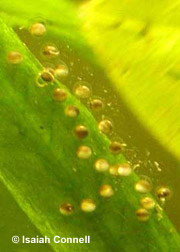 P. waltl eggs. |
Related Species
Pleurodeles nebulosus
Pleurodeles poireti
References:
Angelier, N, Moreau, NA, N'Da, EA, Lautredou, NF. (1989) Cold-induced changes in amphibian oocytes. Experimental Cell Research 183: 508-513.
Dournon, C, Houillon, C, Pieau, C. (1990) Temperature sex-reversal in amphibians and reptiles. International Journal of Developmental Biology 34: 81-92.
Dournon, C, Bautz, A, Membre, H, Lauthier, M, Collenot, A. (1998) Expression of hindlimb abnormalities under rearing temperature effects during the larval development of the salamander Pleurodeles waltl. Development, Growth and Differentiation 40: 555-565.
Griffiths, RA. (1996) Newts and Salamanders of Europe. T&AD Poyser Natural History.
Gualandris-Parisot L, Husson D, Foulquier F, Kan P, Davet J, Aimar C, Dournon C, Duprat AM. (2001) Pleurodeles waltl, amphibian, Urodele, is a suitable biological model for embryological and physiological space experiments on a vertebrate. Advances in Space Research 28:569-578.
Indiviglio, F. (1997) Newts and Salamanders. Barrons: Hauppauge, NY.
©2000 Heather Björnebo. Revised by Jennifer Macke, February 2002. Revised by Mark Aartse-Tuyn, December 2009.