Gravel size C. orientalis

Fepl

New member
Joined
Nov 1, 2011
Messages
3
Reaction score
0
Points
0
Country
Belgium
I'd like to set up a tank for C. orientalis, inspired by the Walstad method. Basically i want to set up an aquarium with lots of vegetation and a potting soil/gravel substrate. The past weeks, I've been doing quite a lot of research but i still have a question that i can't seem to answer. I'd like to use gravel with a small grain size as i think it's very pretty and from what i've read, gravel works best in a "walstad" tank.

Caudata Culture Species Entry - Cynops orientalis - Chinese firebelly

F.e., i really like the gravel used in the second and third picture.

However, i'm having some trouble trying to estimate how big the grains are in real life. What size are they? About 2mm? And will this work well in a walstad inspired tank? Is there still a risk of impaction? I've seen quite a lot of people that use a similar grain size but the problem is that i can't seem to figure out what size is too big and what size is too small. Perhaps someone can give me a rough diameter of the grains?

Oh and i've read the caudata culture article about substrates, it was very helpful but i'm still not sure what grain size would be the best choice.

Just to summarize, what gravel/sand size is small enough to avoid health risks (for C. orientalis) but will not hinder the plant growth/newt health?

Some help would be appreciated! Thank you! :)
 
I´d say the sand in those pictures is probably 1mm or so.
I have no significant experience with the walstad method, really, others will be able to help you better. However, i wonder if you could use a thinnish layer of fine sand (like in the pictures or smaller) for the walstad method or perhaps using larger gravel but securing it with some type of mesh that would allow the plants to go through but not the gravel?
I say that because personally i think that using anything significantly larger than the sand in the pictures and leaving it exposed is a risk. Something may or may not happen, but prevention is always best.
 
I dont have much experience either, but I just set up a Walstad for orientalis myself.

I heard Diana herself had changed from gravel to sand due to a number of reasons, so I decided to go with sand. The trick is to keep the sand layer very shallow so as not to create an anaerobic environment in the soil layer. I went with about an inch of soil with maybe a cm of play sand on top of that. Then I bought loads of Egeria densa and filled the tank with it, I will leave it like thus for about a month until the orientalis goes in. I chose Egeria densa because it is rated as the fastest growing aquatic plant by Tropica, so it will quickly consume the initial release of excess nitrogen substances etc.

That is what I did anyway and the tank seems to be alright already, no clouding and the Egeria is growing like crazy.
 
(Oops, i just noticed that i posted this topic in the photo's & pictures forum :) If a mod reads this, feel free to move this topic to the appropiate forum!)

However, i wonder if you could use a thinnish layer of fine sand (like in the pictures or smaller) for the walstad method or perhaps using larger gravel but securing it with some type of mesh that would allow the plants to go through but not the gravel?
I say that because personally i think that using anything significantly larger than the sand in the pictures and leaving it exposed is a risk. Something may or may not happen, but prevention is always best.

I totally agree, prevention is best! Using mesh might be an option but i don't think it'd be very appealing visually, which to me is a big disadvantage as i like tanks that look "pretty" :)

Thin layers of sand might also be an option but it makes me wonder, won't the newts easily "dig" through the sand and expose the potting soil? Small gravel might be better to avoid this... I don't have lots of experience with aquariums so i'm not even sure if what i'm saying makes any sense but i just want to make sure that i make the right decisions.


Thank you for your input! I'm curious how your project will evolve, i hope all goes well!

When will you introduce the newts in the tank?

Do you remember why Diana switched to sand? I wouldn't mind using sand but i'm just not sure if it really is the best option for a Walstad orientalis tank. There are probably plenty of people out there that use such a tank for orientalis or a similar species, just need to find'm and hope they share their experience, i guess :)
 
Hi,
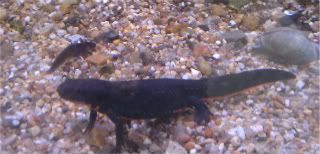
I've used gravel, about 1-2mm in my Fire Belly tank for years now.

Newt2-1.jpg


I have never had a problem with the newts swallowing it. I have also never seen them digging it up so if I was going to put soil in the tank I would use this size gravel.

Dave
 
You may not have had any problems (i used to use that kind of gravel too when i started and i didn´t have problems either), but we were lucky. Others have definitely had problems.

I´ve thinking about the mesh thing and i see your point, it would look horrible. I´m wondering, though, if it could be disguised using some covering plant like java moss so that what you see is mostly green and not unsightly metal. Maybe something like Vallisneria would work too as the roots would cover the surface.

Aquatic newts don´t really dig. I´m not saying it couldn´t happen, but it´s certainly not something they usually do. I use sand in some of my tanks and i´ve never seen any kind of digging, then again the food is in the surface so why would they dig, hehe.
 
General chit-chat
Help Users
  • No one is chatting at the moment.
    There are no messages in the chat. Be the first one to say Hi!
    Back
    Top