
Odds of Getting a Male/Female Pair from Juveniles
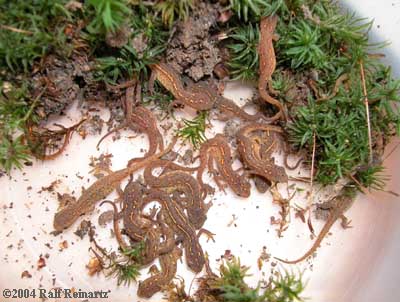
Since juveniles cannot be sexed, how many do you need to have in order to have a high chance of having at least one pair? If you take a truly random group of juveniles, your odds are as shown in the table below.
However, there are some factors that may cause you to get non-random distribution of genders. The following are some ways that a breeder might inadvertently skew the sex ratio when distributing offspring.
- If you get only the largest - or smallest - of the juveniles, you may tend to get mostly one sex.
- If you choose a group with one particular color, or the most aquatic individuals, you may be predisposed to getting all one sex. This has been documented in Triturus marmoratus, in which the brightest-colored offspring are usually female. A breeder who keeps all the brightly colored offspring may be surprised to find that they are all female. And the buyer who got all the least-colorful may have all males.
- Some species have a phenomenon of sex reversal when the offspring are raised at unusually high or low temperatures. In these cases, the offspring may be predominantly of a single sex. This has been documented in Pleurodeles waltl.
| Number of juveniles | Chance of having at least one pair |
|---|---|
| 1 | 0% |
| 2 | 50% |
| 3 | 75% |
| 4 | 88% |
| 5 | 94% |
| 6 | 97% |
| 7 | 98% |
| 8 | 99% |
© 2008 Caudata Culture