
Caudate Illness Part 3: Illness Photographs
The photos below show specific symptoms or illnesses in newts, salamanders, and axolotls. For more information about illnesses and treatments, see Caudate Illnesses and Treatments.
 |
Escape Following escape from a tank, it is rare to find the animal alive. If found, they usually look like this. To prevent escape, see Preventing Escape. |
 |
Bloat Adult Ambystoma texanum with advanced bloat. For more information, see Bloat in Newts. |
 |
Bloat Larval newt with advanced bloat. As can be seen here, bloat is the accumulation of fluid in the body cavity. |
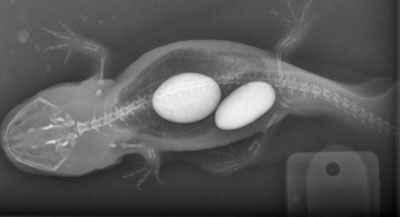 |
Ingestion Axolotls will swallow gravel and rocks from their enclosure. This X-ray demonstrates just how large of an object they can swallow. For details about this case, see forum thread. |
 |
Emaciation Cynops pyrrhogaster (Japanese firebelly newt) with advanced emaciation. The animal shown here died the following day. |
 |
Sore
Tylototriton shanjing with an open sore on top of the head. These kinds of sores are common on newly-imported Tylototritons. |
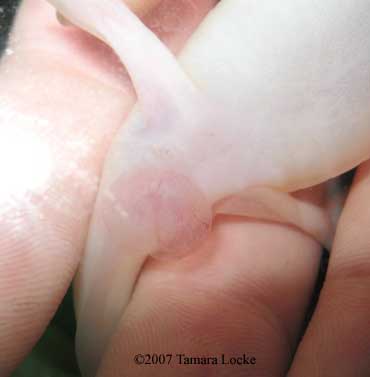 |
Prolapse
Axolotl with a prolapse of the cloaca. |
 |
Mouth rot
Fire bellied newt with mouth rot. In advanced stages, the throat is swollen and the animal is unable to close its mouth. |
 |
Abcess
Taricha granulosa with an abcess of the parotoid gland. |
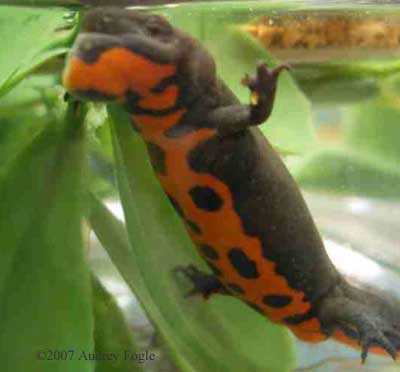 |
Tumor
Cynops orientalis with a tumor. The newt lived for several years with a tumor on the underside of the mouth. It was examined by a vet and determined to be a hard growth. When photographed, the tumor had enlarged, probably due to infection. |
 |
The shine
Taricha granulosa with 'the shine'. Note that the skin is abnormally shiny, and despite the newt having a good weight, the spine and ribs are showing. This newt died a few days after the photo was taken. |
 |
The shine
Tylototriton shanjing with 'the shine' and partial emaciation. Compare the shiny skin of this animal to the granular texture of healthy T. shanjing. This sign of poor health is common in newly-imported Tylototritons. Animals often recover from this problem if kept cool and terrestrial and fed well. |
 |
Fungus
Neurergus strauchii with leg covered in fungus. The origin of the problem was not observed, but the leg probably suffered some injury prior to becoming infected. |
 |
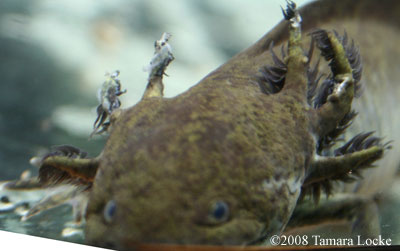
Blood in eye
This Taricha granulosa had apparent blood in the eyes. Both eyes were affected, and there had been no trauma or infection prior to this. The condition went away on its own. See forum thread. |
 |
Gill infection
Axolotl with infection of gills. See forum thread. |
 |
Blister
Taricha granulosa with blister. When drained by a vet, no bacteria were found in the fluid. The newt recovered. See forum thread. |
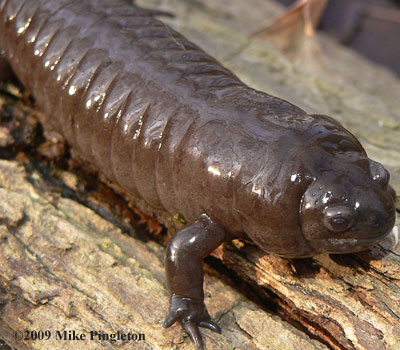 |
Edema
Ambystoma texanum found in the wild with selective bloating (edema). Only the neck and legs are swollen, while the abdomen is normal. The symptoms are probably caused by a blockage of the lymphatic system, possibly due to an infection. A similar case was seen in a captive in this forum thread. |
 |
Leg injury This paddletail newt was injured in the pet shop, probably by a tankmate. Despite the protruding bone, the leg did heal and regrow without intervention. View original Forum Thread. |
 |
Internal parasite This Tylototriton newt has an internal parasite (nematode), visible in the eye. View original Forum Thread. NOTE: Similar looking worms are common in aquariums and in terrarium substrates, but these do not usually indicate parasitic infections! See Aquarium Invaders. |
Related Articles
Caudate Illness Part 1 has additional information, resources and links about treating amphibian illnesses.
Caudate Illness Part 2 has accounts and anecdotes contributed by readers.
Photos of Sick Axolotls at the Axolotl Sanctuary.
©2007 Caudata Culture. Text by Jennifer Macke. Photograph copyrights as marked.